
European Economic
and Social Committee
Civil society needs funds to be able to monitor the management of radioactive waste
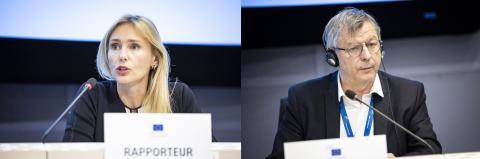
An opinion adopted during the October plenary session pointed out that local communities, particularly those close to nuclear installations, and national civil society organisations should have their say, and be given the support needed to do so. The burden of processing nuclear waste should not be left to future generations and recycling techniques should be used wherever possible.
The EU’s Member States should facilitate inclusive engagement, openness and transparency with civil society in all areas of radioactive waste management. This refers to both current and potential host communities, especially in light of the fact that increasing amounts of radioactive waste will be generated every year over the next decade and more.
In an opinion adopted during the October plenary session, the European Economic and Social Committee (EESC) takes a firm stand. It argues that available funding should be used to build the capacity of civil society groups, particularly local communities close to nuclear installations, to take part independently in projects and studies assessing participation and transparency in radioactive waste management.
Currently, local information commissions, safety committees and government associations are involved in most Member States. They gather information about a project, organise broader discussions with the public and monitor and oversee various aspects of facilities, for example transport and storage.
The EESC recommends that Member States report on the methods for public participation in the decision-making process on radioactive waste management, as well as on how transparency is ensured. ‘The Committee calls on the Member States to take steps to ensure the monitoring and regular disclosure of environmental, public health and socio-economic developments regarding the management of radioactive waste,’ said the rapporteur, Alena Mastantuono.
Developing shared solutions and recycling radioactive waste
The Member States should shoulder their responsibilities and not leave future generations with the burden of processing nuclear waste, whatever its nature, lifespan and hazard level.
Some Member States, for example those with small or medium-sized inventories of spent nuclear fuel and radioactive waste, might be interested in developing shared solutions, including but not limited to multinational radioactive waste repositories. In light of this, the Member States are encouraged to consider ways and means to implement potential pre-disposal and disposal solutions.
In addition, given that a high proportion of used nuclear fuel can be reprocessed, fissile materials should be recycled, thereby reducing the need for a supply of natural uranium to operate nuclear reactors. Circular economy strategies would enable the Member States to minimise the amount of waste to be tackled by waste management strategies.
Improving safety indicators
The European Radioactive Waste Directive (Council Directive 2011/70/Euratom on the responsible and safe management of spent fuel and radioactive waste) set minimum standards for planning and managing radioactive waste across the EU, marking a real step forward in this field.
However, while all Member States have established national programmes, the application of the directive is patchy. This has resulted in a lack of comparable data and, in some Member States, in very limited involvement of civil society in the management of radioactive waste.
The Member States should therefore step up their use of Key Performance Indicators (KPIs) when monitoring and reporting on the progress made in implementing the directive. Appropriate KPIs are crucial for reporting to the European Commission every three years as well as being a useful mechanism for guaranteeing transparency.
‘Member States should make sure that cost assessments for decommissioning and for managing spent fuel and radioactive waste account for cost increases over time. They should also make sure that funding is sufficient to cover the actual costs,’ said the co-rapporteur, Christophe Quarez.
Work organisation
Recommended for you
Il-KESE jappella għal regolamentazzjoni b’saħħitha u ssemplifikata tal-kriptoassi
News
Il-Kumitat Ekonomiku u Soċjali Ewropew jappoġġja żieda fir-regolamentazzjoni tal-kriptoassi, b’regoli robusti u koerenti biex l-investituri fl-UE jiġu protetti aħjar, f’konformità mal-miżuri attwali…
L-istrumentalizzazzjoni tal-migranti u l-kriżi tar-refuġjati tal-Ukrajna jappellaw għal bidu ġdid għall-politika dwar il-migrazzjoni
News
L-istrumentalizzazzjoni tal-migranti sostnuta mill-Istat, li għandha l-għan li tiddestabbilizza lill-UE, u l-gwerra attwali fl-Ukrajna, li wasslet għal influss bla preċedent ta’ refuġjati, jagħmluha…
“L-Ewropa Tiegħek, Leħnek” 2023: Iż-żgħażagħ jitolbu UE aktar trasparenti, diġitali u semplifikata
News
Fit-23 u l-24 ta’ Marzu, il-Kumitat Ekonomiku u Soċjali Ewropew (KESE) ospita l-14-il avveniment L-Ewropa Tiegħek, Leħnek!, li laqqa’ fi Brussell 105 studenti minn 35 skola mis-27 Stat Membru tal-UE…
Euro-Med – L-organizzazzjonijiet tas-soċjetà ċivili huma essenzjali biex l-ekonomija u s-soċjetà jaħdmu tajjeb
News
Matul is-sessjoni plenarja ta’ Diċembru tal-Kumitat Ekonomiku u Soċjali Ewropew (KESE) sar dibattitu dwar ir-rikostruzzjoni u r-reżiljenza tar-reġjun Ewro‑Mediterranju wara l-pandemija tal-COVID-19.…
Il-KESE jiftaħ l-applikazzjonijiet għall-Premju tiegħu għas-Soċjetà Ċivili li se jkun qed jindirizza s-saħħa mentali
News
L-organizzazzjonijiet tas-soċjetà ċivili, l-individwi u l-kumpaniji privati issa jistgħu jdaħħlu l-proġetti tagħhom mingħajr skop ta’ qligħ għall-premju tal-KESE ddedikat għall-appoġġ tal-benesseri…