
European Economic
and Social Committee
Women still underrepresented in green and digital sectors
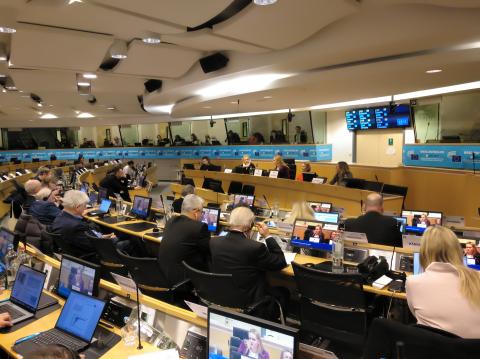
A debate organised by the European Economic and Social Committee (EESC) highlighted that, despite recent initiatives, men continue to be predominant in science, technology, engineering and maths. The EU needs to adopt new specific measures to promote women's participation and so ensure a just green and digital transition.
The sectors at the forefront of new technologies continue to be among the least diverse and inclusive workplaces. Science, technology, engineering and maths, the so-called "STEM", are still male-dominated and the current green work policies risk further embedding gender inequalities in the labour market and hindering a just transition.
The thematic debate "Women in a gender-just transition", held on 19 December 2023 by the EESC's section for Transport, Energy, Infrastructure and the Information Society (TEN), revealed alarming data.
Research shows that in the energy sector, around 80% of the workforce is made up of men. When it comes to renewable energy in particular, women represent on average 35% of the labour pool, which is slightly higher but still significantly unbalanced.
This gap does not necessarily reflect the lack of female participation in STEM education. The majority of Master's students in science are women, but it is just that they tend to leave the sector at higher rates. This is a recognised phenomenon known as the "leaky pipeline".
Moreover, like everywhere else in the labour market, standard gender divides remain and women are still overrepresented in lower paid sectors and underrepresented in decision-making positions.
Filling the gender gap
All in all, even though inequalities still exist, the EU has made significant progress over the past few years. In 2020, the European Commission adopted its "EU Gender Equality Strategy 2020-2025", highlighting the discriminatory social norms and stereotypes about women's and men's skills, and pointing out the undervaluation of women's work in certain sectors.
The end objective is a gender-equal Europe, a Union where women and men are free to pursue their chosen path in life in all their diversity and have equal opportunities in our European society.
In addition, against the background of the European Year of Skills 2023, the Commission set out the goal of matching people's aspirations and skill sets with labour market opportunities, calling to bridge the divide between women graduates and their employment in STEM careers.
Likewise, in the 2023 revision of the National Energy and Climate Plans, Member States were invited to indicate specific action plans to promote clean energy jobs for women and reduce gender imbalances in the sector.
Specific measures to ensure women's contribution
The EU has a key role to play in moving towards greater gender equality and inclusion and needs more initiatives on this track, in particular to oppose the "leaky pipeline" phenomenon and ensure a gender‑just transition.
We need focused interventions to ensure that the digital and green transitions are inclusive, and allow women to contribute to achieving the EU Green Deal,
said TEN president Baiba Miltoviča. This can be done by promoting women's participation in technical fields, fostering gender balance in various roles and ensuring equal pay for equal work.
The debate, which saw the participation of Ana Carrero from the European Commission's DG EMPL and Rasma Pīpiķe, representing Latvia's Association of Young Researchers, was held as part of the European Gender Equality Week 2023.
For more information, please consult our website.
Work organisation
Recommended for you
Il-KESE jappella għal regolamentazzjoni b’saħħitha u ssemplifikata tal-kriptoassi
News
Il-Kumitat Ekonomiku u Soċjali Ewropew jappoġġja żieda fir-regolamentazzjoni tal-kriptoassi, b’regoli robusti u koerenti biex l-investituri fl-UE jiġu protetti aħjar, f’konformità mal-miżuri attwali…
L-istrumentalizzazzjoni tal-migranti u l-kriżi tar-refuġjati tal-Ukrajna jappellaw għal bidu ġdid għall-politika dwar il-migrazzjoni
News
L-istrumentalizzazzjoni tal-migranti sostnuta mill-Istat, li għandha l-għan li tiddestabbilizza lill-UE, u l-gwerra attwali fl-Ukrajna, li wasslet għal influss bla preċedent ta’ refuġjati, jagħmluha…
“L-Ewropa Tiegħek, Leħnek” 2023: Iż-żgħażagħ jitolbu UE aktar trasparenti, diġitali u semplifikata
News
Fit-23 u l-24 ta’ Marzu, il-Kumitat Ekonomiku u Soċjali Ewropew (KESE) ospita l-14-il avveniment L-Ewropa Tiegħek, Leħnek!, li laqqa’ fi Brussell 105 studenti minn 35 skola mis-27 Stat Membru tal-UE…
Euro-Med – L-organizzazzjonijiet tas-soċjetà ċivili huma essenzjali biex l-ekonomija u s-soċjetà jaħdmu tajjeb
News
Matul is-sessjoni plenarja ta’ Diċembru tal-Kumitat Ekonomiku u Soċjali Ewropew (KESE) sar dibattitu dwar ir-rikostruzzjoni u r-reżiljenza tar-reġjun Ewro‑Mediterranju wara l-pandemija tal-COVID-19.…
Il-KESE jiftaħ l-applikazzjonijiet għall-Premju tiegħu għas-Soċjetà Ċivili li se jkun qed jindirizza s-saħħa mentali
News
L-organizzazzjonijiet tas-soċjetà ċivili, l-individwi u l-kumpaniji privati issa jistgħu jdaħħlu l-proġetti tagħhom mingħajr skop ta’ qligħ għall-premju tal-KESE ddedikat għall-appoġġ tal-benesseri…