Fundamental Rights and the Rule of Law

This page is also available in:

The EU is not only a common market; it is a union of common values that shape the European identity. These values are set out in the Treaty on the European Union and also include the rights, freedoms and principles laid out in the Charter of Fundamental Rights: the "indivisible, universal values of human dignity, freedom, equality and solidarity; [the Union] is based on the principles of democracy and the rule of law. It places the individual at the heart of its activities, by establishing the citizenship of the Union and by creating an area of freedom, security and justice."

The Charter brings together into a single text all the personal, civic, political, economic and social rights enjoyed by people within the EU and apply to the EU institutions and Member States when they implement EU law.

The EESC is very active in the promotion of fundamental rights, the rule of law and democracy, and especially in the fight against discrimination based on race, ethnic origin, disability or gender. In 2018, it established the Group on Fundamental Rights and the Rule of Law to further expand analysis of the situation across Europe and promote a constructive dialogue amongst all stakeholders.
  • The Fundamental Rights and Rule of Law (FRRL) Group has closely followed the large scale protests in Serbia following the tragedy in Novi Sad and aligns with the Statement on Serbia | EESC and Statement on the Right to Peaceful Assembly in Serbia | EESC.

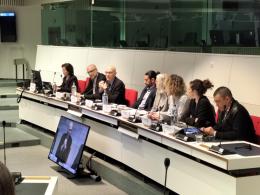
  • On Tuesday 28 January, the European Economic and Social Committee (EESC) and the UN Human Rights Regional Office for Europe, in partnership with the Human Rights and Democracy Network (HRDN), hosted an interactive dialogue between civil society representatives and the UN High Commissioner for Human Rights, Volker TÜRK. The discussions highlighted concerns over shrinking civic space, disinformation, threats to democracy, the need for stronger protections for human rights defenders, migration policies, international justice and corporate accountability.

  • On 27-28 November 2024, the Fundamental Rights and Rule of Law (FRRL) Group of the European Economic and Social Committee (EESC) concluded a two-day visit to Paris.

    This visit gave the opportunity to the group of five EESC Members to hear civil society representatives about key trends in France concerning fundamental rights of social partners, freedoms of association and assembly, freedom of expression (including media freedom), the right to non-discrimination, and the rule of law.

  • Greater use of digitalisation in the construction and housing industry and the involvement of social economy actors in housing provision can bring opportunities to address current challenges in the area of housing affordability and sustainability in Europe. Since housing is not just a need but a human right, a pan-European response to the various challenges is needed, according to a conference organised by the Civil Society Organisations’ Group of the European Economic and Social Committee (EESC) on 21 November, at which a new EESC study on the subject was presented.

  • On 16-17 October 2024, the Fundamental Rights and Rule of Law (FRRL) Group of the European Economic and Social Committee (EESC) concluded a two-day visit to Rome.

    This visit gave the opportunity to the group of six EESC Members to hear civil society representatives about key trends in Italy, concerning fundamental rights of social partners, freedoms of association and assembly, freedom of expression (including media freedom), the right to non-discrimination, and the rule of law.  

  • Just a few days after the nomination of a new European Commissioner for Democracy, Justice, and the Rule of Law, the European Economic and Social Committee (EESC) has issued a strong call for a renewed commitment to the rule of law and fundamental rights within the EU. At its September plenary session, the EESC took stock of the current situation and debated ideas for a stronger EU response, including European Commission President von der Leyen's recent announcement of a long-anticipated civil society platform. 

  • The Presidency of the EESC's Fundamental Rights and Rule of Law Group (FRRL) is deeply concerned about the imminent risk of extradition from Serbia to Belarus of journalist Andrey Gnyot (Андрей Гнёт).

  • Reference number
    34/2024

    With hate speech and hate crime rising at a frightening rate, Europeans are joining forces and stepping up action against all forms of hatred to send the message that there is no place for hate in the EU

  • Addressing immediate and long-term challenges, properly implementing existing EU policies and strengthening EU values are some of the priorities proposed by civil society organisations for the new mandate, along with structured civil dialogue and a strong social agenda.

  • A properly structured civil dialogue can be a means of making European democracies more resilient to current societal challenges. Civil society organisations (CSOs) trust in the European Parliament to be the driving force when it comes to an agreement on structured civil dialogue between the Council of the European Union, the European Commission and the European Parliament, as a Parliament resolution proposed such an agreement in 2022. CSOs consider such an inter-institutional agreement a basis for developing more inclusive and qualitative policy-making.