In view of Europe's current security challenges, in particular with the armed conflict caused by Russia’s full-scale aggression against Ukraine, defence funding places a significant burden on the budgets of many EU Member States, worsening their fiscal position.
At the same time, the resources that Member States are currently able to allocate to the development of defence capabilities still seem to be insufficient.
As Europe needs to develop defence capabilities in a more integrated way, there is a need to significantly increase investment in European defence infrastructure and technological innovation to improve preparedness to respond to threats.
EESC with this Resolution, calls on the Member States of the European Union and its leaders, the European institutions and the EU citizens, to safeguard and protect the economic, social and territorial cohesion of the EU according to Article 174 of the TFEU.
The fundamental principle of cohesion policy, according to which ‘no one should be left behind’, remains sound and valid. Civil society partners are ready to continue working towards it by means of a solid EU investment policy.
In the coming months, the Hungarian Presidency will have a crucial role to play at Europe’s helm. At a moment of political renewal, the EESC intends to be a responsible partner for the Hungarian Presidency, and play a pivotal role in shaping some of the political priorities that will be developed throughout the next European cycle.
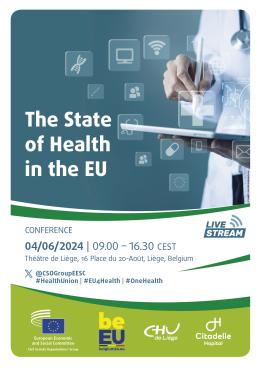
Healthcare professionals and civil society representatives called on policy-makers to introduce a ‘Health check’ for all future policies. Their demand just before the elections to the European Parliament: the ‘Right to Health’ must remain at the top of the EU and national agendas, as citizens demanded at the Conference on the Future of Europe.
Conference on 'The State of Health in the EU', organised by the EESC Civil Society Organisations' Group, in partnership with the Centre Hospitalier Universitaire de Liège and the Hôpital de la Citadelle, in the framework of the Belgian presidency of the Council of the EU, 4 June, Liège (Belgium)
Conference in the framework of the Belgian presidency of the Council of the European Union
Event type
Conference
Location
16 Place du 20-Août
Liège
Belgium
The Civil Society Organisations' Group organised this conference in partnership with the Centre Hospitalier Universitaire de Liège and the Hôpital de la Citadelle.
In its opinion on 'Additional considerations on the euro area economic policy 2024', the EESC urges closer coordination of national budgetary policies and considers instruments like NextGenerationEU essential for future stability.
The EESC recommends including similar tools in the EU’s future financial frameworks to ensure resilience and fiscal sustainability.
The Committee calls for the completion of the Capital Markets Union to prevent investors from migrating to global markets, prioritising financial market stability and consumer protection, and highlights the need to fully implement the Banking Union by addressing regulatory disparities across Member States, creating a common deposit insurance scheme, and mobilising financial resources for European infrastructure projects.
Lessons learned from the first years of the implementation of the programming period 2021-2027
Event type
Debate
Location
Online event
Belgium
Public debate on 9th Cohesion report: Lessons learned from the first years of the implementation of the programming period 2021-2027, in the framework of the ECO section meeting.
The European Council of December 2023 discussed the EU enlargement policy, including the stabilisation and association process and next steps in this respect. The enlargement policy will be one of the top priorities for the next coming years. One of the most important aspects of the enlargement process will be the cohesion policy and the structural funds.
The need for a structural policy to be applied following enlargement is justified both by the external necessity of reducing the gap between the applicant countries and the EU average and by the internal necessity of combating increasing disparities amongst and within accession countries.
Download format:
Download — EESK atzinums: The role of cohesion policy in upcoming rounds of EU enlargement