
European Economic
and Social Committee
Highlights of the EEESC's 575th Plenary session
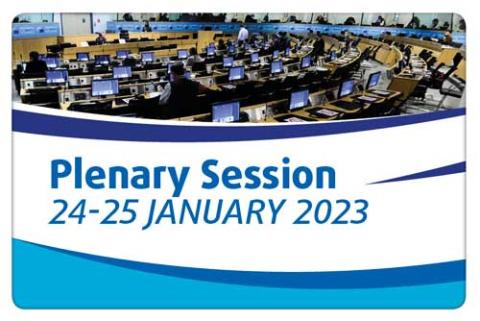
Charlemagne building - 24 January, 2.30 to 6.30 pm; 25 January, 10.00 am to 1 pm
The EESC will host the following debates:
- 24 January, 3.00 pm "Mid-term assessment of the progress towards the 2030 Sustainable Development Agenda - organised civil society's perspective", with Guillaume Lafortune, Vice-President of the UN Sustainable Development Solutions Network (UN SDSN),
- 24 January, 5.30 pm "30 years of the Single Market, our greatest success but also the biggest challenge for the next generation!" with Margrethe Vestager, Executive Vice-President of the European Commission
- 25 January, 11.00 am "European Union's responses to (geo-) political challenges in 2023 – the perspective of the European Parliament, with Roberta Metsola, President of the European Parliament
- 25 January, 11.45 am Priorities of the Swedish Presidency of the Council of the European Union with Jessika Roswall, Minister for EU Affairs, Sweden
Key reports to be put to the vote:
Social
- The European Care Strategy (SOC/741, rapporteur: Kinga JOÓ, Civil Society Organisations, HU; co-rapporteur: Zoe TZOTZE-LANARA, Workers, EL)
The EESC welcomes the proposals put forward in the European Care Strategy, envisageoning actions at the EU and national levels with the goal of strenghtneing the care infrastructure in Europe. It renews its proposal to launch a European Care Guarantee, an instrument which should ensure life-long access to affordable quality healthcare and care services for all people living in the EU. The instrument would also contribute to addressing care deficits and promoting decent working conditions for all carers, including informal ones. More
Economy
- Euro area economic policy 2023 (ECO/598, rapporteur: Petru Sorin Dandea – Workers, RO)
The EESC tackles the energy price crisis, reiterating that the EU must support consumers and businesses and that nobody should be left behind. To this end, it is essential to step up coordination of national fiscal policies with the monetary policy of the European Central Bank. More
External relations
- The EU Strategic Compass (REX/562, rapporteur: Christian MOOS, Civil Society Organisations' Group, DE; co-rapporteur: Peter CLEVER, Employers' Group, DE)
The EESC believes that the strategic compass marks an essential step forward for the European security and defence policy and calls for a broader definition of security and for a reflection on strategic independence. The opinion stresses that security goes far beyond defence and that it also includes aspects of energy, transport, food security or citizens' security, making civil society a key stakeholder in a debate. More - The implementation of the EU-UK Withdrawal Agreement, including the Protocol on Ireland and Northern Ireland (REX/563, rapporteur Jack O'Connor, Workers' Group, IE)
The information report underlines the gravity of the situation with regard to the EU-UK relationship which is heavily burdened by the impasse in the implementation of the Protocol on Ireland/Northern Ireland, with the UK Government insisting on EU "concessions" on the terms of the Protocol. stresses that a sustainable solution needs to be found and implemented. The report also highlights important issues such as the relations between EU and UK civil society or the rights of EU citizens in the UK. More - Setting the course for a sustainable blue planet, an update of the international ocean governance agenda (REX/558, rapporteur: Stefano Palmieri – Workers, IT)
The EESC backs a new and strengthened international governance of the Oceans, calling for increased international cooperation and the effective and transparent involvement at every stage of this process of different stakeholders supporting policy-making, communication and outreach. More - Forced labour products ban (REX/565, rapporteur: Thomas Wagnsonner – Workers, AT)
The Committee supports the Commission's proposal for a regulation prohibiting products made with forced labour on the Union market, pointing out that the institutional anchoring of social partners and NGOs in the new legislation is of paramount importance. More
Trade
- The power of trade partnerships: together for green and just economic growth (REX/561, rapporteur Tanja BUZEK , Workers Group, GE)
The opinion aims to put together a number of recommendations and action points that are essential for the recent EC review of the Trade and Sustainable Development (TSD). The review sets a new benchmark on the TSD and the EESC stresses the need for clearer and more detailed TSD provisions that will help to better define roadmaps and help both trade partners to better understand what is expected from them. The EESC believes that the role of the civil society must be reinforced as well as this of the Domestic Advisory Groups ( DAGs), which the review has taken into account. More.
Recommended for you
Sabiedrisko pakalpojumu līdzradīšana veselības nozarē būs ieguldījums līdzdalības demokrātijas stiprināšanā Eiropas Savienībā
News
Šajā pasākumā, ko organizēja Eiropas Ekonomikas un sociālo lietu komiteja (EESK) un Debrecenas Universitāte, tika uzsvērts, cik būtiska ir vispārējas nozīmes pakalpojumu līdzradīšana veselības un…
Eiropas Savienībai ir vajadzīgs rīcības plāns, lai nodrošinātu cenas ziņā pieejamus un kvalitatīvus mājokļus
News
Augsta līmeņa konferencē, ko Rīgā rīkoja Eiropas Ekonomikas un sociālo lietu komiteja (EESK), tika paustas bažas par cenas ziņā pieejamu mājokļu krīzi un izskanēja brīdinājumi, ka Eiropas Savienībai…
Migrantu instrumentalizācija un Ukrainas bēgļu krīze liek no jauna pievērsties migrācijas politikai
News
Valsts finansētā migrantu instrumentalizācija, kuras mērķis ir destabilizēt ES, un pašreizējais karš Ukrainā, kas novedis pie vēl nepieredzēta bēgļu pieplūduma, liek pārskatīt Eiropas migrācijas…
“JŪSU EIROPA, JŪSU LĒMUMI” 2023. gadā jaunieši prasa pārredzamāku, digitālāku un vienkāršotāku Eiropas Savienību
News
23. un 24. martā Eiropas Ekonomikas un sociālo lietu komitejā 14. reizi norisinājās pasākums “Jūsu Eiropa, jūsu lēmumi”, kurā piedalījās 105 skolēni no 35 skolām. Jaunieši bija ieradušies no visām…
#EnergyPoverty – enerģētiskā nabadzība sievietes skar vairāk nekā vīriešus
News
Ekonomisku, fizioloģisku, sociālu un kultūras iemeslu dēļ enerģētiskā nabadzība sievietes var skart vairāk nekā vīriešus. Ņemot vērā jaunākos satraucošos statistikas datus, Eiropas Ekonomikas un…