believes that mental health literacy for the whole of society is needed, both to fight stigma and to facilitate an early intervention and diagnosis of mental health conditions;
considers that relevant policies should aim for an integrated mental health system based on cooperation among the sectors of education, employment, social care and mental health care;
believes empowerment and support for self-representation are key to ensuring the full participation of people in what concerns them and to co-producing strategies and programmes. This involves the planning, design, provision and evaluation of care. It should be accompanied by technical and financial support for forms of self-management.
Only nine EU countries criminalise forced sterilisation as a distinct offence, while 13 allow it to be performed on persons with disabilities – and in three of those countries that includes minors. When it comes to the sexual and reproductive health rights of women with disabilities, the EU is far from being a union of equality, an EESC hearing revealed
the Commission to put the topic of informal carers high on the political agenda and to establish a Platform for the exchange of best practices among Member States;
Member States to adopt policies that i) encourage the provision and uptake of high-quality, community-based long-term care services, and ii) ensure that informal carers have access to respite services and preventive medicine to tackle the high risk of burnout and physical and mental overload to which they are exposed;
Member States to take appropriate measures to ensure that the decision to take on informal care is voluntary, that gender inequalities are tackled and that informal carers can keep their jobs and levels of pay thanks to more flexible working conditions and can easily re-enter the job market if they are forced to leave it.
Room VMA 23 and Interactio, EESC building, Rue Van Maerlant 2, 1040
Brussels
Belgium
The EESC is organising a hearing on " Leaving No One Behind: European Commitment to Rare Diseases " on 12 July 2024 from 9:30 am to 1 pm.
During the event, we will listen to contributions from policy makers, civil society and patients' organisations and other relevant stakeholders, on the achievements and challenges at EU level and try to identify possible ways to move forward.
The outcomes of the hearing will feed into the EESC's opinion.
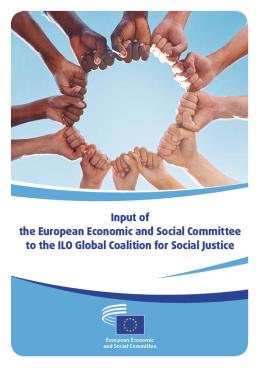
This document seeks to provide input to the Global Coalition for Social Justice. It highlights key messages from EESC opinions on the six priority areas identified by the International Labour Organization (ILO) for immediate action.
Healthcare professionals and civil society representatives called on policy-makers to introduce a ‘Health check’ for all future policies. Their demand just before the elections to the European Parliament: the ‘Right to Health’ must remain at the top of the EU and national agendas, as citizens demanded at the Conference on the Future of Europe.
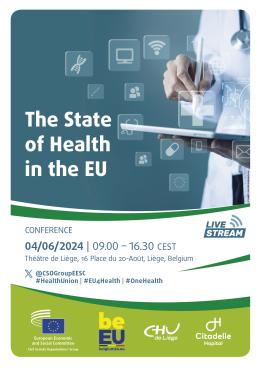
Conference on 'The State of Health in the EU', organised by the EESC Civil Society Organisations' Group, in partnership with the Centre Hospitalier Universitaire de Liège and the Hôpital de la Citadelle, in the framework of the Belgian presidency of the Council of the EU, 4 June, Liège (Belgium)
With the number of cancers and cancer-related deaths across the EU rising at an alarming rate, the European Economic and Social Committee (EESC) calls for due attention to be paid to the need for cancer prevention measures, as about 40% of cancer cases are deemed preventable.
Conference in the framework of the Belgian presidency of the Council of the European Union
Event type
Conference
Location
16 Place du 20-Août
Liège
Belgium
The Civil Society Organisations' Group organised this conference in partnership with the Centre Hospitalier Universitaire de Liège and the Hôpital de la Citadelle.