In their consultative work, the European Economic and Social Committee and the European Committee of the Regions have long been committed to sustainable development and fighting climate change. However, are we actually putting our recommendations into practice inside our own offices?
To ensure that the Committees act as environmentally as possible, since 2008 we have been engaged in setting up an EMAS-compliant environmental management system.
The conference "The Anti-Money Laundering Legislative Package" will take stock of the state of play and debate in particular the legislative proposals tabled by the European Commission in July 2021 to strengthen the EU's anti-money laundering and countering terrorism financing (AML/CFT) rules.
The conference is organised on 5 October 2021, starting at 14:30.
The event is accessible via webstream. No registration is needed, and participation is free of charge.
Both a sustainable economic and social recovery from the COVID-19 crisis and the need to address effectively the climate change will require a massive expansion of investments. To achieve this, reshaping the EU fiscal rules is indispensable. Against this background, the Section for Economic and Monetary Union and Economic and Social Cohesion (ECO) of the European Economic and Social Committee (EESC) is currently working on an own-initiative opinion on Reshaping the EU Fiscal Framework for a Sustainable Recovery and a Just Transition.
The EESC welcomes the Commission initiative for the strategy on business taxation in the 21st century. The EESC strongly supports and appreciates the fact that the Commission is aligning its work with the international discussions and agreements and encourages the Commission to pursue its Action Plan for Fair and Simple Taxation Supporting the Recovery Strategy. The EESC is calling for uniform and globally concerted and coordinated implementation of Pillars 1 and 2 of the OECD agreement.
Download format:
Download — ETSK:n lausunto: Business Taxation for the 21st Century
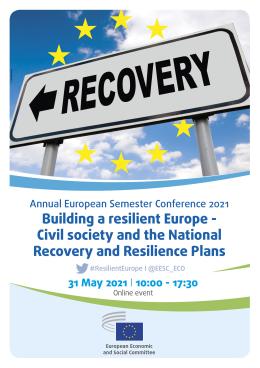
Building a resilient Europe - Civil society and the National Recovery and Resilience Plans
Event type
Conference
Location
Brussels
Belgium
The Recovery and Resilience Facility is moving into its next phase, and the European Semester Group of the EESC is following the process. In this high-level conference we will discuss whether the national recovery and resilience plans will deliver as regards the aim of achieving fair, inclusive, competitive and sustainable growth and cohesion through the new growth strategy – the European Green Deal. Focus will be on the implementation of the national recovery and resilience plans, with particular attention on the implementation of the European Pillar of Social Rights and the just transition towards a green, digital and sustainable European economy. The conclusions of this event will be forwarded to EU institutions and the "EU Recovery Summit" conference in Lisbon on 28 June 2021.
The EESC laments the severity of the money laundering phenomenon in the EU. Current European legislation is largely inadequate in the face of coordination failures and national divergences, and therefore strongly supports the Anti Money Laundering legislative package, in particular the creation and design of the new European Anti-Money Laundering Authority (AMLA) with direct supervisory powers.
The EESC strongly believes in the importance of the next Semester cycle as a key instrument for implementing the Recovery and Resilience Facility.
However, it is still concerned about the lack of clarity in most Member States as regards their National Recovery and Resilience Plan governance systems and the distribution of responsibilities for their implementation.
The EESC would also draw attention to the need to measure progress in implementation, for which good monitoring indicators are needed; in this connection it welcomes the "Recovery and Resilience Scoreboard" initiative.
Moreover, the COVID-19 crisis has highlighted the need for a strong industrial policy to avoid dependence on other economic zones for many products and services.
The EESC wants to see real action in this respect by Member States, in terms of investment in education, infrastructure and industrial policy to raise employment and boost European industry.