
European Economic
and Social Committee
EESC term of office kicks off with over 40% new members
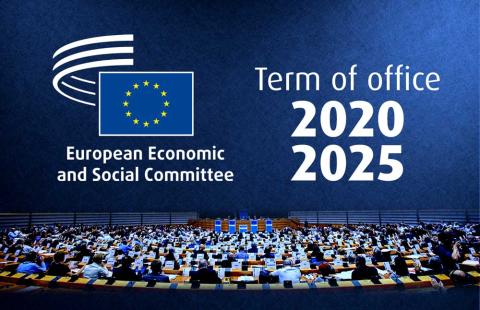
137 out of the European Economic and Social Committee's 329 members will be new to the EESC as it begins its 2020-2025 term of office in October.
They will be the voice of organised civil society in the EU for the next five years.
Members starting out at the EESC will begin their term under the constraints of COVID-19, with social distancing and hybrid meetings still being the rule in Brussels as infection rates spike across Europe.
The EESC's 329 members are newly appointed every five years, as laid down by the Treaties. This time over 40% of them will be new, bringing their fresh outlook, ideas and energy to their work alongside returning members.
Women will make up 33% of members in the new term, up from 27.30% last time and 24.70% in 2010-2015. The countries with the most women members will be Estonia, at 85.71%, and the Czech Republic and Croatia following with 66.67%. At the other end of the scale, Portugal and Cyprus have no women in their representation. Sweden has a perfect gender balance.
The youngest member is 27, while the most senior, who is to chair the plenary session which will elect the EESC's new leadership, is 76.
Members are appointed for a period of five years by the Council, based on nominations from Member States. The full list of members for the new term – to run from 2020 to 2025 – will soon be available on the EESC's website.
The 329 new or reconfirmed members are scheduled to meet for the first time in Brussels on 27 October. On 28 October, they will elect a new president and two vice-presidents (the latter for Communication and Budget) for a term of two and a half years.
The position of president rotates between the Committee's three groups (Employers, Workers and Diversity Europe). The two previous presidents were elected from the Workers and Diversity Europe Groups.
Each member will join one of the three Groups, which will also elect their own Group president for a renewable two-and-a-half-year term.
The EESC's main role is to advise EU lawmakers (the European Commission, the European Parliament and the Council) on draft legislation and policies through the work of its six sections and one consultative commission, which cover a wide range of policy areas, such as social, economic, agricultural, environmental and transport issues.
Members will join one or more of the sections, which will each also elect a president for a renewable two-and-a-half-year period.
For further information, please contact:
Ewa Haczyk Plumley, Head of Press – EESC
E-mail: Ewa.Haczyk@eesc.europa.eu • Tel: +32 2 546 8641 • @EESC_PRESS
Recommended for you
EU:n ja Yhdysvaltojen kauppa- ja teknologianeuvoston on tartuttava tilaisuuteen ja otettava tavoitteeksi johtoasema kaupan, teknologian ja innovoinnin alalla
News
Euroopan talous- ja sosiaalikomitea (ETSK) totesi heinäkuun täysistunnossaan, että uudesta kauppa- ja teknologianeuvostosta (Trade and Technology Council, TTC) voi tulla sekä EU:ta että Yhdysvaltoja…
”Sinun Eurooppasi, sinun mielipiteesi” ‑tapahtuma 2023: Nuoret vaativat avoimempaa, digitaalisempaa ja yksinkertaisempaa EU:ta
News
Euroopan talous- ja sosiaalikomitea (ETSK) isännöi 23.–24. maaliskuuta 14. ”Sinun Eurooppasi, sinun mielipiteesi” -tapahtumaa, joka toi Brysseliin 105 opiskelijaa 35 koulusta EU:n 27 jäsenvaltiosta…
Puurakentaminen voi auttaa vähentämään hiilidioksidipäästöjä
News
Euroopan talous- ja sosiaalikomitean järjestämässä keskustelussa kävi ilmi, kuinka hyödyllistä puurakentaminen voi olla, kun EU pyrkii saavuttamaan hiilineutraaliuden tavoitteen vuoteen 2050 mennessä…
Pro Lapinlahti -yhdistykselle ja Lilinkotisäätiölle ETSK:n mielenterveysaiheinen kansalaisyhteiskuntapalkinto
News
Suomalaisorganisaatiot jakoivat mielenterveyttä edistäville hankkeille myönnetyn Euroopan talous- ja sosiaalikomitean (ETSK) kansalaisyhteiskuntapalkinnon muut palkintosijat kahden muun hakijan…
Euroopan talous- ja sosiaalikomitea on avannut mielenterveysaiheisen kansalaisyhteiskuntapalkintonsa haun
News
Kansalaisyhteiskunnan organisaatiot, yksityishenkilöt ja yksityiset yritykset voivat nyt ehdottaa voittoa tavoittelemattomia hankkeitaan tätä eurooppalaisten henkisen hyvinvoinnin tukemiselle…