
European Economic
and Social Committee
EESC term of office kicks off with over 40% new members
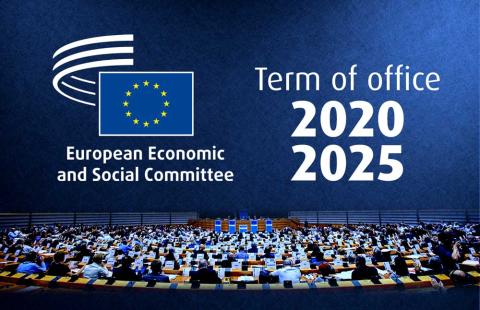
137 out of the European Economic and Social Committee's 329 members will be new to the EESC as it begins its 2020-2025 term of office in October.
They will be the voice of organised civil society in the EU for the next five years.
Members starting out at the EESC will begin their term under the constraints of COVID-19, with social distancing and hybrid meetings still being the rule in Brussels as infection rates spike across Europe.
The EESC's 329 members are newly appointed every five years, as laid down by the Treaties. This time over 40% of them will be new, bringing their fresh outlook, ideas and energy to their work alongside returning members.
Women will make up 33% of members in the new term, up from 27.30% last time and 24.70% in 2010-2015. The countries with the most women members will be Estonia, at 85.71%, and the Czech Republic and Croatia following with 66.67%. At the other end of the scale, Portugal and Cyprus have no women in their representation. Sweden has a perfect gender balance.
The youngest member is 27, while the most senior, who is to chair the plenary session which will elect the EESC's new leadership, is 76.
Members are appointed for a period of five years by the Council, based on nominations from Member States. The full list of members for the new term – to run from 2020 to 2025 – will soon be available on the EESC's website.
The 329 new or reconfirmed members are scheduled to meet for the first time in Brussels on 27 October. On 28 October, they will elect a new president and two vice-presidents (the latter for Communication and Budget) for a term of two and a half years.
The position of president rotates between the Committee's three groups (Employers, Workers and Diversity Europe). The two previous presidents were elected from the Workers and Diversity Europe Groups.
Each member will join one of the three Groups, which will also elect their own Group president for a renewable two-and-a-half-year term.
The EESC's main role is to advise EU lawmakers (the European Commission, the European Parliament and the Council) on draft legislation and policies through the work of its six sections and one consultative commission, which cover a wide range of policy areas, such as social, economic, agricultural, environmental and transport issues.
Members will join one or more of the sections, which will each also elect a president for a renewable two-and-a-half-year period.
For further information, please contact:
Ewa Haczyk Plumley, Head of Press – EESC
E-mail: Ewa.Haczyk@eesc.europa.eu • Tel: +32 2 546 8641 • @EESC_PRESS
Recommended for you
Presidentes do CESE e do CR debatem desafios comuns para o futuro da Europa
News
Na reunião plenária de julho do Comité Económico e Social Europeu (CESE), a sua presidente, Christa Schweng, e o presidente recentemente eleito do Comité das Regiões Europeu (CR), Vasco Alves…
Movimento Transformers entre os finalistas do Prémio CESE para a Sociedade Civil dedicado à juventude
News
A associação sem fins lucrativos portuguesa Movimento Transformers figura na lista de finalistas do Prémio CESE para a Sociedade Civil de 2022 que, este ano, é atribuído a duas categorias, a saber,…
Associação portuguesa Movimento Transformers recebe Prémio CESE para a Sociedade Civil 2022 pelo apoio a jovens desfavorecidos
News
O Movimento Transformers é uma das organizações sem fins lucrativos que o Comité Económico e Social Europeu (CESE) distinguiu pelos seus projetos em prol da juventude. O Movimento Transformers…
«A tua Europa, a tua voz!» de 2023: jovens reclamam uma UE mais transparente, digital e simplificada
News
Em 23 e 24 de março, o Comité Económico e Social Europeu (CESE) acolheu a 14.ª edição do evento «A tua Europa, a tua voz!», que reuniu em Bruxelas 105 alunos de 35 escolas dos 27 Estados‑Membros da…
#RareDiseases – UE precisa de estratégia para ajudar 36 milhões de pessoas com doenças raras na Europa
News
Na conferência que organizou em Bilbau, o Comité Económico e Social Europeu (CESE) instou a União Europeia a lançar um plano de ação europeu para reforçar a cooperação entre os sistemas nacionais de…