
European Economic
and Social Committee
Cyprus Presidency highlights partnership with EESC and organised civil society
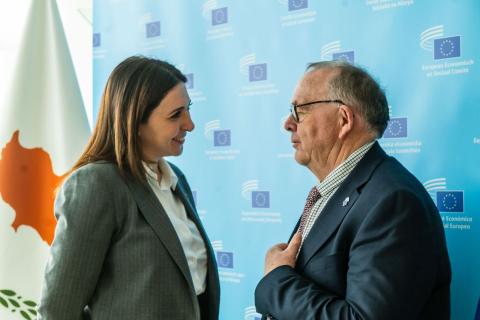
Debates at the European Economic and Social Committee (EESC) plenary revealed strong alignment between the Cypriot Presidency’s five priorities and the Committee’s own work programme: security and preparedness, competitiveness, openness to the world, a Union of values that leaves no one behind, and a robust long-term EU budget.
Following a presentation by Marilena Raouna, Cyprus’ Deputy Minister for European Affairs, EESC members discussed the Presidency’s priorities brought together under the motto An Autonomous Union. Open to the World. The Cyprus Presidency invited the EESC to contribute expertise through fourteen exploratory opinions, providing recommendations on EU legislative proposals and strategic issues while reflecting the views of social partners and organised civil society.
The Committee will focus on tackling energy poverty through affordable and sustainable housing; strengthening Europe’s water resilience via the Water Resilience Strategy and the European Climate Adaptation Plan; and promoting social inclusion and independent living for people with disabilities. The EESC brings decades of experience and pioneering work in these fields, shaping policies that reflect civil society's perspectives.
EESC president Séamus Boland noted that 'The priorities of the Cyprus Presidency resonate closely with my programme, which focuses on opportunity, security and resilience, with the fight against poverty at its core.' Deputy Minister Marilena Raouna underscored early and close cooperation with organised civil society: 'Employers, workers and civil society organisations must remain at the heart of European policymaking.'
Participants highlighted the challenging context of geopolitical uncertainty, climate pressures, and rapid technological change. The Presidency reaffirmed its commitment to comprehensive security, including maritime and water security, and resilience against hybrid threats. As an island Member State particularly exposed to climate change, Cyprus identified water resilience as a key priority. The EESC’s EU Blue Deal initiative, launched in 2023, complements this focus by promoting sustainable, integrated management of water resources.
Competitiveness also featured prominently. The Presidency aims to strengthen the single market, reduce administrative burdens, support SMEs, and advance the green and digital transitions. Affordable energy, modern infrastructure, and strong interconnections were highlighted as essential for Europe’s strategic autonomy.
On enlargement and neighbourhood policy, Cyprus reaffirmed its commitment to a credible, merit-based process and closer cooperation with the EU's Mediterranean partners. An informal EU summit in April will focus on projects under the Pact for the Mediterranean. Complementing this, the EESC’s Enlargement Candidate Members (ECM) initiative gives representatives from civil society in the candidate countries a role in its advisory work. Selected in February 2024, ECMs work alongside EESC members on key EU policies, fostering ties and supporting gradual EU integration.
Social cohesion was another central theme. Affordable housing was identified as a pressing challenge and a core priority under the Presidency’s values pillar, alongside gender equality, disability rights, health security, and social inclusion. The EESC has long championed decent, sustainable, and affordable housing and is ready to support the Presidency by means of civil society input, policy recommendations, and its European Affordable Housing Plan, including the upcoming EU Housing Summit.
On migration, Cyprus reiterated its determination to implement the Pact on Migration and Asylum, with a ministerial meeting scheduled for June.
Building on the Danish Presidency’s work, Cyprus also aims to advance discussions on the Multiannual Financial Framework (MFF) 2028–2034. The EESC is preparing a package of opinions warning that underfunding would undermine cohesion, agriculture, social investment, and democratic trust. The Committee calls for a stronger, fairer, and future-proof budget that protects cohesion and the Common Agricultural Policy, invests in youth, skills, and innovation, reinforces competitiveness, and ensures no region or generation is left behind.
Closing the debate, Ms Raouna reaffirmed the Presidency’s commitment to cooperation: 'We will work hand in hand with the EESC, EU institutions and all relevant actors to ensure that our shared priorities deliver tangible results for European citizens.'
Additional quotes
Workers' Group Vice President Thomas Kattnig: 'We must enhance our autonomy by strengthening our security but also our social cohesion. The EU must defend many values for its citizens, and fend off attacks against our democracy. An autonomous Union must stand up to autocracies and people that go against solidarity and tolerance'
Employer's Group President Sandra Parthie: 'The focus of the priorities of the EU Cyprus Presidency on competitiveness and strategic autonomy is spot-on. We call on Cyprus to follow Mr Draghi and leverage its Presidency to complete the Single Market, accelerate the Capital Markets Union and close the tech gap with the US and China by building European AI value chains. Employers stand ready as partners.'
Civil Society Organisations' Group President Cillian Lohan: 'The full involvement of civil society is essential for us. That is why we continue, more than ever, to call for stronger and more systematic participation of civil society in all major European policies. In this respect, we welcome and strongly support the Cyprus Presidency's focus on implementing the Democracy package.'
OPINION LIST
REX/612 Civil Society’s Role in Supporting Reform under the Growth Plans for the Western Balkans and Moldova, as well as in Ukraine’s Reform Path
REX/613 The Role of the Private Sector and Civil Society in Strengthening Economic Cooperation within the Pact for the Mediterranean
SOC/852 EU Competitiveness and Youth Entrepreneurship
TEN/866 Tackling Energy Poverty through Affordable and Sustainable Housing
TEN/865 Energy connectivity, electricity grids
INT/1113 Over-tourism, Short-Term Rentals and the Crowding-Out of Local Populations – Finding the Right Balance
ECO/689 The Island Dimension in European Cohesion, Competitiveness and Sustainable Development Policies
NAT/973 Water Resilience Strategy & European Climate Adaptation Plan
SOC/850 Enhancing quality in employment and working conditions by introducing and promoting related tools (incl. AI) and strengthening social dialogue and collective bargaining
SOC/851 Social inclusion and independent living for persons with disabilities through high quality and specialized social services
SOC/842 New Erasmus+: Inclusion, Internationalisation and Relevance to Future Skills
INT/1111 Developing a European Centre of Clinical Excellence for Pharmaceuticals
INT/1112 EU Startups and scale up strategy - with a focus on European Innovation Act
TEN/867 The European Life Science Strategy and Research along with the Strategy on Technology infrastructures – with focus on the treatment of rare diseases