
European Economic
and Social Committee
Annual European Semester Group Conference 2026
Unprecedented pressures are forcing a rethink of the economic direction of the European Union. Geopolitical shocks, environmental transformation, the surge of artificial intelligence and demographic change are reshaping Europe’s path and its global role.
To respond, the European Semester must be further strengthened as an effective instrument for coordinated action, economic resilience, social fairness, and long-term competitiveness across the EU.
The European Economic and Social Committee calls for an in-depth analysis and clarification on the relationship between the European Semester and the Competitiveness Coordination Tool and the forthcoming Multiannual Financial Framework. In this regard, the Committee stresses that it is imperative for national and European investments to be aligned with the EU’s shared ambitions.
Delivering the EU’s priorities through a strategic European Semester: competitiveness, sustainable growth and social resilience
The EU and its Member States face an increasingly demanding global environment. In designing the 2026 cycle of the European Semester, the European Commission has set a clear direction: reduce economic dependencies, strengthen competitiveness, and secure sustainable prosperity.
Delivering on this ambition requires far deeper coordination. Investment must be mobilised at scale, the single market strengthened, regulatory frameworks simplified and European businesses empowered to respond to unfair competition and persistent trade imbalances. At the same time, this must ensure that the EU moves forward on a path of socially fair and ecologically sustainable development.
The EESC underlines in particular the need to tackle the fragmentation of financial markets while ensuring their stability, to reinforce economic and social governance, to recognise human capital as strategic infrastructure, and to embed defence cooperation within a coherent European fiscal and strategic framework.
In this regard, the European Semester should act as the EU’s central platform for aligning fiscal, structural and investment policies with long-term competitiveness goals in a socially and environmentally sustainable manner. The Semester process should be anchored in democratic accountability and meaningful participation by civil society.
The EU’s strategic priorities must translate into specific national reform commitments and be consistently implemented through the Semester cycle. This is the path towards sustainable prosperity and stronger social resilience across the EU.
Building a strategic link between the European Semester and the future Multiannual Financial Framework:
The 2026 cycle of the European Semester will serve as a bridge to the next Multiannual Financial Framework (MFF). The national and regional partnership plans are expected to address, in whole or in part, the challenges identified in the European Semester, notably the country-specific recommendations (CSRs). The Commission has proposed that a significant share of future EU funding be channeled through these national and regional partnership plans for reform and investment. In practice, the European Semester would become the primary reference framework for these plans, the implementation of which will also determine payments to the Member States.
Such an approach has the potential to enhance the coherence of EU economic governance by tying funding more closely to agreed reform priorities, responding to genuine social and development needs. Given that EU funding will increasingly depend on the achievement of agreed objectives and milestones, the Semester will play a key role in aligning reforms, investments and budgetary priorities with the objectives of sustainable growth and competitiveness.
For this model to succeed, the CSRs (adopted in the context of the European Semester process) and the partnership plans (which are to be submitted by the Member States under the next MFF) must be prepared and carried out in close cooperation with national and regional authorities, the social partners and civil society organisations. Meaningful consultation is essential to ensure that the funding decisions are grounded in reality and embedded in a consistent long-term vision, and that EU policy-making is comprehensively anchored in a democratic framework. A stronger role for civil society is not a barrier to efficiency; it is a condition for ensuring that policies are fairer, more resilient and democratically legitimate.
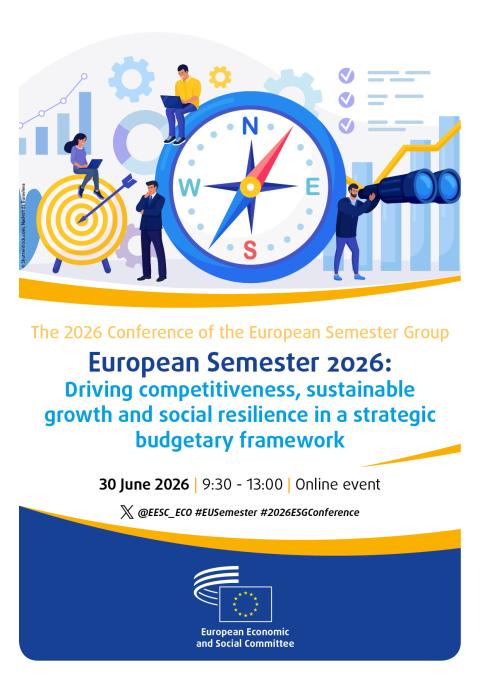
To this end, the EESC’s European Semester Group is bringing together speakers from the EU institutions, organised civil society, the Member States and research institutes for its annual conference, which this year is entitled European Semester 2026: Driving competitiveness, sustainable growth and social resilience in a strategic budgetary framework, to be held from 9.30 a.m. to 1 p.m. on Tuesday 30 June 2026.
The event will be webstreamed (original, EN and FR). No registration is needed and participation is free of charge.
Ask your questions to the panelists via Sli.do with the event code: #2026ESGConference
Follow us on X: @EESC_ECO | #EUSemester | #2026ESGConference