Fundamental Rights and the Rule of Law

This page is also available in:

The EU is not only a common market; it is a union of common values that shape the European identity. These values are set out in the Treaty on the European Union and also include the rights, freedoms and principles laid out in the Charter of Fundamental Rights: the "indivisible, universal values of human dignity, freedom, equality and solidarity; [the Union] is based on the principles of democracy and the rule of law. It places the individual at the heart of its activities, by establishing the citizenship of the Union and by creating an area of freedom, security and justice."

The Charter brings together into a single text all the personal, civic, political, economic and social rights enjoyed by people within the EU and apply to the EU institutions and Member States when they implement EU law.

The EESC is very active in the promotion of fundamental rights, the rule of law and democracy, and especially in the fight against discrimination based on race, ethnic origin, disability or gender. In 2018, it established the Group on Fundamental Rights and the Rule of Law to further expand analysis of the situation across Europe and promote a constructive dialogue amongst all stakeholders.


  • Over the last years, the EU founding values have been increasingly challenged, making the consensus on which they are based seem more fragile than ever. While the EU has addressed these threats by becoming more active in defence of democracy, fundamental rights, the rule of law, discourses have also risen portraying such action as political battles based on unclear or relative criteria.

    Participants in the hearing will discuss how to address this phenomenon, and more generally how to better communicate fundamental rights and the rule of law to the whole population.

  • Published in
    64 pages

    What kind of Europe do you dream of?
    Civil society and the Conference on the Future of Europe
    Lisbon, 18-19 November 2021

  • The EU has adopted legislation covering various grounds of discrimination in a variety of policy areas, in particular employment, to meet its aim of combating all forms of discrimination. However, gaps still exist as Member States have not yet agreed on a horizontal Directive on non-discrimination outside of the labour market proposed in 2008.

    This hearing with the participation of EU institutions and civil society organisations in the framework of the preparation of an EESC own-initiative aims at closing the gaps and identifying ways to improve equality in Europe, including with an Equal Treatment Directive.

  • In order to prepare its opinion on the Commission proposal for a directive on combating violence against women and domestic violence, the EESC is organising a hybrid public hearing on 21 April 2022 from 9:30 am to 1 pm.

    The aim of the event is to gather input from civil society, including social partners and academia as well other EU Institutions and international organisations.

    Your participation and input are most welcome!

  • Published in
    7 pages

    Report on the virtual country visit to the Czech Republic – 30 September and 1 October 2021
    This report relays the views of Czech civil society on freedom of association, freedom of assembly, the rule of law.

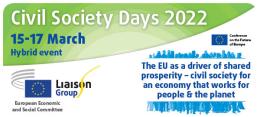
  • The EU as a driver of shared prosperity – civil society for an economy that works for people & the planet
    -

    While Europe and its societies are still in the grip of the COVID-19 pandemic and with the Conference on the Future of Europe in its closing stages, the EESC will be holding its annual Civil Society Days in March 2022.

  • Published in
    Study
    76 pages

    This report examines how the COVID-19 pandemic has affected the work of civil society organisations (CSOs) across Europe. It also focuses on how solutions implemented in individual EU Member States have impacted CSOs' ability to exercise their fundamental rights and freedoms.

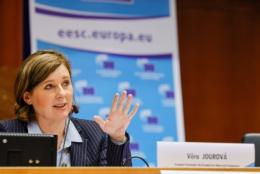
  • EESC plenary debate with Věra Jourová, European Commission Vice-President for Values and Transparency, linked to the opinion SOC/691

  • Published in
    8 pages

    Report on the virtual country visit to Ireland – 28-29 June 2021
    This report relays the views of Irish civil society on freedom of association, freedom of assembly, the rule of law.

    • Editorial by EESC President, Christa Schweng
    • Barometer 2021 on participation
    • Time to move forward and build resilience in the disability services sector
    • Guidance documents on improving civil dialogue in the European Semester process
    • Civil society space post-COVID
    • European Citizens' Initiative Forum
    • Prioritising learners' well-being
    • Just Transition Monitor
    • The future of higher education in Europe ...and much more