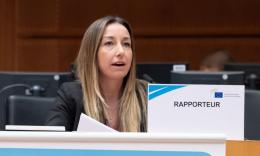
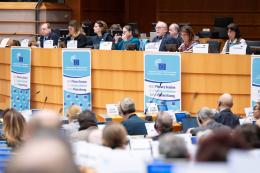
The European Economic and Social Committee (EESC) placed fundamental rights, dignity and equality at the centre of its April plenary session, holding a high‑level debate on Union of Equality: Advancing LGBTIQ+ rights and banning conversion practices. The debate was followed by the adoption of two key EESC opinions calling for stronger enforcement of the EU’s LGBTIQ+ Equality Strategy 2026–2030 and a comprehensive EU‑wide ban on conversion practices.
At its March 2026 plenary session, the European Economic and Social Committee (EESC) adopted an exploratory opinion on how to ensure social inclusion and independent living for persons with disabilities through high‑quality, specialised social services. Building on the UN Convention on the Rights of Persons with Disabilities (UNCRPD), the Strategy for the Rights of Persons with Disabilities 2021–2030, and years of civil‑society advocacy, the Committee sets out a clear roadmap to close the gap between commitments and reality.
At its March 2026 plenary session, the European Economic and Social Committee (EESC) adopted an exploratory opinion addressing how artificial intelligence and algorithmic management are reshaping work across Europe. Building on the Committee’s long‑standing engagement with social and employment policies, the opinion outlines a roadmap to ensure that AI strengthens workers’ rights, enhances job quality and supports a fair, competitive and inclusive digital transformation.
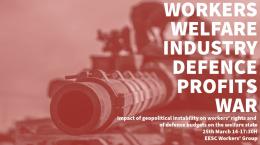
On 25th of March, the EESC Workers’ Group gathered together with a number of guest speakers from academia, trade unions and MEPs from the European Parliament, to discuss the current geopolitical situation, its impact on social and defence expenditure, its spillovers on supply chains and industry, and the consequences for the welfare states and workers’ rights.
To mark International Women’s Day 2026, the European Economic and Social Committee (EESC) hosted a panel discussion highlighting the essential but undervalued work carried out largely by women across Europe. The event, held at the close of Civil Society Week, examined how invisible work supports families, communities, and entire economies, yet too often remains unrecognised, unprotected and uncompensated.
Gender stereotypes continue to be perpetuated and amplified by contemporary media, particularly in the digital sphere. At a conference organised by the European Economic and Social Committee (EESC), speakers called for stronger use of EU legal instruments to address the repression of female journalists, both online and offline.
At its January 2026 plenary session, the European Economic and Social Committee (EESC) adopted a resolution outlining the EU’s priorities for the 70th United Nations Commission on the Status of Women (UN CSW70). With a strong focus on access to justice, women’s participation in public life and the elimination of gender‑based violence, the EESC sets out a roadmap to strengthen women’s rights and reinforce democracy across Europe and beyond.
At its January 2026 plenary session, the European Economic and Social Committee (EESC) adopted an opinion calling for a significantly strengthened European Social Fund (ESF) within the future National and Regional Partnership Plans (NRPPs). The Committee argues that the ESF must play a central role in ensuring quality jobs, lifelong learning, social inclusion and equal opportunities for all during the 2028–2034 programming period.
The European Economic and Social Committee (EESC) adopted its opinion on the European Citizens’ Initiative (ECI) My Voice, My Choice: For Safe and Accessible Abortion during its January plenary session, following a debate that underscored that abortion is a fundamental human right that must be protected for every woman.
At its December 2025 plenary session, the European Economic and Social Committee (EESC) adopted an opinion supporting the European Commission’s proposals for the AgoraEU and Justice programmes for 2028–2034. The EESC calls for robust support for civil society, enhanced democratic participation, and a stronger European Area of Justice, in the pursuit of a free and democratic Europe.