Amid a projected rise in the number of people at risk of poverty, adequate minimum income is a necessary condition to ensure a dignified life for many Europeans. To make sure it is available to all those who need it, Member States should put in place transparent and non-discriminatory criteria for people to obtain it.
Poverty must always be combated in the EU and in the rest of the world. This is all the more important as the cost of living has increased significantly since the onset of the war in Ukraine. While civil society organisations provide important solutions to tackle the effects of poverty, it is clear that future policy measures must be poverty-proof. These are the conclusions of a discussion organised by the Civil Society Organisations' Group of the European Economic and Social Committee (EESC) on 22 March 2023. The event was attended by high-level guest speakers, including Italy's Minister for Labour and Social Policies, Marina Elvira Calderone.
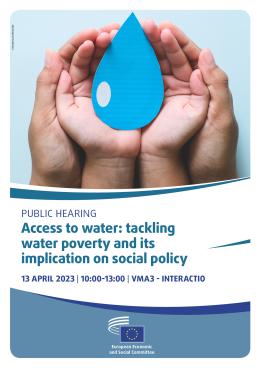
As part of its work to prepare an opinion on "Access to water: tackling water poverty and its implication on social policy", the European Economic and Social Committee (EESC) is organising a hybrid public hearing on 13 April 2023 from 10 a.m. to 1 p.m.
The thematic debate of the Group will see the participation of Marina Elvira Calderone, Minister for Labour and Social Policies of Italy, Marie Toussaint, MEP and Vice-Chair of the European Parliament's Intergroup on "Fighting against poverty", and several representatives of civil society organisations.
Energy poverty exacerbates gender gap worldwide. It is estimated that 70% of 1.3 billion population in developing countries living in poverty are women. Research has shown that women are more likely to fall into energy poverty as they are the main users and producers of household energy, due to economic, biological/physiological and socio-cultural factors. For instance, older women are the most likely to suffer from energy poverty due to a higher life expectancy and lower pensions compared to men. Women are also more likely to be responsible for householding and cooking activities requiring energy sources.
As the number of EU households unable to warm their homes is likely to grow and with energy annual inflation hitting over 40%, the EU and the Member States should adopt and implement urgent measures to prevent and tackle energy poverty threatening Europeans
The EESC is organising a hybrid conference entitled "Towards an EU framework against homelessness based on the principle of 'Housing First'" on 7 October 2022 (9h30 to 13h00).
The aim of the conference will be to reflect on how the EU, national, regional and local authorities, as well as organised civil society, can join forces to identify practical steps to be taken to eradicate homelessness in the EU.
Drastically improving the energy efficiency of Europe's buildings, increasing the use of renewables and educating consumers on energy savings are among the main prerequisites for reducing the number of energy poor in the EU in the long term.