
European Economic
and Social Committee
Never before have the Western Balkans been so close to EU accession
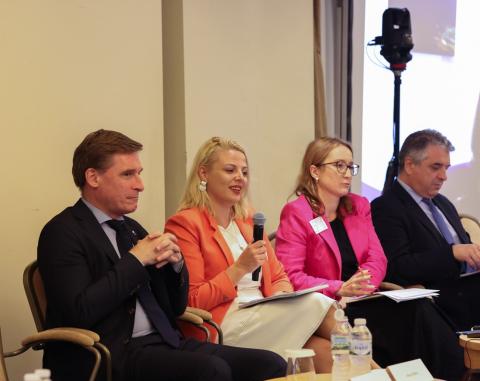
The European Economic and Social Committee (EESC) held the 9th edition of the Western Balkans Civil Society Forum on 19-20 October 2023, just a few weeks ahead of the European Commission's Enlargement Package and the New Growth Plan. The Forum signalled a renewed momentum for the region to join the EU, in view of the current geopolitical situation and a clear commitment of EU leaders to the enlargement policy. Representatives of Civil Society Organisations stressed the need for greater support and safeguarding of civic space to facilitate the essential socio-economic reforms required for EU integration.
The forum was organised in cooperation with the European Commission, the European Training Foundation, the Regional Cooperation Council and the European Centre for the Development of Vocational Training (Cedefop) in Thessaloniki, where 20 years ago the path to the European future of the Western Balkans was confirmed. The participants recognised the strong and vital role of civil society organisations (CSOs) to ensure that economic, social and political reforms are anchored to society.
Opening the forum, the EESC president Oliver Röpke said: The EESC has been an integral part in the EU's enlargement process and I am proud to see that we are taking our support a step further. Only a few weeks ago, the EESC took a historic decision to open our doors to the EU candidate countries, by appointing enlargement candidate members. Today, for the first time, I had a chance to discuss the initiative with civil society from the Western Balkans. I hope to see some of them soon in Brussels working alongside our colleagues in the Committee. You are democratic watchdogs – key for the success of the accession negotiations
.
The Vice-President of the European Commission for Democracy and Demography Dubravka Šuica said: I would like to say to the countries of the Western Balkans that our present and our future are intimately connected. That no matter what age you are or what background you have, each person has their rights enshrined in the European Union. I look forward to fruitful exchanges on these aspirations in my exchanges when visiting the Western Balkans in the coming months. I welcome the EESC's initiative on enlargement candidate members to include them in your advisory work. The EESC is the first of the European Union bodies to do this
.
The speakers, who came from various CSOs and NGOs across all countries in the Western Balkans, mentioned the challenges that civil society organisations are facing, such as sporadic consultations, notable decline in cooperation with the governments, limited involvement in the monitoring and implementation process of the European policies, restricted access to foreign funding and information.
The forum discussed the state of the education system, youth policy and skills development in the Western Balkans including adult education, lifelong learning and vocational education and training, with particular emphasis on the skills supply and demand in the labour market, equitable opportunities for both foster skills and holistic personal development, improvement of the green and digital skills of the adult population and motivation of employees and unemployed people to receive additional education.
Cedefop's Deputy Director Mara Brugia said: Addressing skill gaps and mismatches is not only about skill development but also better use of skills in the workplace, quality and attractive jobs, and fostering constructive social dialogue to ensure these elements align effectively
.
The European Training Foundation's Head of the Systems Performance and Assessment Unit Hugues Moussy said: Policy initiatives to develop skills must also address equity within education and training system. Lower skilled youth, for instance, have fewer opportunities for reskilling and uskilling throughout life. Governments should engage in dialogue with civil society, whose role is crucial to address this imbalance
.
The third session of the 9th Western Balkans Civil Society Forum was dedicated to civil society's contribution to the implementation of the Green Agenda for the Western Balkans.
The Declaration adopted at the end will be a step towards the European Commission's Enlargement package expected in November and the EU-Western Balkans Summit in December.
Work organisation
Downloads
-
Never before have the Western Balkans been so close to EU accession
Recommended for you
Il-KESE jappella għal regolamentazzjoni b’saħħitha u ssemplifikata tal-kriptoassi
News
Il-Kumitat Ekonomiku u Soċjali Ewropew jappoġġja żieda fir-regolamentazzjoni tal-kriptoassi, b’regoli robusti u koerenti biex l-investituri fl-UE jiġu protetti aħjar, f’konformità mal-miżuri attwali…
L-istrumentalizzazzjoni tal-migranti u l-kriżi tar-refuġjati tal-Ukrajna jappellaw għal bidu ġdid għall-politika dwar il-migrazzjoni
News
L-istrumentalizzazzjoni tal-migranti sostnuta mill-Istat, li għandha l-għan li tiddestabbilizza lill-UE, u l-gwerra attwali fl-Ukrajna, li wasslet għal influss bla preċedent ta’ refuġjati, jagħmluha…
“L-Ewropa Tiegħek, Leħnek” 2023: Iż-żgħażagħ jitolbu UE aktar trasparenti, diġitali u semplifikata
News
Fit-23 u l-24 ta’ Marzu, il-Kumitat Ekonomiku u Soċjali Ewropew (KESE) ospita l-14-il avveniment L-Ewropa Tiegħek, Leħnek!, li laqqa’ fi Brussell 105 studenti minn 35 skola mis-27 Stat Membru tal-UE…
Euro-Med – L-organizzazzjonijiet tas-soċjetà ċivili huma essenzjali biex l-ekonomija u s-soċjetà jaħdmu tajjeb
News
Matul is-sessjoni plenarja ta’ Diċembru tal-Kumitat Ekonomiku u Soċjali Ewropew (KESE) sar dibattitu dwar ir-rikostruzzjoni u r-reżiljenza tar-reġjun Ewro‑Mediterranju wara l-pandemija tal-COVID-19.…
Il-KESE jiftaħ l-applikazzjonijiet għall-Premju tiegħu għas-Soċjetà Ċivili li se jkun qed jindirizza s-saħħa mentali
News
L-organizzazzjonijiet tas-soċjetà ċivili, l-individwi u l-kumpaniji privati issa jistgħu jdaħħlu l-proġetti tagħhom mingħajr skop ta’ qligħ għall-premju tal-KESE ddedikat għall-appoġġ tal-benesseri…