Between 26 and 29 March 2026, EESC members joined the EU delegation at the 14th Ministerial Conference of the World Trade Organisation (WTO) in Yaoundé.
The delegation attended the daily debriefings for civil society hosted by DG Trade, and had informal meetings with the African Union ECOSOCC, the WTO, the French business association AFEP and the International Trade Union Confederation (ITUC). A short impromptu meeting was also organized with MEP Warborn (INTA).
EESC's EU Consumer Day 2025 pointed to the urgent need to protect EU markets from an avalanche of cheap imports shipped by Temu, Shein and other third-country e-commerce platforms which are threatening to devastate the European economy and society, forcing European businesses to close and draining billions from public budgets
On 25 June 2025, the European Economic and Social Committee (EESC) held an event in the context of European Public Diplomacy Week, launched for the first time by the European External Action Service (EEAS). The participants highlighted a fundamental dimension of European action, the contribution of civil society to public diplomacy, from international trade to water, through enlargement. When official diplomacy has limited outreach due to political or other issues, civil society can provide added value.
New mandate, new challenge - reaffirming TSD amid economic security ambitions
Location
Brussels
Belgium
The third edition of the EESC Civil Society Forum on Trade and Sustainable Development (TSD) took place on Thursday, 5 December, from 13:45 to 17:30 at the EESC premises in Brussels. Under the theme "New mandate, new challenge: reaffirming TSD amid economic security ambitions," this year's Forum focused on ensuring that the EU's economic security agenda is consistent with and delivers for TSD. As we welcome a new EU Commission, this is the moment to influence policy direction and ensure that trade policy fosters resilience and security alongside long-term development and social justice for all partners.
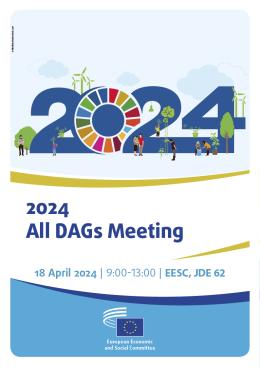
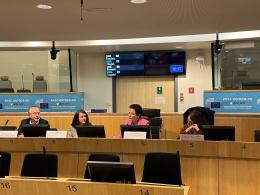
The 4th annual All DAGs meeting took place on Monday 18 April 2024 09:00-13:00 at the EESC premises in JDE62. This was the first All DAGs meeting of this DAG mandate which welcomed the newer DAG Members, as well as more experienced ones. It was a unique opportunity to gather all EU DAG Members and EU institutions as one TSD community, to openly exchange ideas, challenges, and aspirations. The meeting featured, among others, CTEO Denis Redonnet and DDG Maria Martin-Prat, DG Trade.
The EU-Japan DAG hosted a workshop: "Promoting human rights and environmental due diligence together" on 9 April 2024 following a Joint Dialogue with Civil Society in Tokyo on 8 April. The workshop's objective was to foster dialogue between EU and Japan civil society representatives, focusing on best practices and a solution-oriented approach in an area of importance to the implementation of the TSD-chapter of the EU-Japan EPA. Human rights and environmental due diligence are topics of common interest, as the EU and Japan share values and want to secure resilient supply chains so as to do business in a sustainable way.
Download — Evaluation of Directive (EU) 2019/633 of 17 April 2019 on unfair trading practices in B2B relationships in the agricultural and food supply chain (Incl. Mapping of national UTP legislation)
In its capacity as the home of civil society, the EESC welcomed participants from several developing countries to the 2023 Civil Society Forum on Trade and Sustainable Development. Joined by high-level representatives from the EU, the ILO and UNCTAD, civil society speakers openly discussed existing policies and new initiatives, called for a truly inclusive approach and proposed concrete solutions to make trade a driving force for the Just Transition.