The objective of the public hearing is to examine how cohesion policy can more effectively address housing affordability challenges to advance its core goals of economic, social and territorial cohesion. The participants will explore how strategic housing investments can stimulate regional economic development, enhance competitiveness, improve labour market efficiency, and reduce territorial disparities. The aim is to provide concrete recommendations for improving the effectiveness of existing instruments for the remainder of the 2021-2027 period and developing a more comprehensive approach to affordable housing within the post-2027 cohesion policy framework.
In this opinion, the EESC fully supports the priorities identified by the Commission and reiterates the need for a cohesive European response. The EESC also stresses that removing barriers is key and that regulatory simplification must take place with full respect for social and workers’ rights. Finally, it calls on the Commission to put forward legislative proposals to address regional supply constraints.
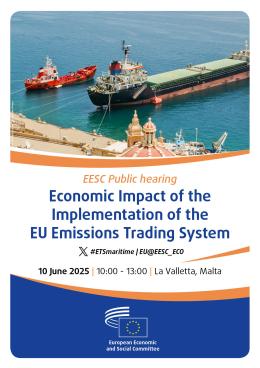
The European Economic and Social Committee (EESC) is organising a public hearing to assess the economic impact of extending the EU Emissions Trading System (ETS) to the maritime sector.
The hearing will focus on the risks of carbon and business leakage, and how these developments may affect port competitiveness and trade flows- particularly in smaller and peripheral EU Member States. The event will provide a platform for maritime stakeholders, economic experts, and EU institutions to discuss real-world implications and explore fiscal and strategic solutions to mitigate negative effects.
Speakers will include representatives from DG CLIMA, maritime and port organisations, as well as leading economists and policy analysts.
Malta’s strategic location and role in European maritime logistics make it an ideal setting for this timely discussion.
In a context such as the one that Europe is experiencing, characterised by multiple crises, it is appropriate to promote a reflection on European public goods and on fundamental political priorities capable of ensuring the sustainable growth of the EU and the well-being of its citizens. This reflection gets ever more important in view of the upcoming negotiations on the next European Multiannual Financial Framework for the period post 2027.
The EESC welcomes the overall positive trade balance of the EU and calls for measures to maintain it, while recommending targeted support for strategically important industries, stronger investment conditions, and effective financing through the Single Market, the Savings and Investments Union, and a more integrated capital market. The EESC also underlines the need to support ambitious companies entering global markets, ensure opportunities for highly skilled professionals, simplify procedures without undermining social and environmental standards, create fiscal space for growth-enhancing investments, and strengthen multilateralism through new trade agreements and WTO reforms.
Given the significance of the provision of public goods for the well-being of the citizens, the EESC believes that particular attention should be paid to providing these European public goods (EPGs) and identifying them in the next multiannual financial framework (MFF) post-2027.
Special attention must be given to ‘functional EPGs’ – those linked to Article 3 TEU – that can ensure the normal functioning of the EU: the completion of the single market; the completion of the economic and monetary union; economic, social and territorial cohesion; EU open strategic autonomy (e.g. the joint EU health policy, food security, the EU energy union); defence and security; EU research and development; and the rule of law.