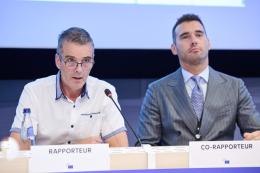
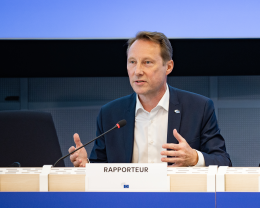
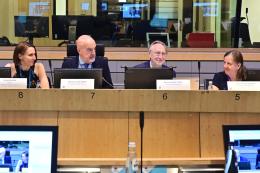
Committee welcomes Commission's strategy but calls for stronger funding, mandatory labelling and strengthening competitiveness for Europe's livestock farmers.
The European Economic and Social Committee (EESC) has broadly welcomed the European Commission's new Vision for Agriculture and Food and its forthcoming livestock strategy, but says Brussels must go significantly further if it wants Europe's livestock sector to remain competitive, sustainable and resilient. While supporting the Commission's overall direction, the Committee argues that the current proposals leave important gaps on financing, trade, labelling and support for farmers.
The EESC continues to push for an end to Europe’s housing crisis. In a new opinion, it argues that, to achieve more affordable housing, the EU needs a number of urgent measures, including: a better strategy for land use and rural areas, much more investment and public funding linked to clear social criteria, faster planning and permitting procedures through digitalisation, the right workforce and skills, and modern construction methods.
The fight against racism in Europe must move beyond good intentions and become a genuine political priority, the European Economic and Social Committee says in its recently adopted opinion on the EU Anti-Racism Strategy 2026-2030.
The European Economic and Social Committee (EESC) has welcomed the European Commission’s proposed Industrial Accelerator Act (IAA) as a timely move to strengthen Europe’s industrial competitiveness, at a time when manufacturing’s share of EU GDP has fallen from 17.4% in 2000 to just 14.3% today.
As the world celebrates the International Volunteer Year 2026 (IVY 2026), experts from across Europe gathered at an EESC hearing to underline the vital contribution that volunteers make to building resilient, prepared and cohesive societies. The hearing, organised as part of the EESC's work on the forthcoming opinion on the role of volunteering for European preparedness, explored how volunteering strengthens communities before, during and after crises.
As global trade governance becomes more fragmented and politicised, members from all 15 EU Domestic Advisory Groups met in Brussels to discuss how organised civil society can strengthen its contribution to the implementation of EU trade agreements and ensure that sustainability commitments are effectively monitored and followed up.
Europe will need significantly more investment if it wants to secure the critical raw materials required for its green, digital and defence transitions, the European Economic and Social Committee (EESC) warned in an opinion adopted at its June plenary session.
On 30 June, the European Economic and Social Committee initiative 'Empowering youth voices through the EESC Youth Test' joined three other finalists in the 'Excellence in diversity and inclusion' category at the ceremony for the Ombudsman Award for Good Administration. Amidst the shortlisted projects, the winning recognition was awarded to the DiscoverEU Inclusion Action, a European Commission initiative dedicated to opening Europe to young people with fewer opportunities.
The European Economic and Social Committee (EESC) backs the Commission’s proposed Digital Networks Act and says there is a need to remove internal market barriers and ensure uniform rules. Effective governance is essential, with a clear allocation of competences between the EU and national authorities, which avoids overlaps and institutional duplication.