
European Economic
and Social Committee
All DAGs meeting: civil society steps up as trade becomes more strategic and geopolitical
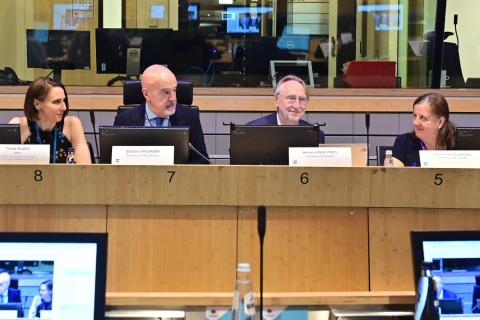
Members from all 15 EU Domestic Advisory Groups (DAGs) gathered at the European Economic and Social Committee (EESC) on Thursday 2 July to discuss how organised civil society should play a stronger role in the implementation of EU trade agreements. Against a backdrop of growing geopolitical tensions and increasing pressure on the multilateral trading system, participants examined how DAGs can remain effective and influential while the EU's network of trade agreements continues to expand.
The 2026 All DAGs Meeting, the fifth edition of this important annual gathering, brought together members of the EU DAGs and representatives of the European Commission and the European Parliament. Discussions focused on the evolving role of civil society in supporting sustainable and rules-based trade and on providing practical advice for the implementation of EU trade agreements.
"Domestic Advisory Groups are becoming increasingly important as trade policy takes on a broader political and strategic significance. DAGs help make trade agreements more credible and accountable by bringing the expertise and experience of employers, workers and civil society organisations directly into the implementation process." Stefano Palmieri, President of the EESC's Section for External Relations (REX).
"This meeting is not only a technical exercise. It is also about maintaining and strengthening the relevance of organised civil society in EU trade governance, especially at a time when trade policy is becoming more geopolitical, more strategic and less purely technical. Today’s discussions are very timely." Tanja Buzek, vice-president of REX, EESC DAG Coordinator and Chair of the EU DAG for Canada.
Speakers stressed that civil society should remain actively involved as the EU develops new trade partnerships and responds to growing economic and geopolitical challenges.
The discussions highlighted the growing responsibilities of the DAG network. While many DAGs were initially created to monitor Trade and Sustainable Development (TSD) commitments, some of the EU's newer trade agreements give them a wider role in advising the implementation of the agreement as a whole. Participants discussed what support, information and cooperation are needed to ensure that DAGs can continue to fulfil this role effectively.
The opening panel examined the impact of geopolitical tensions, unilateral trade measures and challenges facing the multilateral trading system. Participants also reflected on how civil society can help bridge the gap between the growing number of EU trade agreements and the resources available to monitor their implementation in practice.
"Sustainability provisions like labour rights and environmental provisions are not an auxiliary component of EU trade policy, but central to its legitimacy and credibility. Together with our Domestic Advisory Groups, we make sure that these provisions are well respected in practice." Bernd Lange, Chair of the European Parliament Committee on International Trade (INTA).
The event also featured four interactive breakout sessions looking at practical ways to strengthen the effectiveness and impact of the DAGs. Discussions focused on the European Commission's Single Entry Point (SEP) complaints mechanism, civil society participation in emerging trade-related arrangements such as critical raw materials partnerships, communication within the expanding DAG network and stronger cooperation with the European Parliament.
Participants highlighted the importance of transparency and meaningful follow-up to recommendations and regular dialogue with policymakers. They also discussed how the expertise of business organisations, trade unions and civil society organisations can contribute not only to monitoring sustainability commitments, but also to wider discussions on trade implementation and the EU's broader economic priorities.
"We currently have 45 free trade agreements, some still to be ratified. The priority is the effective implementation of these in an ever challenging trade environment. It is important that civil society is involved and our commitment to the DAGs remains steadfast." Sofia Muñoz Albarrán, DG Trade, European Commission
The meeting sought to identify practical ways of improving how the DAGs operate, strengthening civil society participation and increasing accountability in the implementation of EU trade agreements. Participants also explored how cooperation with the European Parliament, the European Commission and EU Delegations could further strengthen the visibility and impact of DAG recommendations.
For the EESC, which provides the secretariat for all the EU DAGs and acts as the institutional home of organised civil society at EU level, the meeting was also an opportunity to reflect on how civil society can continue to contribute meaningful expertise and scrutiny as trade policy becomes more political, strategic and visible.
Background
What are Domestic Advisory Groups?
Domestic Advisory Groups (DAGs) are civil society bodies established under EU trade agreements. They bring together representatives of business, trade unions, environmental organisations and other civil society groups to monitor and advise on the implementation of trade agreements. Most DAGs focus on Trade and Sustainable Development commitments, while some newer agreements give them a broader monitoring role covering the entire agreement. DAGs exist on both the EU and partner-country sides.
Why are DAGs important?
DAGs help ensure that trade agreements deliver on those commitments and provide recommendations to policymakers, identify implementation challenges, raise concerns from civil society and contribute independent expertise to the trade policy process.
What was the focus of the 2026 All DAGs Meeting?
- How to strengthen the role and impact of DAGs;
- The use of the Trade and Sustainable Development complaints mechanism through the Single Entry Point (SEP);
- Civil society participation in emerging trade-related arrangements such as critical raw materials partnerships;
- The future organisation and communication of the expanding DAG network;
- Partnering with the European Parliament;
- Practical solutions to improve transparency, accountability and implementation monitoring.
Work organisation
Recommended for you
EESC steps up relations with the Brazilian civil society, reinforcing EU's strategic partnership with Brazil
News
On 9 April, the President of the European Economic and Social Committee, Oliver Röpke signed a Memorandum of Understanding with the newly established Sustainable Economic and Social Development…
EESC steps up relations with African civil society, reinforcing the EU's strategic partnership with the African Union
News
On 17 July, the President of the European Economic and Social Committee (EESC), Oliver Röpke, signed a Memorandum of Understanding (MoU) with the African Union Economic, Social and Cultural Council…
EESC steps up relations with civil society across the African Union, reinforcing EU’s strategic partnership with the African Union
News
On 17 July, the President of the European Economic and Social Committee, Oliver Röpke signed a Memorandum of Understanding with the African Union Economic, Social and Cultural Council (ECOSOCC)…
2023 All DAGs Meeting
Event
The 3rd annual All DAGs meeting took place in a hybrid format on Monday 17 April 2023 at the EESC.As the Domestic Advisory Groups (DAGs) approached the end of the 2020-2023 mandate, the objective of…
2024 All DAGs Meeting
Event
The 4th annual All DAGs meeting took place on Monday 18 April 2024 09:00-13:00 at the EESC premises in JDE62.This was the first All DAGs meeting of this DAG mandate which welcomed the newer DAG…