
European Economic
and Social Committee
UKRAINE’S STOLEN CHILDREN: EVERY CHILD RETURNED IS AN INVESTMENT IN GLOBAL SECURITY AND STABILITY
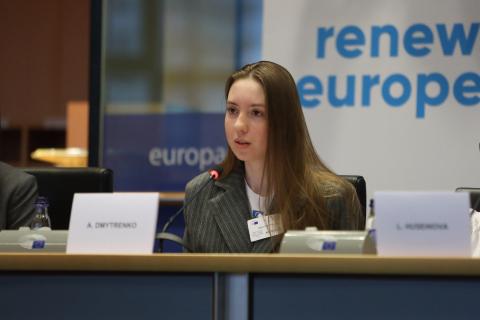
An integral part of President Volodymyr Zelenskyy’s Bring Kids Back UA initiative, Save Ukraine is the leading organisation working to rescue the stolen Ukrainian children from Russia and temporarily occupied territories of Ukraine. Placed in institutions or in foster families, the abducted children face isolation, indoctrination and militarisation. Russia no longer hides its crimes – last summer, the team uncovered a catalogue of abducted Ukrainian children advertised for adoption, detailing their physical characteristics or describing them as obedient or hardworking. And the clock is ticking: the longer children remain in Russia’s adoption system, the harder it will be to bring them home. Save Ukraine’s Alina Dmytrenko told us more.
You are the NGO that has returned the largest number of deported Ukrainian children, having so far rescued and brought back to Ukraine over 1000 children abducted by Russia since 2022. From what you see in your work, what is life like for the children who have not been brought home? Do you have a sense of how many abducted children may still be in Russia or Russian-controlled territories?
To date, Save Ukraine has rescued 1146 children, representing the majority of documented rescues. Last year alone, we brought back 500, and this year we aim to return 1000 more.
However, the scale of the crime is staggering. Since 2014 – and especially after February 2022 – over 1.6 million Ukrainian children’s lives have been stolen as they remain trapped under occupation or have been abducted to Russia. As of 2023, Ukraine has officially tracked only 19 546 cases of abduction due to Russia’s near-total information blockade that severely limits access to data. Meanwhile, in 2023, Russian authorities themselves reported that over 700 000 Ukrainian children had been officially registered in Russia – suggesting that the true scale of abduction is exponentially higher.
The situation for Ukrainian children in Russia and occupied territories is dire. They face indoctrination, militarisation and forced placement in institutions or Russian families, often with changed identities. Many have lost contact with their parents, who have been killed, detained or disappeared. And time is working against us. The longer they remain there, the harder it becomes to bring them home. The children we rescue describe fear, pressure and isolation – and say that only after returning to Ukraine do they finally feel safe and free again. That is why we remain fully committed to bringing as many children home as possible.
There have been reports that some deported Ukrainian children are entered into Russian adoption or guardianship systems. Have you encountered this in your work, and what does it mean for the children involved?
Yes, many Ukrainian children have been placed in Russian foster families or institutions. In many cases, they still have parents or relatives in Ukraine ready to take them back. Instead of facilitating reunification, Russia blocks contact and has created incentives for Russian families to adopt Ukrainian children – increasing financial payments and simplifying procedures to change citizenship, names, birthdates and other personal data, making children harder to identify and trace. We personally remain in contact with parents who are trying to reach children held in institutions or families without any access to communication.
Save Ukraine has rescued children both from institutions and from foster families, but once a child is fully absorbed into the Russian adoption system, return becomes extremely difficult. We have documented numerous cases where teenagers, upon turning 18, have attempted to escape the institutions or foster families on their own. There are also cases where foster families abandon children once state payments end. You can imagine that the psychological damage is severe – especially for children who know they have a real family in Ukraine.
What is especially horrifying is that for very young children taken during infancy – including those abducted from baby homes like the one in Kherson – the tragedy may be permanent. After years in Russian families with altered identities, some may never learn they are Ukrainian.
Last summer, our team uncovered an online catalogue listing Ukrainian children from a Russian-run institution in the occupied Luhansk region. The format resembled a marketplace: children were described in terms such as ‘obedient’ and ‘hardworking’, and could be filtered by physical traits like eye and hair color. The images were explicit and deeply disturbing. In Russia – a country where corruption is widespread and systemic – such exposure creates real risks of exploitation and trafficking. This case revealed a system that treats the most vulnerable Ukrainian children as commodities.
This isn’t a new tactic, however. Since 2014, Ukrainian children have appeared in Russian adoption databases. However, since 2022, the practice has become widespread and systematic. Initially, Russian authorities tried to cover their tracks – shutting down registries and erasing references. Now, the pretense is gone. The official website of the so-called ‘ministry’ of the Luhansk occupation administration brazenly displays this data for all to see.
Can you walk us through how a rescue mission to bring a stolen Ukrainian child home actually works?
Of course, for security reasons, we cannot disclose operational details, as these are complex, high-risk missions. But what we can share is that we have built a full-cycle rescue system: identifying children, establishing secure communication, verifying their circumstances and carefully planning every step of the extraction process. Because Russia blocks access to information inside the occupied territories, the most effective channel for connecting with families and children is often word of mouth. Those we successfully rescue help us reach those still trapped. Strategic communication, therefore, becomes a lifeline.
Each journey is long and dangerous – often from occupied territories through Russia and Belarus to the Ukrainian border, where our team welcomes the children and immediately provides protection and care. Russian authorities heavily screen and interrogate those attempting to leave, and restrictions are increasing constantly, so we adapt each time, prioritising safety above all else.
When children cross back into Ukraine, almost all of them say the same thing: they can finally breathe. They feel free. And for the first time in a long while, they allow themselves to dream again.
What happens after a child returns – how does Save Ukraine support their psychological recovery and reintegration with family, school and community?
After a child returns to Ukraine, Save Ukraine is responsible for the full recovery process. This is often long-term. Many children have lived under constant pressure, surveillance and psychological control. The first step is restoring a sense of safety – and helping them reclaim their identity, voice and agency.
We provide holistic support: temporary accommodation, humanitarian assistance, legal aid and trauma-informed psychological care. Just as importantly, we support reintegration – enrolling children back in school or university, helping families access employment and assisting them in rebuilding stable, independent lives. For orphans, we carefully look for loving foster families, so that no child is placed in an institution. Rescue is only the beginning. Real recovery takes time, consistency and care – and we stay with children and families throughout that process.
How can people support your work?
People can support our work through our website, by sharing the stories of rescued children and by helping us expand our network of partners and supporters.
Right now, we are running a major emergency fundraising campaign to help children and families in Kyiv survive the humanitarian crisis caused by massive attacks on our energy infrastructure, leaving tens of thousands without electricity and heating. Our goal is to keep our centres functioning as safe, heated hubs – providing light, hot meals and shelter for children during air raids and prolonged blackouts. Link to fundraiser
We are grateful for any contribution – large or small – and we remain open to diverse forms of cooperation to pursue and scale up our mission.
What do you wish the international community understood better about the deportation of Ukrainian children, and what concrete actions could make the biggest difference right now?
It is becoming increasingly clear – not only to us, but to the wider international community – that the issue of Ukrainian children is not just a humanitarian tragedy. Given the system Russia has built, it has become a matter of regional and global security.
Through indoctrination and militarisation, Ukrainian children are being taught to reject their identity and to view the West – Europe, NATO, the United States – as enemies. All are being prepared for military service. This is not only about Ukraine’s future; it is about the long-term security of the democratic world.
Europe and the international community must treat this with the seriousness it deserves. Every child returned is an investment in global security and stability.
We see clearly that Russia is not willing to return our children and that diplomacy alone has not created a functioning return mechanism. That is why we call on international partners to help strengthen and scale the rescue system that is already working – so that we can increase our capacity and bring more children home.
Alina Dmytrenko brings extensive experience working with the Parliament of Ukraine and European parliamentarians. She currently leads government and European affairs at Save Ukraine, advancing the issue of stolen Ukrainian children and mobilising support for their rescue among EU governments and national parliaments.