
European Economic
and Social Committee
Scientists and civil society call for ten decisive policy actions to avert irreversible environmental and social tipping points
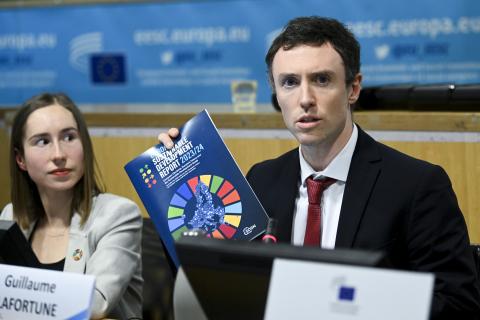
The 5th Europe Sustainable Development Report (ESDR) has revealed that at the current pace, the EU is set to fail to achieve one third of the Sustainable Development Goals (SDGs) by 2030. The report, co-produced with civil society, highlights stagnation and regression in environmental and social goals across many European countries, exacerbated by crises since 2020. The SDGs cover areas such as poverty reduction, zero hunger, health, education, gender equality, climate action, and clean water.
To address this, ten decisive policy actions have been proposed to avert irreversible environmental and social tipping points. Urgency was emphasised during an event co-hosted by the European Economic and Social Committee's (EESC) Agriculture, Rural Development and Environment Section (NAT) and the UN Sustainable Development Solutions Network (SDSN). The report aims to guide the EU in bolstering its SDG leadership ahead of the June 2024 European elections and the September 2024 Summit of the Future convened by the UN Secretary-General.
Speakers at the event stressed the need for immediate action before 2030 to avert irreversible tipping points. Camilla Brückner of the UN/UNDP, Zakia Khattabi, Belgian Federal Minister for Climate, and Petra Petan of the European Commission, emphasised the importance of staying committed to the 2030 Agenda and the Paris Climate Agreement.
Guillaume Lafortune, Vice-President of the UN SDSN, presented the report and the ten priority actions aimed at political parties, the next European Parliament, the next European Commission, the European Council, and the Member States. The call for action, co-signed by the EESC and the SDSN, urges European leaders to work together for a green, social, and international European Deal for the Future. Peter Schmidt, president of the EESC's NAT section, stressed that the next six years were crucial for advancing the 2030 Agenda, emphasising the EESC's commitment to pushing the EU institutions towards the SDGs and meaningful civil society involvement. The call for action is positioned to guide European leaders towards a comprehensive European deal aligned with the green and social goals advocated by the EESC. (ks)