
European Economic
and Social Committee
How to build resilient and sustainable European health and care systems: learning from the experiences of the COVID-19 pandemic
By the EESC Civil Society Organisations' Group
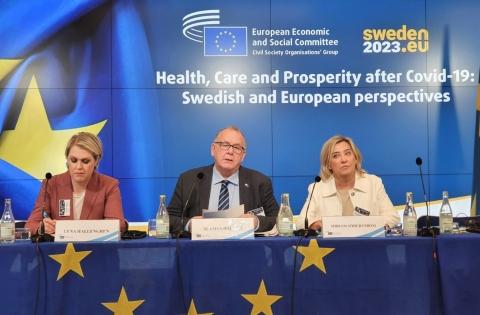
Healthcare must be people-centred and valued as a social investment, not a 'cost', concluded a conference organised by the Civil Society Organisations' Group of the European Economic and Social Committee at the House of Europe in Stockholm on 25 May 2023.
For this to happen it is necessary to change mindsets socially, economically and politically. Building on cooperation during the COVID-19 pandemic, EU Member States need to join forces to build resilient and sustainable health and care systems that leave no one behind and value the work of care workers, civil society organisations and volunteers.
The conference was attended by some 90 civil society and institutional representatives from the national and the European level.
Opening the conference, Séamus Boland, president of the Civil Society Organisations' Group, recalled that access to affordable and quality healthcare is a right for EU citizens. It was agreed upon by all EU Member States with the adoption of the European Pillar of Social Rights in 2017, stated Mr Boland and added that it was reiterated by citizens in 2021, when they called for the 'Right to Health' in the Conference on the Future of Europe. Mr Boland also stressed that in order to provide qualitative healthcare for the most vulnerable - be it the elderly, the young, or persons with a disability – it was necessary to build resilient and qualitative health and care systems.
Lena Hallengren, Member of Parliament and former Swedish Minister for Health and Social Policy (2019-2022), reflected in her speech on the measures taken by the Swedish government in response to the pandemic. She said: Regarding our chosen measures, Sweden was often described in the international media as odd. But we saw that the measures we took had a sufficient effect when people kept distance and refrained from visiting public places. And when other countries closed their schools, ours were open. Because we knew how important school is for children and young people in their upbringing, especially for those coming from the smallest means."
To continue reading, visit our website.