
European Economic
and Social Committee
EESC backs EU Preparedness Union Strategy but warns: fund it, leave no one behind
With Russia’s war of aggression against Ukraine and mounting climate risks, Europe’s preparedness has shot to the top of EU and national agendas.
The European Economic and Social Committee (EESC) has welcomed the European Commission’s new Preparedness Union Strategy, calling it a long-overdue shift to an “all-hazards, whole-of-government and whole-of-society” approach to crises ranging from wildfires and floods to cyberattacks and full-scale armed aggression. But the EESC warned that the plan must come with clear, long-term financing and a real role for organised civil society to succeed.
At its plenary debate with civil defence and humanitarian experts on 18 September, the EESC stressed that solidarity, public trust and social unity are just as vital as new rules and tools. After the debate, the EESC adopted its opinion on the Strategy.
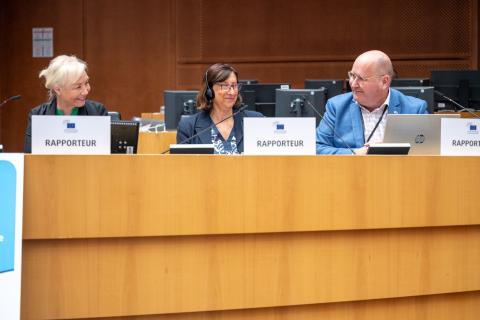
'Preparing for crises means strengthening the ability of our democracies to face new global challenges without compromising their fundamental values. Only a Europe firmly anchored in peace, freedom and democratic participation can ensure lasting resilience and citizens’ trust,' stressed the rapporteurs of the opinion Tomas Arvidsson, Giulia Barbucci and Ariane Rodert.
Jessika Bohr, Head of Section for EU and International Affairs,Division of Civil Defence at the Swedish Ministry of Defence, underlined the urgency: 'We find ourselves in a new security reality where the security situation in Europe is dire. The threats we face are complex, cross border and increasingly antagonistic. In this context, preparedness is not optional. It is essential.'
The Swedish defence concept includes both military and civil defence and is based on the idea that the whole of society must be involved in defence efforts. Since 2022, Sweden has had a minister for civil defence tasked with strengthening and coordinating civil preparedness. Private-public cooperation is part of the country’s structure, and a cross-sectoral Business Council for Preparedness helps safeguard the internal market even in worst-case scenarios.
Magali Mourlon, Head of the Disaster Management and Development Unit at the Red Cross EU Office, warned: 'The implementation of the European Commission strategy at all levels should build on existing structure, reinforce them and deepen the complementarity of local action and presence with other local, regional and national level. Also, societal preparedness needs to take into account that society is not homogeneous, and we must leave no one behind.'
'We have been calling for many years for resilience to be understood not just as the strength of systems but as the strength of societies. Societies are not made resilient by regulations alone. They are resilient when citizens, volunteers, youth workers, civil society organisations and communities are empowered and recognised as part of Europe's preparedness fabric,' said Piotr Sadowski, Secretary General of Volonteurope.
EESC KEY MESSAGES
In the opinion, the EESC backed 'preparedness by design' across EU policies, meaning preparedness must be built into laws. At the same time, the EU and national governments must also keep investing in social cohesion and progress, which is vital to prevent and resolve conflicts. It also asked the Commission to clarify who does what between EU, national and local levels and to stick to a firm rollout timetable.
On financing, the EESC flagged a gap: the Strategy asks a lot of Member States without spelling out what funding is available. The EESC called for structural, long-term mechanisms to finance prevention, mitigation and recovery ─ plus a next multiannual financial framework that strengthens preparedness without raiding other resilience pillars such as the CAP, cohesion policy and the EU Solidarity Fund.
Citizens must be informed and empowered, including guidance toward 72-hour household self-sufficiency with tailored support for vulnerable groups. Water security is another priority, as over 10 million people in the EU still lack access to safe drinking water.
The EESC also calls for the following:
• European solidarity must be rapid, consistent and cover all types of crises, with reconstruction as an integral part.
• Stable, long-term financing is essential, without undermining key EU policies such as agriculture, cohesion and the Solidarity Fund.
• Decent wages, safe jobs and strong social dialogue are preconditions for resilience.
• Operational tools like the ERCC, the Civil Protection Mechanism and rescEU must be reinforced, avoiding duplication and promoting best practices.
• Innovation and public–private partnerships, including AI and emerging technologies, are crucial to strengthen resilience.
• International cooperation, with the UN, NATO, candidate countries and EEA partners, is key to reducing vulnerabilities and promoting global stability.
Work organisation
Recommended for you
EU:n ja Yhdysvaltojen kauppa- ja teknologianeuvoston on tartuttava tilaisuuteen ja otettava tavoitteeksi johtoasema kaupan, teknologian ja innovoinnin alalla
News
Euroopan talous- ja sosiaalikomitea (ETSK) totesi heinäkuun täysistunnossaan, että uudesta kauppa- ja teknologianeuvostosta (Trade and Technology Council, TTC) voi tulla sekä EU:ta että Yhdysvaltoja…
”Sinun Eurooppasi, sinun mielipiteesi” ‑tapahtuma 2023: Nuoret vaativat avoimempaa, digitaalisempaa ja yksinkertaisempaa EU:ta
News
Euroopan talous- ja sosiaalikomitea (ETSK) isännöi 23.–24. maaliskuuta 14. ”Sinun Eurooppasi, sinun mielipiteesi” -tapahtumaa, joka toi Brysseliin 105 opiskelijaa 35 koulusta EU:n 27 jäsenvaltiosta…
Puurakentaminen voi auttaa vähentämään hiilidioksidipäästöjä
News
Euroopan talous- ja sosiaalikomitean järjestämässä keskustelussa kävi ilmi, kuinka hyödyllistä puurakentaminen voi olla, kun EU pyrkii saavuttamaan hiilineutraaliuden tavoitteen vuoteen 2050 mennessä…
Pro Lapinlahti -yhdistykselle ja Lilinkotisäätiölle ETSK:n mielenterveysaiheinen kansalaisyhteiskuntapalkinto
News
Suomalaisorganisaatiot jakoivat mielenterveyttä edistäville hankkeille myönnetyn Euroopan talous- ja sosiaalikomitean (ETSK) kansalaisyhteiskuntapalkinnon muut palkintosijat kahden muun hakijan…
Euroopan talous- ja sosiaalikomitea on avannut mielenterveysaiheisen kansalaisyhteiskuntapalkintonsa haun
News
Kansalaisyhteiskunnan organisaatiot, yksityishenkilöt ja yksityiset yritykset voivat nyt ehdottaa voittoa tavoittelemattomia hankkeitaan tätä eurooppalaisten henkisen hyvinvoinnin tukemiselle…