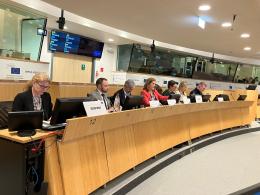
The European Economic and Social Committee (EESC) has adopted an information report and a resolution calling for a stronger role for social partners and civil society organisations in shaping national reforms and investments. The EESC calls for the creation of a European code for structured consultations and mandatory assessments of partnership practices to improve transparency, effectiveness and democratic legitimacy.
The European Economic and Social Committee (EESC) has adopted an opinion arguing that putting the New European Bauhaus into practice can help tackle the housing crisis, as long as it moves from inspiring pilot projects to systemic, scalable and place-based delivery.
On World Refugee Day (20 June), the European Economic and Social Committee (EESC) reaffirms its long-standing commitment to a fair, humane and comprehensive European approach to migration, asylum and refugees: one that upholds fundamental rights while recognising the social and economic contributions of people on the move.
A conference held in Brussels by the European Economic and Social Committee and the Basque Government showcased the political and social importance of services of general interest in making intergenerational solidarity a reality in Europe and building a more inclusive society.
The EESCConsultative Commission on Industrial Change (CCMI) is holding a high-level conference under the theme: "The future of the European battery industry" in the context of the Battery Booster Strategy adopted by the European Commission.
Date: 11 June 2026
Time: 14.30-17.00
Venue: EESC, rue Belliard 99, JDE, 6th floor, room 62
Insufficient enforcement of common EU rules, threats to consumer confidence, excessive complexity for SMEs and a loss of competitiveness in the digital sector are among the greatest challenges facing the Single Market. The EU has a duty to protect it in order to promote economic growth and maintain social cohesion.
The European citizens’ initiative (ECI) ‘Stop Destroying Videogames’ calls for measures to stop publishers from remotely disabling video games that consumers have already purchased. Backed by almost 1.3 million signatures, it has become the 14th valid ECI to reach the European Commission, placing pressure on the EU institutions to address consumer rights in digital gaming.
Europe’s single market is facing ongoing challenges due to fragmentation, unfair commercial practices and the accelerating pace of technological change.