
European Economic
and Social Committee
EESC debates ECI that protects rights of Europe's video gamers
The European citizens’ initiative (ECI) ‘Stop Destroying Videogames’ calls for measures to stop publishers from remotely disabling video games that consumers have already purchased. Backed by almost 1.3 million signatures, it has become the 14th valid ECI to reach the European Commission, placing pressure on the EU institutions to address consumer rights in digital gaming.
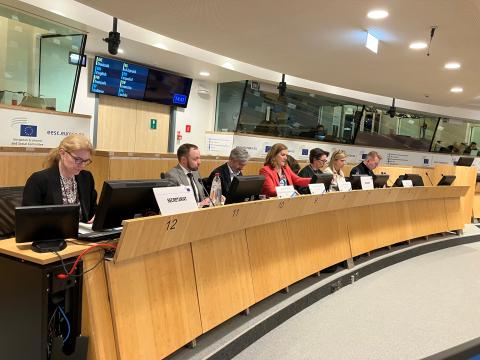
On 19 May, the European Economic and Social Committee’s (EESC) Section for the Single Market, Production and Consumption held a debate on the ECI ‘Stop Destroying Videogames’. The Commission must respond to the ECI by 27 July 2026 at the latest and has already announced that it will publish its response on 16 June.
Submitted to the European Commission on 26 January this year, the ECI gathered 1 294 188 verified signatures, reflecting the widespread popularity of video games across the EU. According to recent figures, some 130 million Europeans play video games, representing 29% of the population.
The ECI aims to prevent game publishers from rendering video games unplayable at any time and without justification — as is currently possible — after selling or licensing them to users in the EU. It calls on the European Commission to find appropriate ways to better enforce existing legislation, or to establish new rules ensuring that games remain functional even after official support ends.
Currently, a majority of publishers sell video games that require a connection to the game publisher. When support for these games ends, publishers often simply sever the necessary connection and disable the game, effectively destroying working copies and preventing consumers from accessing or repairing them.
Another problem is that, at the time of purchase, buyers are often not informed when the game will stop working, and they are not offered any compensation once it is discontinued.
‘If designed responsibly, most games that connect to the internet can operate indefinitely without publisher support. This has been a customer expectation for over 50 years. We are open to any solution that solves the problem. We are flexible on specifics and implementation by publishers. We understand that not all game features may be operable in a discontinued game. We are not seeking ongoing support from publishers after a game has been discontinued,’ explained Pavel Zálešák, organiser of the ECI and deputy director of the NGO Stop Killing Games, at the EESC debate.
Participants in the EESC debate emphasised that the ECI raises questions regarding consumer rights, ownership and licensing. Current EU legislation and consumer agencies are poorly equipped to protect customers from the ‘killing’ of video games.
‘Major publishers in the video game industry ignore consumer rights and spoil the market for both consumers and good faith actors. We, EU citizens, are asking the European Commission to address this critical consumer issue,’ Mr Zálešák said.
Moreover, the licence agreements required to run a game often bypass many existing consumer protections. ‘Clear, harmonised regulation of such practices is needed to avoid distortion between countries operating in the same digital single market and to ensure a high level of protection for EU consumers,’ stressed Alberto Hidalgo Cerezo, ECI signatory and law professor at CEU San Pablo University in Spain.
‘When a game is functional, it should not cease to function as a result of deliberate and avoidable decisions,’ Mr Hidalgo Cerezo said, giving examples such as planned digital obsolescence or products rendered unusable although technically viable. ‘Consumers are defenceless. There isn’t even a right to repair applicable to video games.'
Wytze Koppelman, curator at the Netherlands Institute for Sound & Vision, one of the world’s largest media archives collecting digital media before it disappears, said games must remain functional if they are to be preserved for research, education and future access. ‘Accessibility is becoming a problem. The essence of media is to “play a game”. The Sound & Vision museum cannot protect video games if they are not playable.’
Representatives of the European Commission avoided giving any indication of what the Commission’s response would be on 16 June.
‘The Commission will consider whether the requested measure is proportionate and whether the objectives of the initiative could be addressed, at least partly, through better enforcement or adaptation of existing rules. We will also analyse whether there is a need to update the common rules to ensure consumers can exercise their legal rights more effectively,’ said Isabelle Pérignon of the Commission’s Directorate-General for Justice and Consumers.
Background
An ECI is an EU participatory mechanism designed to strengthen direct democracy by enabling at least one million EU citizens (with a minimum number of nationals from seven EU Member States) to request that the European Commission propose legislation in areas where Member States have transferred powers to the EU. Once an ECI has been formally submitted, the European Commission has six months to review the initiative and publish a formal response detailing whether it will propose new legislation, take alternative action or reject the proposal.