
European Economic
and Social Committee
New European Bauhaus – The EESC calls for investment in sustainable, affordable and quality housing
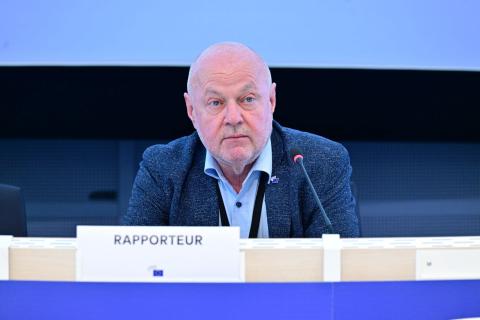
The European Economic and Social Committee (EESC) has adopted an opinion arguing that putting the New European Bauhaus into practice can help tackle the housing crisis, as long as it moves from inspiring pilot projects to systemic, scalable and place-based delivery.
At a time when the EU is facing a housing crisis compounded by rising energy costs and a number of social fractures in terms of income, age and origin, it is important to set out practical solutions. Adopted at the June plenary session, the EESC opinion on Implementing the New European Bauhaus by Rudolf Kolbe voices the concerns and expectations of organised civil society across Europe.
The New European Bauhaus represents a key cultural shift that can act as a bridge between the European Green Deal and our daily living spaces. By weaving together sustainability, inclusivity and aesthetics, this initiative proves that the green transition does not have to be purely technical or place limits on our lives, but can actively improve our well-being and visual environments.
‘The New European Bauhaus is one of the EU’s most ambitious recent initiatives. And let me be clear: this is not a building programme nor a design trend. It connects the European Green Deal with people’s everyday lives through three values: sustainability, inclusion and aesthetics,’ said Mr Kolbe. ‘My conclusion is simple: the time to act is now. And civil society must be fully part of it, so that the New European Bauhaus becomes everyday practice, everywhere.’
Focussing on people’s everyday lives
In the opinion, the EESC sets out some key recommendations to successfully apply the concepts of the New European Bauhaus. To tackle the housing crisis, it is essential to upgrade isolated pilot projects to widespread and adaptable solutions which are specific to the different territories.
1) Developing key performance indicators (KPIs)
First, the EESC recognises that the New European Bauhaus has an added value in translating policy objectives into tangible, people-centred solutions, while fostering green innovation and enhancing competitiveness. For this reason, it is important to measure the extent to which its values and principles are reflected in new and revised EU policies and regulatory acts. This objective can be reached by developing key performance indicators (KPIs) assessing horizontal cross-cutting implementation.
2) Revision of the Public Procurement Directives
Second, in the upcoming revision of the Public Procurement Directives, public authorities must give priority to life-cycle and quality criteria for services shaping the built environment, enabling innovation and circularity.
3) Sustainable, affordable and quality housing policies
Third, the New European Bauhaus and affordable housing policies are inseparable. One without the other simply does not work. The next implementation step of the New European Bauhaus must therefore focus on investment in sustainable, affordable and quality housing, using the Energy Performance of Buildings Directive (EPBD) and the renovation wave as key levers.
4) Accessible funding
Fourth, funding must reach those who need it most. It must be accessible to small municipalities and civil society groups who may lack experience and resources. This means simplified guidelines, lower administrative barriers and hands-on support from local experts, including planning professionals, social organisations and New European Bauhaus national contact points.
5) Wide and diverse participation
Finally, participation must cover society in its full diversity, without digital exclusion, and must be supported by skills, education and better impact evidence. This is why the Commission should implement KPIs for relevant New European Bauhaus participatory tools and processes, and reconsider its increasing use of digital tools, as this can lead to age discrimination and discrimination against other groups.
The Commission should also put more emphasis on making the New European Bauhaus accessible and understandable to civil society groups who have not yet been reached and who are not engaged. To this end, the EU should develop more targeted communication tools using diversity-sensitive approaches, arts and culture, and cooperation with civil society organisations, and put a stronger focus on cultural heritage, which should be seen as a resource, not an obstacle.
Background – The New European Bauhaus
In December 2025, the European Commission presented its plans for the future of the New European Bauhaus. The communication on the New European Bauhaus: From vision to implementation and its accompanying Proposal for a Council Recommendation were adopted as part of the European Housing Package. They set out the key measures to strengthen the initiative and its impact, with an end goal to lead the clean transition and innovation in Europe and all over the world.
In 2022, the EESC adopted an opinion on the New European Bauhaus, where it welcomed the European Commission’s efforts to introduce the concept of a New European Bauhaus with the aim of creating beautiful, sustainable and inclusive places and ways of living that are accessible and affordable for all, in particular in response to the climate crisis.
Work organisation
Recommended for you
EESC PLENARY: EESC calls for a European Affordable Housing Plan
Article
<< Back to NewsletterAt its plenary session on 18 September, the European Economic and Social Committee (EESC) hosted a debate with Commissioner for Energy and Housing, Dan Jørgensen, and…
Implementing the New European Bauhaus
News
BackgroundIn December 2025, the European Commission presented its plans for the future of the New European Bauhaus (NEB). The Communication New European Bauhaus: From vision to…
#HousingCrisis – EESC calls for a European Affordable Housing Plan
News
At its September plenary, the European Economic and Social Committee (EESC) hosted a debate with Commissioner for Energy and Housing Dan Jørgensen, and called on the European Commission to take…
Social housing in the EU - decent, sustainable and affordable
News
BackgroundAccess to affordable, decent, sustainable, inclusive and resilient housing is both a social need and a social right: it is one of the 20 essential principles of the EU Pillar of Social…
New European Bauhaus
Opinion
Key pointsThe EESC welcomes the adoption by the European Commission of the communication introducing the concept of a New European Bauhaus (NEB) with the aim of creating beautiful, sustainable, and…