Fundamental Rights and the Rule of Law

This page is also available in:

The EU is not only a common market; it is a union of common values that shape the European identity. These values are set out in the Treaty on the European Union and also include the rights, freedoms and principles laid out in the Charter of Fundamental Rights: the "indivisible, universal values of human dignity, freedom, equality and solidarity; [the Union] is based on the principles of democracy and the rule of law. It places the individual at the heart of its activities, by establishing the citizenship of the Union and by creating an area of freedom, security and justice."

The Charter brings together into a single text all the personal, civic, political, economic and social rights enjoyed by people within the EU and apply to the EU institutions and Member States when they implement EU law.

The EESC is very active in the promotion of fundamental rights, the rule of law and democracy, and especially in the fight against discrimination based on race, ethnic origin, disability or gender. In 2018, it established the Group on Fundamental Rights and the Rule of Law to further expand analysis of the situation across Europe and promote a constructive dialogue amongst all stakeholders.
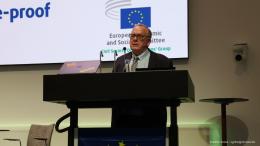
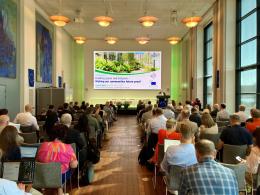
  • Conference of the EESC Civil Society Organisations' Group in the framework of the Danish Presidency of the Council of the European Union, Copenhagen, Danish Society of Engineers (IDA), 2 July 2025

  • Reimagining the design of cities, communities and housing is essential to face the current challenges. Civil society organisations have a key role to play in steering this transformation. Sustainability and the right to housing must be at the heart of future strategies. The EU could contribute to this by increasing European funding for affordable housing and supporting the social economy.

  • Published in
    22 pages

    Report on the country visit to Italy – 16-17 October 2024 and Authorities’ observations on the report
    The report relays the views of Italian civil society on freedom of association, freedom of assembly, the rule of law. This report has been communicated to the Italian authorities, which in turn submitted their reply.

  • On 23-24 June 2025, the Fundamental Rights and Rule of Law (FRRL) Group of the European Economic and Social Committee (EESC) concluded a two-day visit to Budapest.

  • Building green and inclusive

    In this issue:

    • Members on the future of housing and public spaces in the EU
    • Guest articles by Laura KLITGAARD (The Danish Society of Engineers - IDA), Signe HELLEDI (Cycle Superhighways), Nils Thor ROSTED (Amager Resource Centre), and Gustavo GHIDINI (Movimento Consumatori)
    • Interview with rapporteur Elena-Alexandra CALISTRU on Measures for a resilient, cohesive and inclusive European economy (EESC opinion ECO/661)
    • Civil Society Organisations' Bulletin - June 2025
  • Fotoudstilling
    -

    På initiativ af EØSU's Gruppe for civilsamfundsorganisationer præsenterede denne udstilling projekter, der er blevet koordineret af det danske arkitektfirma BIG-Bjarke Ingels Group.

  • The President of the European Economic and Social Committee (EESC) and its Group on Fundamental Rights and the Rule of Law express deep concern over the recently introduced Hungarian draft law titled “On Transparency in the Public Sphere.” It is our understanding that this bill poses a significant threat to the operations of civil society organisations and independent media in Hungary.

  • Statement by
    Oliver Röpke, President of the European Economic and Social Committee
    Organisation
    European Economic and Social Committee

    The President of the European Economic and Social Committee (EESC) and its Group on Fundamental Rights and the Rule of Law express deep concern over the recently introduced Hungarian draft law titled “On Transparency in the Public Sphere.” It is our understanding that this bill poses a significant threat to the operations of civil society organisations and independent media in Hungary.

  • The topic of the conference was the mental and physical condition of young Europeans and the role of civil society organisations in supporting it. The event was organised as part of the Polish presidency of the EU Council on the initiative of the Minister for Civil Society, Adriana Porowska, and the Civil Society Organisations' Group of the EESC.

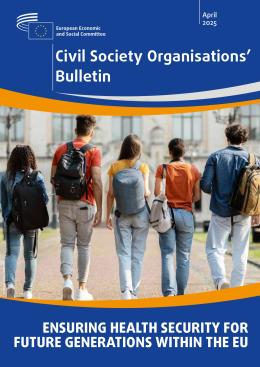
  • Ensuring health security for future generations within the EU

    In this issue:

    • Members on ways to ensure (mental) health security
    • Guest articles by Lejla Šehić Relić (Centre for European Volunteering), Ian Mostert (Dutch Institute for Nature Education) and Christelle Savall (Young European Federalists)
    • Interview with rapporteur Miguel Ángel Cabra de Luna on how to address loneliness (EESC opinion SOC/813)
    • Information on conference 'The role of civil society organisations in ensuring the health security of children and young people within the EU', jointly organised with the Minister for Civil Society of the Republic of Poland on 15 May in Warsaw
    • Comments on the future of cohesion policy, EU-UK relations, Clean Industrial Deal and Omnibus packages, and the results of COP16
    • Civil Society Organisations' Bulletin - April 2025