
European Economic
and Social Committee
EESC President Röpke Champions Global Governance Reform, Multilateralism and Social Justice at G20 Social Summit in Brazil
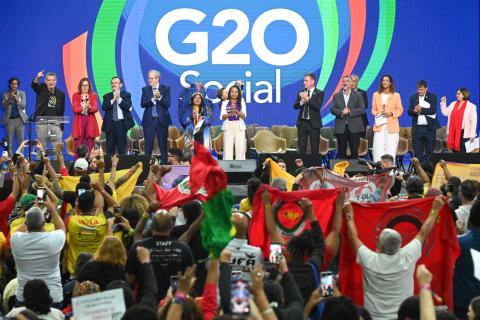
President Oliver Röpke took center stage at the G20 Social Summit in Rio de Janeiro, Brazil, advocating alongside President Luiz Inácio Lula da Silva for urgent reforms in global governance, expanded social protections, and enhanced economic inclusivity. Representing European civil society, President Röpke joined international leaders to address social issues that align with the Brazilian G20 presidency's priorities: combating hunger and inequality, tackling climate change, and advancing just transitions in labor markets.
In his plenary speech, the President stressed the need for a global governance structure that places civil society at the center to address 21st-century challenges. He emphasised that current governance systems, designed in the post-World War II era, are no longer fit to address today's interconnected issues, such as climate action, digital transformation, and rising inequality. Röpke highlighted that Economic and Social Councils are uniquely positioned to bridge governments, employers, and civil society, ensuring global policies reflect the needs of ordinary citizens rather than solely serving elite interests.

President Röpke identified key areas where the G20 could make impactful changes, such as promoting social protection policies that ensure fair wages, establish social safety nets, and invest in sustainable local economies. These efforts, he stated, are essential to addressing poverty and preventing forced migration. Citing Europe’s experience with the European Pillar of Social Rights, he outlined the EU’s successes in workers' rights protections, accessible healthcare, and social inclusion as potential models for G20 countries.
On the topic of global governance reform, President Röpke called for equitable representation in international bodies, particularly highlighting the need to give emerging economies and developing countries a greater voice, and a rethinking of global finance to serve everyone, especially the most vulnerable regions. He also advocated for a just transition to climate neutrality, focusing on green jobs and sustainable practices. He reiterated that a fair and effective global order must be responsive to civil society’s needs and must ensure equal opportunities for all countries to contribute to global decision-making. He outlined the increasing cooperation between the European Economic and Social Committee and the Councils from the African Union and United Nations for a coordinated multilateral approach to these crucial topics.

In a solemn moment of the Closing Session of the G20 Social, along with the most vocal leaders of civil society and trade unions, President Röpke shared the stage with Brazilian President Luiz Inácio Lula da Silva and eight ministers of his government, to hand them a Declaration approved by the forum. President Lula then passed it on to the Ambassador of the South African Republic the country taking over the G20 presidency for the next mandate.
President Röpke held multiple exchanges at the Summit. During his bilateral meeting with Brazilian Minister Alexandre Padilha he discussed how to strengthen cooperation between EU and Brazilian civil societies, prepare the upcoming EU-Brazil Roundtable next year. He also met with Márcio Macedo, current Chief Minister of the General Secretariat of the Presidency of the Republic and Wellington Dias, Minister of Social Development and Assistance, Family and Hunger Combat.
He also met with representatives of international organisations and Trade Unions such as President Miguel Torres, and Ortélio Palácio from Força Sindical, Lourenco Ferreira do Prado from UGT and Antonio Lisboa from CUT-Brazil. Topics discussed included the fight against inequalities and poverty, informal labour and progress in ensuring better protection for workers across regions, and the challenges of the transforming labour markets.

Moreover, the President conducted interviews with Voice of America journalists Aline Barros and Yan Boechat and with Brazilian journalist Jamil Chade. These discussions centered on migration policies, global governance reform, and social justice. Röpke conveyed the EESC’s commitment to addressing the social dimensions of migration, ensuring humane treatment and support for migrants, and championing policies that address inequality at a systemic level. He reiterated the critical role of social dialogue and fair labor standards as part of a global approach to migration and economic justice.
The G20 Social Summit concluded with a strong commitment to equity, inclusion, and participatory governance. President Röpke’s contributions underscored the EESC’s vision for democratic, fair, and effective global policies, further reinforcing Europe’s commitment to a sustainable, just, and people-centered world order. He joined the voices of the civil society gathered at the Summit, calling for the next G20 Presidencies to build up on the achievements of this landmark event.


Recommended for you
YEYS! 2023: De unge ønsker et mere gennemsigtigt, digitalt og forenklet EU
News
Den 23.-24. marts var Det Europæiske Økonomiske og Sociale Udvalg (EØSU) vært for den 14. udgave af arrangement Dit Europa, din mening! (YEYS!), hvor 105 elever fra 35 skoler fra alle 27 EU…
EØSU åbner for ansøgninger til civilsamfundsprisen, som i år har fokus på mental sundhed
News
Civilsamfundsorganisationer, enkeltpersoner og private virksomheder kan nu indstille deres nonprofitprojekter til EØSU's pris til støtte for europæernes mentale trivsel Det Europæiske Økonomiske og…
Gør brug af din stemme i juni 2024: EØSU opfordrer europæerne til at stemme for et forenet og demokratisk Europa
News
Det går tilbage for demokratiet i store dele af verden, misinformationen florerer, og der er stadig større utilfredshed på grund af stigende inflation og truslen om krig, som lurer i baggrunden. Der…
Kunstig intelligens kan fremme behandlingen af sjældne sygdomme
News
På en konference afholdt i Danmark af Det Europæiske Økonomiske og Sociale Udvalg (EØSU) fremhævedes den afgørende rolle, som kunstig intelligens kan spille i udviklingen af nye fremtidsorienterede…
Det danske rådsformandskab vil arbejde for "et stærkt Europa i en verden i forandring"
News
I juli var Det Europæiske Økonomiske og Sociale Udvalgs (EØSU) plenarforsamling vært for en debat om de politiske prioriteter for det nuværende formandskab for Rådet for Den Europæiske Union. De…