As in previous years, the European Economic and Social Committee (EESC) will actively participate in COP17 to the UN Convention on Biological Diversity (CBD), which will take place from 19 to 30 October 2026 in Yerevan, Armenia.
The European Economic and Social Committee (EESC) invites you to attend our public hearing on how using artificial intelligence and digitalisation in tax administration can strengthen legal clarity, cross-border comparability, economic development and tax certainty.
The public hearing will focus on the capacity to reduce fragmentation and compliance burdens, while facilitating compliance and collection across Member States. The hearing will bring together policymakers, stakeholders and experts from across countries and organisations to discuss on digitizing the EU tax system.
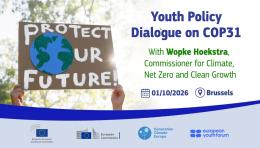
The European Commission and the European Economic and Social Committee, in cooperation with the European Youth Forum and Generation Climate Europe, will organise the Youth Policy Dialogue on COP31. The event will take place on Thursday 1 October 2026.
The agenda and all information regarding this plenary session will be available 8 days prior to the event. You will be able to follow the debates by web streaming. Web streaming
Actively engaging farmers, fishers, and forest owners' organisations in the CBD negotiations
Location
Online
Belgium
This partnership event hosted by the EESC together with the European Bureau for Conservation and Development aims to explore how farmers, fishers, and forest owners’ organisations (at the EU and international level) can better coordinate, strengthen their engagement, and contribute more effectively to the CBD process ahead of COP17.
Room VMA 22, EESC building, rue Van Maerlant 2, 1040 Brussels and Interactio
Brussels
Belgium
This event will feature insights from EU institutions and highlight recommendations from persons with lived experience, civil society and disability organisations. #EndForcedSterilisation #DisabilityRights
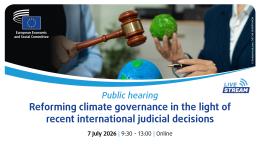
The EESC is organising a public hearing to feed into a timely own-initiative opinion which will examine civil society proposals on how to reform climate governance, including decision-making processes, negotiation frameworks, and the participation and impact of civil society organisations at global climate summits. It will also assess how international climate litigation is shaping climate negotiations and may further influence the governance of the UNFCCC, particularly in light of the International Court of Justice’s advisory opinion of 23 July 2025.