Fundamental Rights and the Rule of Law

This page is also available in:

The EU is not only a common market; it is a union of common values that shape the European identity. These values are set out in the Treaty on the European Union and also include the rights, freedoms and principles laid out in the Charter of Fundamental Rights: the "indivisible, universal values of human dignity, freedom, equality and solidarity; [the Union] is based on the principles of democracy and the rule of law. It places the individual at the heart of its activities, by establishing the citizenship of the Union and by creating an area of freedom, security and justice."

The Charter brings together into a single text all the personal, civic, political, economic and social rights enjoyed by people within the EU and apply to the EU institutions and Member States when they implement EU law.

The EESC is very active in the promotion of fundamental rights, the rule of law and democracy, and especially in the fight against discrimination based on race, ethnic origin, disability or gender. In 2018, it established the Group on Fundamental Rights and the Rule of Law to further expand analysis of the situation across Europe and promote a constructive dialogue amongst all stakeholders.


  • Published in
    8 pages

    This resolution presents recommendations of the European Economic and Social Committee to the legislature 2024-2029. They are based on discussions with social partners and civil society organizations from all walks of life, including young people during the first EESC Civil Society Week, and contain a comprehensive set of actionable steps to strengthen and safeguard democratic principles.

  • On 16-17 October 2024, the Fundamental Rights and Rule of Law (FRRL) Group of the European Economic and Social Committee (EESC) concluded a two-day visit to Rome.

    This visit gave the opportunity to the group of six EESC Members to hear civil society representatives about key trends in Italy, concerning fundamental rights of social partners, freedoms of association and assembly, freedom of expression (including media freedom), the right to non-discrimination, and the rule of law.  

  • Sprejeta on 30/04/2025 - Bureau decision date: 24/10/2024
    Referenca
    INT/1076-EESC-2025-00003-00-00-AC-TRA
    Employers - GR I
    Austria
    Plenary session number
    596
    -

    The rule of law is one of the common values on which the European Union is founded. European Commission’s rule of law mechanism has so far only examined compliance with the rule of law in the member states in only four areas, but unfortunately not as a prerequisite for economic activity or as a location factor. The own-initiative opinion on the economic dimension of the Rule of Law looks for examples of protectionism and the implementation of discriminatory measures against foreign investors in some member states as non-compliance and circumvention of European regulations leading to enormous distortions of competition for companies operating in the internal market. The economic dimension of the rule of law is not adequately reflected in the European Commission’s Rule of Law Report, which is why the EESC advocates the inclusion of a fifth pillar.

    • Record of proceedings INT/1076
    • Follow-up from the Commission INT/1076
    Download format:
    Download — Mnenje EESO: The economic dimension of the Rule of Law
  • Published in
    51 pages

    This report provides an overview of the visits organised by the EESC Fundamental Rights and Rule of Law (FRRL) group during its first cycle of country visits to the 27 EU Member States (2018-2024).

  • Protecting the most vulnerable in European societies 

    In this issue:

    • Our members reflect on ways for protecting the most vulnerable in European societies;
    • Guest articles by Carlos SUSÍAS RODADO (European Anti Poverty Network), Sirpa RAUTIO (European Union Agency for Fundamental Rights), Rocío URÍAS MARTÍNEZ (European Federation of National Organisations Working with the Homeless) and Rainer HUB (National Network for Civil Society in Germany);
    • Report on our recent conference on intergenerational solidarity in the EU;
    • Interview with rapporteur Pietro Vittorio BARBIERI on the new EESC opinion on 'Caregivers'.
    • Civil Society Organisations' Bulletin - October 2024
  • Published in
    Study
    53 pages

    This study explores effective practices for youth participation in policy and decision-making processes, providing a comprehensive overview of what youth participation means and its key characteristics

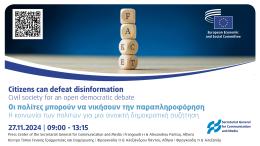
  • Civil society for an open democratic debate
    Event type
    Conference

    This conference in Athens is the third event on disinformation being hosted by the European Economic and Social Committee (EESC) as part of its ongoing project aiming to fight disinformation with the help of civil society.

  • Event type
    Conference
  • Just a few days after the nomination of a new European Commissioner for Democracy, Justice, and the Rule of Law, the European Economic and Social Committee (EESC) has issued a strong call for a renewed commitment to the rule of law and fundamental rights within the EU. At its September plenary session, the EESC took stock of the current situation and debated ideas for a stronger EU response, including European Commission President von der Leyen's recent announcement of a long-anticipated civil society platform. 

  • The Presidency of the EESC's Fundamental Rights and Rule of Law Group (FRRL) is deeply concerned about the imminent risk of extradition from Serbia to Belarus of journalist Andrey Gnyot (Андрей Гнёт).