The United Nations' Sustainable Development Goals must continue to serve as the compass for Europe's future well beyond 2030. Civil society organisations and policymakers must prepare for the end of the decade, when the SDGs should be strengthened. The energy transition and the circular economy agenda must play a central role in this process.
On 30 June 2026, the Civil Society Organisations՚ Group will host a high-level conference in Cork. Registration for in-person participation is now closed. We invite you to follow via live streaming. Prior registration for the streaming is not required.
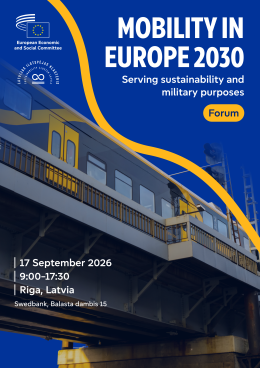
The TEN section, in cooperation with the Latvian Sustainability Cluster, is organising a forum on Mobility in Europe 2030 – serving sustainability and military purposes on 17 September 2026 in Riga, Latvia. The forum will deliver recommendations, identify investment and regulatory priorities, and clarify implementation pathways. The outcome of the forum will feed into the EESC’s policy work at EU level and provide practical guidance for Member States in advancing climate-neutral, resilient and competitive mobility systems, including strengthened military mobility, in response to evolving geopolitical challenges.
The EU needs a long-term vision that takes greater account of geographic specificities. Sustainable water management and food security must become top priorities, with food security and biodiversity going hand in hand.
The Italian Alliance for Sustainable Development (ASviS) organised this event in collaboration with the EESC Civil Society Organisations’ Group and with the support also of SDG Watch Europe.
The European Anti-Poverty Network unveils the 2025 EU Poverty Watch at the EESC, highlighting the role of national and local strategies in the fight against poverty.