The thematic debate of the Group will see the participation of Marina Elvira Calderone, Minister for Labour and Social Policies of Italy, Marie Toussaint, MEP and Vice-Chair of the European Parliament's Intergroup on "Fighting against poverty", and several representatives of civil society organisations.
Energy poverty exacerbates gender gap worldwide. It is estimated that 70% of 1.3 billion population in developing countries living in poverty are women. Research has shown that women are more likely to fall into energy poverty as they are the main users and producers of household energy, due to economic, biological/physiological and socio-cultural factors. For instance, older women are the most likely to suffer from energy poverty due to a higher life expectancy and lower pensions compared to men. Women are also more likely to be responsible for householding and cooking activities requiring energy sources.
The EESC is organising a hybrid conference entitled "Towards an EU framework against homelessness based on the principle of 'Housing First'" on 7 October 2022 (9h30 to 13h00).
The aim of the conference will be to reflect on how the EU, national, regional and local authorities, as well as organised civil society, can join forces to identify practical steps to be taken to eradicate homelessness in the EU.
challenges from an economic and social perspective
Location
Rue Belliard 99, 1040
Brussels
Belgium
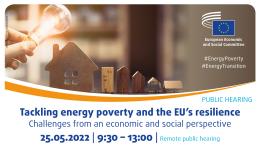
As part of its work to prepare an opinion on "Tackling energy poverty and the EU's resilience: challenges from an economic and social perspective'', the European Economic and Social Committee (EESC) is organising a remote public hearing on 25 May 2022 from 9:30 am to 1 pm.
The discussion will focus on how European organised civil society, together with the EU, national, regional and local authorities, can join forces to fight against energy poverty.
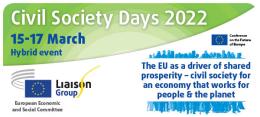
The EU as a driver of shared prosperity – civil society for an economy that works for people & the planet
-
Location
HYBRID EVENT • EESC
Brussels
Belgium
While Europe and its societies are still in the grip of the COVID-19 pandemic and with the Conference on the Future of Europe in its closing stages, the EESC will be holding its annual Civil Society Days in March 2022.
This study analyses European Union (EU) policy through the lens of intergenerational poverty (IGP), shifting attention from poverty as a static condition to the long-term persistence and transmission of disadvantage across generations.
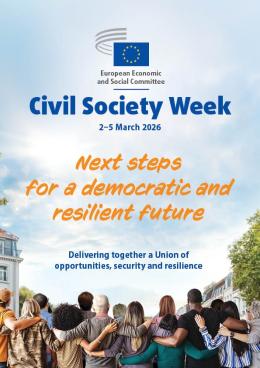
Europe is facing a pivotal moment. Social and economic inequalities, rapid technological change, anti-democratic forces and geopolitical instability are straining the foundations of the European project.
With democracy and civic space under mounting pressure, civil society organisations, human rights defenders and free media face growing constraints - from restrictive laws and disinformation campaigns to underfunding and public distrust. Deepening polarisation and eroding trust in institutions further undermine Europe’s democratic model.
This study examines how social partners and civil society organisations in six Member States — Italy, Austria, Hungary, Poland, Portugal and Sweden — view the effectiveness of current policies in raising employment levels and increasing adult participation in training. It also puts forward recommendations for improving policy outcomes.