
European Economic
and Social Committee
Danish Council presidency will work for ‘a strong Europe in a changing world’
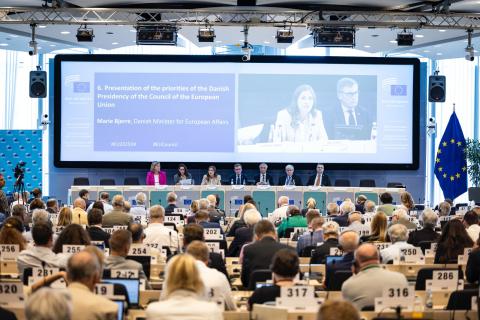
The July plenary session of the European Economic and Social Committee (EESC) hosted a debate on the political priorities of the current Presidency of the Council of the European Union. Main objectives: the EU must take responsibility for its own security and strengthen its competitiveness.
Security and competitiveness will be the two main priorities of the Danish Presidency of the Council of the European Union, which started on 1 July and will come to an end on 31 December 2025.
Europe is currently undergoing significant change, with uncertainty, global competition and increased conflict in a number of areas. ‘We need a strong, competitive and green Europe. A Europe that is able to take responsibility for its own security. And a Europe that is able to innovate and compete at global level. Supporting Ukraine and moving forward on enlargement will be key’, said Marie Bjerre, Denmark’s Minister of European Affairs, speaking at the EESC plenary session on 16 July.
For his part, EESC President Oliver Röpke stressed that ‘The Danish presidency arrives at a defining moment for Europe. Its priorities on security, competitiveness and the green transition closely align with the EESC’s core concerns. We stand ready to provide practical expertise and reflect the voices of Europe’s organised civil society in support of a resilient, values-based Europe that is connected to its people.’
Mr Röpke said that the Committee was currently preparing 11 exploratory opinions at the Council presidency’s request, including one on green skills and vocational institutions. Ms Bjerre thanked the Committee for its support and added that the objective of the Danish Council presidency was to lead with responsibility, act in unity and deliver tangible results for the Union.
The Danish Council presidency agenda
Under the motto ‘A strong Europe in a changing world’, the Danish Council presidency will work for a secure, competitive and green EU:
1) A secure EU
The European Union needs to take more ownership of its own and the Euro‑Atlantic security, and to work closely with NATO and its allies. The EU must therefore develop the capability to defend itself by 2030 at the latest and strengthen its defence industry and production.
With regard to Russia’s war of aggression against Ukraine, continuous support to Ukraine remains a top priority. Simultaneously, the EU’s merit‑based enlargement is a geopolitical necessity and, for Ukraine, the prospect of EU membership is existential. Enlargement also refers to upholding and defending shared European democratic values, such as the rule of law, which face growing pressure worldwide as authoritarian forces gain ground.
2) A competitive and green EU
The second priority will be a competitive and green Europe. In a world of sharpened global rivalry, it is important to boost the EU’s competitiveness through collective action and this goes hand in hand with the green transition.
Mario Draghi’s report on the EU’s competitiveness identified a number of weaknesses which require immediate and urgent action, such as simplifying rules and significantly reducing burdens for businesses, citizens and public authorities.
To ensure the EU’s long-term competitiveness, the green transition must continue to be ambitious. In this respect, the EU must continue to lead on environmental and climate action, including through an ambitious 2040 target set before COP30.
The Union must also be independent of Russian energy and the energy infrastructure must be expanded to ensure that cheap green energy can move across borders. Lastly, regarding the budget, the Council presidency intends to set an ambitious and fiscally responsible course for the negotiations on the EU’s Multiannual Financial Framework.
The position of EU organised civil society
During the debate, on behalf of the EESC’s Employers’ Group, Sandra Parthie, President of the EESC’s Section for the Single Market, Production and Consumption (INT), said: ‘Today, Europe doesn’t need another agenda. It needs action. And your presidency comes at a defining moment. The 20 million companies we represent are not asking for favours - they are asking for conditions that allow them to compete. Denmark can help deliver three essentials: 1. From simplification to a culture of better lawmaking; 2. Stop the innovation drain; 3. Make green a business case.’
Referring to the situation of workers and their working conditions, Dorthe Andersen, Vice-President of the EESC’s Workers’ Group, said that ‘We must care about fair competition, good working conditions and equal treatment of migrant workers. In Denmark, we have a good labour market model. The Danish presidency could help blow life into European social dialogue.’
Séamus Boland, President of the EESC’s Civil Society Organisations’ Group, felt that the Danish Council presidency resonated deeply with the concerns and aspirations of organised civil society: ‘You have set out a programme that recognises the complexity of the challenges Europe faces and you have done so with a spirit of openness and dialogue that we greatly appreciate. We also welcome your recognition of the vital role that citizens and civil society play in shaping Europe’s future. You can count on our commitment to work with you for a Europe that is more sustainable, more just and closer to its citizens.’
Work organisation
Downloads
-
Danish Council presidency will work for ‘a strong Europe in a changing world’
Recommended for you
Skrajni čas za vlaganje v mlade na Zahodnem Balkanu
News
Da bi vlade držav Zahodnega Balkana svojim državljanom zagotovile boljšo prihodnost, se morajo lotiti reševanja težav, s katerimi se srečujejo mladi, ki imajo ključno vlogo pri njenem ustvarjanju.…
Vaša Evropa, vaš glas! v letu 2023: Mladi si želijo, da bi bila EU preglednejša, bolj digitalna in enostavnejša
News
Evropski ekonomsko-socialni odbor (EESO) je 23. in 24. marca gostil dogodek Vaša Evropa, vaš glas! Potekal je v Bruslju, udeležilo pa se ga je 105 dijakov 35 šol iz vseh 27 držav članic EU in sedem…
Začetek zbiranja prijav za nagrade za civilno družbo EESO na temo duševnega zdravja
News
Organizacije civilne družbe, posamezniki in zasebna podjetja lahko svoje nepridobitne projekte prijavijo za nagrado EESO, namenjeno spodbujanju duševnega zdravja Evropejcev Evropski ekonomsko…
Oddajte svoj glas junija 2024: EESO poziva Evropejce, naj volijo za enotno in demokratično Evropo
News
Demokracija po vsem svetu nazaduje, širijo se dezinformacije in vse več je nezadovoljstva zaradi naraščajoče inflacije ter preteče nevarnosti vojne, zato so letošnje evropske volitve, na katerih bodo…
Ohranjanje zagona širitve EU: prizadevanje civilne družbe, da bi s postopnim vključevanjem prinesla koristi Zahodnemu Balkanu
News
Evropski ekonomsko-socialni odbor (EESO) je 20 let po pristopu Slovenije k EU v Ljubljani zbral politične voditelje in voditelje civilne družbe, da bi obeležili to simbolično obletnico in poudarili…