
European Economic
and Social Committee
Sustainable development network warns about risk of a "lost decade for the 2030 Agenda"
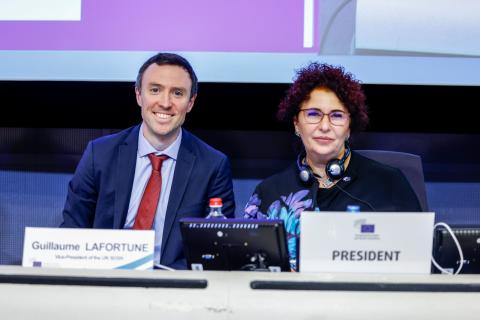
On Tuesday 24 January, the European Economic and Social Committee (EESC) held an exchange of views with Guillaume Lafortune, Vice-President of the UN Sustainable Development Solutions Network (UN SDSN), on the implementation of the UN Sustainable Development Goals (SDGs). The debate revealed that the EU is failing to meet the objectives of the UN's 2030 Agenda. Yet, there is hope. The EU has the opportunity to take the lead, including through financial support. The EESC plays an important role in monitoring progress.
Mr Lafortune presented the 2022 Europe Sustainable Development Report, written with the support and collaboration of the EESC. Whereas the agreement on the Sustainable Development Goals by the global community marked a historical moment, their implementation is currently at risk of not being met. According to Mr Lafortune, the EU is failing to meet the objectives and, worldwide, progress is deteriorating overall. Developing countries in particular, which face severe financing constraints, are lagging behind.
Empowering Europe and accelerating SDG financing
Mr Lafortune called for stepping up EU domestic policies such as due diligence legislation, on the respect of social standards for example, and for more responsible consumption and innovation. However, these measures would need to go hand in hand with international cooperation. The report recommends that the EU advocate within the United Nations system for a global plan to scale-up international finance for the SDGs.
In her opening remarks, EESC President Christa Schweng, echoed this idea by saying Without the EU's leadership, achieving global transformations won't be easy. Now, more than ever, we need to invest in sustainable development goals and lead international efforts to accelerate SDG implementation.
The EESC role in the EU's First Voluntary Review
Mr Lafortune thanked the EESC for the partnership in drafting the Sustainable Development Report. Civil society has an important role in speaking truth to power
and in providing solutions.
The EESC will also contribute to the reporting on the SDGs by the European Commission. To properly assess and present the progress made in the implementation of the 2030 Sustainable Development Agenda, the European Commission will conduct for the first time in July 2023 a so-called Voluntary Review, in the framework of the UN High-Level Political Forum. In this context, the Commission has requested the EESC's support in gathering stakeholders' perspectives.
President of the EESC Agriculture, Rural Development and Environment Section (NAT), Peter Schmidt, emphasised that With the EESC's contribution to the first EU Voluntary Review on the SDGs, we stress that meaningful involvement of civil society is a key element to boosting SDG progress. The transformation to sustainability will only be successful if it is based on broad support, a just transition and active participation by all parts of society.
Background:
The 2022 Europe Sustainable Development Report assesses progress on the Sustainable Development Goals in the EU and its partner countries, and offers practical recommendations for enhancing the EU's leadership in achieving these goals.
The European Economic and Social Committee recommends a transversal approach to Sustainable Development Goals (SDGs), considering the interrelated nature of the SDGs and their respective targets, and proposes the launch of a new platform to foster structured civil society engagement on SDG-related policy.
Further quotes:
Guillaume Lafortune, Vice-President of the UN Sustainable Development Solutions Network: By living up to the ambitions of the European Green Deal at home and strengthening access to international SDG financing, the EU can achieve its strategic objectives and rally other countries to its values centred around human dignity, freedom, and the rule of law. The EU needs to push for this agenda within the UN system to make sure we won't look back to the SDGs as a failure in the future.
Arnaud Schwartz, EESC Member and President of the Sustainable Development Observatory: The EU needs to accelerate progress. We need an overarching EU strategy on the SDGs, going beyond sectoral approaches and encompassing all dimensions of sustainability.
Maurizio Reale, Member of the EESC Employers' Group: The transformation towards more sustainable development models is already happening, but to achieve the SDGs, the EU and our governments need to do more to encourage initiatives within a clear framework, and empower civil society.
Work organisation
Downloads
-
United Nations representative warns about risk of a "lost decade for sustainable development"
Recommended for you
Skrajni čas za vlaganje v mlade na Zahodnem Balkanu
News
Da bi vlade držav Zahodnega Balkana svojim državljanom zagotovile boljšo prihodnost, se morajo lotiti reševanja težav, s katerimi se srečujejo mladi, ki imajo ključno vlogo pri njenem ustvarjanju.…
Vaša Evropa, vaš glas! v letu 2023: Mladi si želijo, da bi bila EU preglednejša, bolj digitalna in enostavnejša
News
Evropski ekonomsko-socialni odbor (EESO) je 23. in 24. marca gostil dogodek Vaša Evropa, vaš glas! Potekal je v Bruslju, udeležilo pa se ga je 105 dijakov 35 šol iz vseh 27 držav članic EU in sedem…
Začetek zbiranja prijav za nagrade za civilno družbo EESO na temo duševnega zdravja
News
Organizacije civilne družbe, posamezniki in zasebna podjetja lahko svoje nepridobitne projekte prijavijo za nagrado EESO, namenjeno spodbujanju duševnega zdravja Evropejcev Evropski ekonomsko…
Oddajte svoj glas junija 2024: EESO poziva Evropejce, naj volijo za enotno in demokratično Evropo
News
Demokracija po vsem svetu nazaduje, širijo se dezinformacije in vse več je nezadovoljstva zaradi naraščajoče inflacije ter preteče nevarnosti vojne, zato so letošnje evropske volitve, na katerih bodo…
Ohranjanje zagona širitve EU: prizadevanje civilne družbe, da bi s postopnim vključevanjem prinesla koristi Zahodnemu Balkanu
News
Evropski ekonomsko-socialni odbor (EESO) je 20 let po pristopu Slovenije k EU v Ljubljani zbral politične voditelje in voditelje civilne družbe, da bi obeležili to simbolično obletnico in poudarili…