At the European Economic and Social Committee plenary session on Wednesday, EESC members discussed the EU's response to geopolitical challenges with Roberta Metsola, President of the European Parliament. The presidents of both institutions agreed that competitiveness, together with more strategic autonomy, is crucial in the current challenging times.
Lifelong learning will ensure jobs and decent living standards. However, in the absence of a standardised system across the EU, not all workers have opportunities to reskill and upskill during their careers, an EESC study finds
Trillions of euros are needed for Europe's economic recovery. EU proposals for accessible investment data and long-term funding must be more flexible and promote a transparent level playing field, to include more investors and businesses in capital markets.
To celebrate Bulgaria's accession to the euro zone, the ECO section organises a public debate to discuss Bulgaria's road to the euro, its prospects as part of the common currency area, and the outlook for the euro area in a world of geopolitical challenges, inflationary pressures and economic uncertainties.
Public debate in the ECO Section on the Latest twists and turns on the road to the next Multiannual Financial Framework in the framework of the opinion ECO/682 Multiannual financial framework 2028-2034.
Public debate on Defence-related investments in the EU budget in the context of the new geopolitical order, to contribute to the final report of the EESC´s ad hoc group on the new geopolitical order, and in the framework of the opinion ECO/679 - Defence-related investments in the EU budget.
Lessons learned and a new Inflation Governance Framework
Event type
Conference
Location
room VMA 22, Van Maerlant 2
Brussels
Belgium
On Wednesday, 3 September 2025, from 14:00 – 17:30 (CET), the European Economic and Social Committee (EESC) will host an event organised by the Foundation for European Progressive Studies, in cooperation with Fondazione Pietro Nenni and tasc, discussing lessons learned from the recent inflation episode and the new inflation governance framework that needs to be developed to prevent or mitigate the supply side inflation shocks in the future.
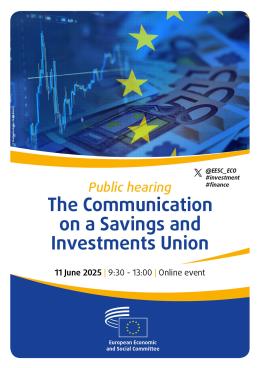
The EESC organises a public hearing on the Communication on a Savings and Investments Union. It will gather together institutions, industry and civil society stakeholders, and will discuss on how to deliver opportunities for households, businesses and the whole EU economy.
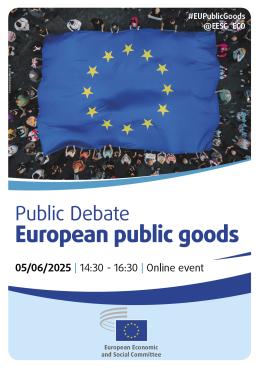
In a context such as the one that Europe is experiencing, characterised by multiple crises, it is appropriate to promote a reflection on European public goods and on fundamental political priorities capable of ensuring the sustainable growth of the EU and the well-being of its citizens. This reflection gets ever more important in view of the upcoming negotiations on the next European Multiannual Financial Framework for the period post 2027.