
European Economic
and Social Committee
Transparency, ethics, and integrity are non-negotiable for EU institutions, stated EESC President Oliver Röpke at the signature ceremony of the Ethics Body
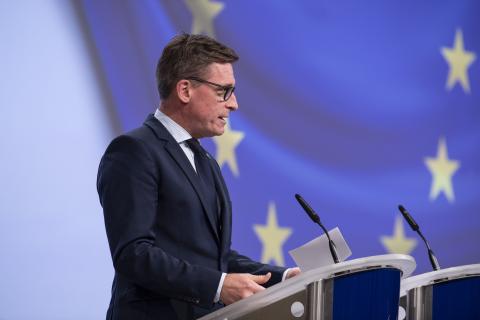
On 15 May, EESC President Oliver Röpke participated in the official signature ceremony for the creation of the new Ethics Body, alongside the representative from seven other EU institutions and bodies, including European Commission Vice-President Věra Jourová, President of the Court of Justice of the EU Koen Lenaerts, President of the European Court of Auditors Tony Murphy, and Vice-President of the Committee of the Regions (CoR) Luca Menesini.
During the ceremony, President Röpke recalled that transparency, ethics, and integr ity are non-negotiable for EU institutions. When taking office in April last year, he committed to boosting the transparency of the EESC’s work, including by supporting the EU Ethics Body. He welcomed the agreement reached by the eight EU institutions and bodies on the creation of the Ethics Body, noting that it represents a first step towards fostering a common culture of integrity and ethics across EU institutions and bodies. Negotiations on behalf of the EESC were led by EESC Vice-President Laurențiu Plosceanu, and the EESC Plenary adopted the agreement on 25 April [press release].
 The new EU body will develop, update, and interpret common minimum standards for ethical conduct, and publish reports on how these standards have been reflected in the internal rules of each participating EU institution and body.
Apart from the EESC, the following seven EU institutions and bodies will be part of the new ethics body: the European Parliament, the Council of the EU, the European Commission, the Court of Justice of the European Union, the European Central Bank, the European Court of Auditors and the European Committee of the Regions.
Recommended for you
Il-KESE jappella għal regolamentazzjoni b’saħħitha u ssemplifikata tal-kriptoassi
News
Il-Kumitat Ekonomiku u Soċjali Ewropew jappoġġja żieda fir-regolamentazzjoni tal-kriptoassi, b’regoli robusti u koerenti biex l-investituri fl-UE jiġu protetti aħjar, f’konformità mal-miżuri attwali…
L-istrumentalizzazzjoni tal-migranti u l-kriżi tar-refuġjati tal-Ukrajna jappellaw għal bidu ġdid għall-politika dwar il-migrazzjoni
News
L-istrumentalizzazzjoni tal-migranti sostnuta mill-Istat, li għandha l-għan li tiddestabbilizza lill-UE, u l-gwerra attwali fl-Ukrajna, li wasslet għal influss bla preċedent ta’ refuġjati, jagħmluha…
“L-Ewropa Tiegħek, Leħnek” 2023: Iż-żgħażagħ jitolbu UE aktar trasparenti, diġitali u semplifikata
News
Fit-23 u l-24 ta’ Marzu, il-Kumitat Ekonomiku u Soċjali Ewropew (KESE) ospita l-14-il avveniment L-Ewropa Tiegħek, Leħnek!, li laqqa’ fi Brussell 105 studenti minn 35 skola mis-27 Stat Membru tal-UE…
Euro-Med – L-organizzazzjonijiet tas-soċjetà ċivili huma essenzjali biex l-ekonomija u s-soċjetà jaħdmu tajjeb
News
Matul is-sessjoni plenarja ta’ Diċembru tal-Kumitat Ekonomiku u Soċjali Ewropew (KESE) sar dibattitu dwar ir-rikostruzzjoni u r-reżiljenza tar-reġjun Ewro‑Mediterranju wara l-pandemija tal-COVID-19.…
Il-KESE jiftaħ l-applikazzjonijiet għall-Premju tiegħu għas-Soċjetà Ċivili li se jkun qed jindirizza s-saħħa mentali
News
L-organizzazzjonijiet tas-soċjetà ċivili, l-individwi u l-kumpaniji privati issa jistgħu jdaħħlu l-proġetti tagħhom mingħajr skop ta’ qligħ għall-premju tal-KESE ddedikat għall-appoġġ tal-benesseri…