
European Economic
and Social Committee
Transparency, ethics, and integrity are non-negotiable for EU institutions, stated EESC President Oliver Röpke at the signature ceremony of the Ethics Body
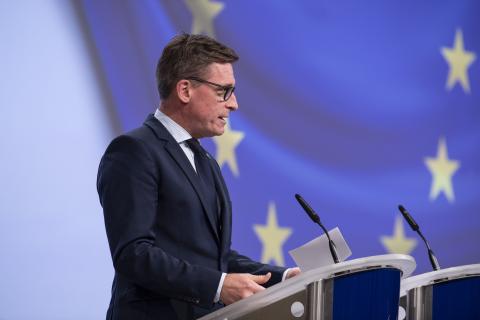
On 15 May, EESC President Oliver Röpke participated in the official signature ceremony for the creation of the new Ethics Body, alongside the representative from seven other EU institutions and bodies, including European Commission Vice-President Věra Jourová, President of the Court of Justice of the EU Koen Lenaerts, President of the European Court of Auditors Tony Murphy, and Vice-President of the Committee of the Regions (CoR) Luca Menesini.
During the ceremony, President Röpke recalled that transparency, ethics, and integr ity are non-negotiable for EU institutions. When taking office in April last year, he committed to boosting the transparency of the EESC’s work, including by supporting the EU Ethics Body. He welcomed the agreement reached by the eight EU institutions and bodies on the creation of the Ethics Body, noting that it represents a first step towards fostering a common culture of integrity and ethics across EU institutions and bodies. Negotiations on behalf of the EESC were led by EESC Vice-President Laurențiu Plosceanu, and the EESC Plenary adopted the agreement on 25 April [press release].
 The new EU body will develop, update, and interpret common minimum standards for ethical conduct, and publish reports on how these standards have been reflected in the internal rules of each participating EU institution and body.
Apart from the EESC, the following seven EU institutions and bodies will be part of the new ethics body: the European Parliament, the Council of the EU, the European Commission, the Court of Justice of the European Union, the European Central Bank, the European Court of Auditors and the European Committee of the Regions.
Recommended for you
La creazione condivisa di servizi pubblici nel settore sanitario contribuirà a una democrazia più partecipativa nell'UE
News
L'evento organizzato dal Comitato economico e sociale europeo (CESE) in collaborazione con l'Università di Debrecen ha posto in evidenza l'importanza cruciale della creazione condivisa di servizi di…
Per combattere i cambiamenti climatici, l'UE ha bisogno di maggiori investimenti pubblici nelle infrastrutture energetiche
News
In un parere adottato nella sessione plenaria di settembre, il Comitato economico e sociale europeo (CESE) avverte che, per realizzare gli obiettivi climatici e di transizione energetica, sono…
Energia - Il CESE mette in guardia di fronte al rischio di nuove dipendenze
News
Il Comitato economico e sociale europeo (CESE) assume una posizione ferma in materia di energia in un parere adottato nella sessione plenaria di settembre. La proposta della Commissione, infatti, è…
La transizione digitale deve essere equa: i diritti umani e il controllo umano devono rimanere pilastri fondamentali
News
Il Comitato economico e sociale europeo (CESE) sottolinea le opportunità offerte dalla rivoluzione digitale, ma mette anche in guardia dai rischi: se attuate troppo rapidamente, le soluzioni digitali…
L'UE ha bisogno di un piano d'azione per fornire alloggi dignitosi e a prezzi accessibili
News
Il convegno ad alto livello organizzato a Riga dal Comitato economico e sociale europeo (CESE) ha lanciato l'allarme per la crisi degli alloggi a prezzi accessibili, sottolineando che è il momento…