
European Economic
and Social Committee
EESC to host Enlargement High-Level Forum at the October plenary
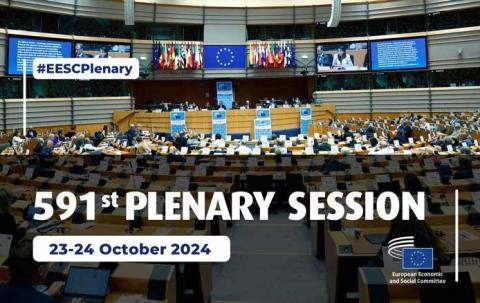
23-24 October 2024
European Commission - Charlemagne building (Alcide De Gasperi room)
Web stream click here
AGENDA
Debates
Wednesday 23 October 2024, 3.00 p.m.
A European flagship initiative for health, with Simona Bellagambi, Vice-President of EURORDIS-Rare Diseases Europe and Maya Matthews, Head of the State of Health, European Semester, Health Technology Assessment Unit, Directorate-General for Health and Food Safety, European Commission
Thursday 24 October 2024
8:30 a.m. -> Press point with Oliver Röpke, President of the European Economic and Social and Committee and Nicolas Schmit, European Commissioner for Jobs and Social Rights
Charlemagne building, 1st floor
9.00 a.m. -> Enlargement High-Level Forum: Towards a Successful EU Enlargement
Opinions in the spotlight
HEALTH
Devising a European flagship initiative for health (SOC/801, rapporteur: Alain Coheur (BE-III))
The EESC sees health as a fundamental public good and recommends a comprehensive and integrated approach in order to strengthen the EU’s health resilience and ensure equal access to healthcare through the single market. Existing mechanisms to overcome health challenges are fragmented and related objectives are not integrated across all EU policies. This opinion calls on the European institutions to turn the flagship initiative and implementation roadmap into a strategic priority in its own right (on par with the Green Deal and the Blue Deal, among others) More
Leaving No One Behind: European Commitment to Tackling Rare Diseases (SOC/806, rapporteur: Ágnes Cser (HU-III))
In Europe, a Rare Disease (RD) is one that affects fewer than five in 10 000 people, with a very rare disease affecting one in 50 000. Responses and initiatives surrounding RD have been developed randomly, meaning there is no integrated assessment system attached to them. This opinion aims to address the remaining shortcomings in the EU's response to RD, including the creation of a European Action Plan on Rare Diseases (APRD), with clear, achievable targets. More
ARTIFICIAL INTELLIGENCE
AI for public services, organisation of work, more equal and inclusive societies (SOC/790, rapporteur: Giulia Barbucci (IT-II))
The digital transition has changed ways of working and the organisation of work itself. Public services are also impacted by this new technology and there are already several cases of public services in the EU using AI. This opinion aims to shed light on the impact of digitalisation and on the introduction of artificial intelligence in public services and assesses how AI and digitalisation can be used as a tool for improving the efficiency of public services and the organisation of public work, while taking into account work changes that could affect workers in public services. More
General-purpose AI: way forward after the AI Act (INT/1055, rapporteur: Sandra Parthie (DE-I))
To be competitive in general-purpose AI (GPAI), Europe must invest in secure connectivity and resilient backbone infrastructure as well as a resilient supply chain to ensure that the effects of generative AI can be harnessed for European actors and aligned with European values and needs. Coordinated European and national investment in innovation is needed to help develop EU value chains and value creation in AI, given that the market is now dominated by large, often non-European digital companies. More
INDUSTRY
From Waste Plants to Resource Plants (CCMI/228, rapporteur: Anastasis Yiapanis (CY-III), Co-rapporteur: Michal Pintér (SK-cat.1))
The EESC is pushing for a new EU strategy focused on recycling and resource recovery over traditional waste disposal methods. The opinion calls for stronger EU oversight, financial support for innovative waste technologies, and public campaigns to boost awareness on waste prevention. Key topics include nutrient recovery from wastewater and training for workers in the waste industry. More
The Clean Transition Dialogues – Stocktaking A strong European industry for a sustainable Europe (CCMI/237, rapporteur: Konstantinos Diamantouros (EL-I), co-rapporteur: John Bryan (IE-cat.3))
While supporting the European Green Deal, the EESC expresses concerns about its impact on EU employment and competitiveness. Announced by von der Leyen in 2023, the Clean Transition Dialogues were created to strengthen the Green Deal’s implementation, with nine dialogues focusing on hydrogen, energy-intensive industries, clean tech, and more. The EESC opinion calls for stronger carbon leakage protection, faster permitting times, and investment in energy infrastructure to ensure a balanced, sustainable transition. More
Industry 5.0 – How to Make It Happen (CCMI/230, rapporteur: Giuseppe Guerini (IT-III), co-rapporteur: Guido Nelissen (BE-cat.2))
The EESC explores Industry 5.0, an innovative approach that prioritises worker wellbeing and sustainability alongside productivity. It complements Industry 4.0 by using new technologies to drive a human-centric and resilient industrial transition, supporting EU priorities like the European Green Deal. This opinion focuses on making Industry 5.0 operational, ensuring a blue and green transition for European industry, and promoting an inclusive approach to digitalisation. Representatives from Turkey contributed to the discussions as part of the EESC's pilot "Enlargement Candidate Members" initiative. More
EXTERNAL RELATIONS
Revision of the EU Visa suspension mechanism (REX/582, rapporteur: Ionuţ Sibian (RO-III))
With increasing challenges resulting from irregular migration and threats to security of the EU, it is clear that a safeguard mechanism against the abuse of the visa exemptions is needed. The EESC supports the idea that the EU should be fully prepared to react swiftly to future security risks and sets out some recommendations for the implementation of the visa exemption mechanism. More
ENERGY
Radioactive waste management: a civil society perspective (TEN/842, rapporteur: Alena Mastantuono (CZ-I), co-rapporteur: Christophe Quarez (FR-II))
The EESC addresses radioactive waste management and says that, in this area, Member States should facilitate inclusive engagement, openness and transparency with civil society, including current host communities and potentially interested host communities. The Committee stresses that available funding should be used to increase the capacity of civil society groups, particularly local communities close to nuclear installations, to participate independently in projects and studies to assess participation and transparency practices in radioactive waste management. More
The potential of geothermal energy for the green transition (TEN/843 - rapporteur: Zsolt Kükedi (HU-III), co-rapporteur: Thomas Kattnig (AT-II))
The EESC points out that geothermal energy in Europe has an untapped potential and urges the Commission to draw up a comprehensive European strategy for geothermal energy aimed to harness its benefits. Geothermal energy production has extremely low greenhouse gas emissions and can play a key role in the EU's green transition, by reducing its dependence on fossil fuels and facilitating its decarbonisation. More
ECONOMY
Enhancing fiscal transparency through participatory budgeting (ECO/643, rapporteur: Elena Calistru (RO-III))
The EESC recommends improving fiscal transparency and participatory budgeting across the EU to enhance democracy and trust in EU fund use. Key proposed measures include a common fiscal framework, digital tools for clearer budget info, and aligning efforts with EU goals like cohesion and sustainability. More
Climate change and its impact on the economy (ECO/645, rapporteur: Juraj Sipko (SK-III))
Climate change poses a major threat to economic and social development, with potential costs reaching EUR 600 billion annually by 2030 without swift action. The EESC stresses the urgency of investing in climate mitigation and adaptation, highlighting both the risks and the economic opportunities tied to sustainable practices and innovation. More
Additional considerations on euro area economic policy 2024 (ECO648, rapporteur: Petru Sorin Dandea (RO-II))
The EESC calls for stronger fiscal coordination in the euro area to enhance stability and resilience, urging the completion of the Capital Markets and Banking Unions. It advocates simplifying regulations to boost competitiveness while maintaining social and environmental standards. Key priorities include advancing decarbonization, improving decision-making, and fostering international cooperation on trade, climate, and public health. More
Additional considerations on the Annual Sustainable Growth Survey 2024 (ECO/649, rapporteur: Elena-Alexandra (RO-III))
The EESC urges the EU to adopt a balanced approach to sustainable competitiveness by promptly implementing initiatives like the Clean Industrial Deal and European Competitiveness Fund. It calls for accelerating the Recovery and Resilience Facility (RRF), with possible deadline extensions and improved support. Emphasizing flexible fiscal policies, the EESC highlights the need for investments in green and digital transitions while addressing labour market challenges through targeted policies. It also stresses strategic autonomy in key sectors, open trade, and the integration of social and environmental protections into economic initiatives, advocating for deeper stakeholder engagement in EU growth strategies. More
For more information, please contact:
EESC Press Unit
E-mail: press@eesc.europa.eu
Tel: + 32 2 546 9793
@EESC_PRESS