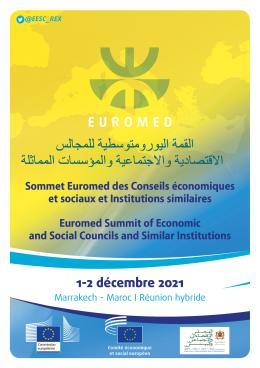
The Euromed Summit has been regrettably postponed to 2022 due to new Covid19 variant & suspension of all international flights to Morocco.
We thank ALL participants/speakers/support teams for their efforts & understanding. New date will be announced once set!
A DAG-to-DAG is a joint civil society body between the partner countries of a Free Trade Agreement (FTA), bringing together the separate DAGs of each party. This is the 2nd joint meeting of the EU and Singapore DAGs under the EU-Singapore FTA.
Extraordinary meeting of the Diversity Europe Group in the framework of the Slovenian Presidency of the Council of the EU
Event type
Meeting
Location
9.30 - 13.00 - Ljubljana & Brussels in hybrid format
The event will take place both in Brussels and in Ljubljana in hybrid form. Registration for external participants will be open on this page until 25 November 2021.
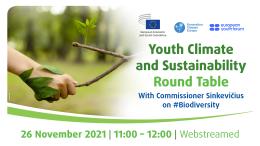
Protecting ecosystems and restoring biodiversity - With Commissioner Sinkevičius
Event type
Round table
Location
11:00 - 12:00 CET - Webstreamed
Brussels
Belgium
Following the success of the first Youth Climate and Sustainability Round Table, the EESC will host the second EU Youth Round Table on Friday 26 November, 11:00-12:00 CET. Virginijus Sinkevičius, Commissioner for the Environment, Oceans and Fisheries, will participate in the event and will engage with the youth representatives on the topic: protecting ecosystems and restoring biodiversity.
10:00 to13:00 | 14:30 to 16:00 - Online event - Rue Belliard, 99
1040 Brussels
Belgium
On 26 November 2021, the EESC's Labour Market Observatory will hold a remote public hearing on A Just Transition for workers of European industries: fostering opportunities for reskilling and upskilling.
The green and digital transition have brought many challenges and opportunities for the EU industry. Investment in skills is essential to support the twin transition and to contribute to a fair recovery. The event will examine, through a discussion with civil society organisations and socio-professional stakeholders, how to ensure a just transition for workers of European industries, taking into consideration the need to strengthen opportunities for reskilling and upskilling. The event includes a webinar taking place in the context of the series of EESC events related to the New Industrial Strategy.
Speakers include representatives of the European Commission, Eurofound, Cedefop and the EESC, as well as the social partners and other civil society organisations.
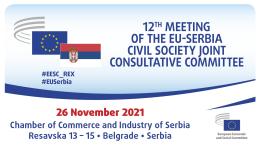
Chamber of Commerce and Industry of Serbia
Resavska 13 – 15
Belgrade
Serbia
It is a platform established within the institutional framework of the EU‑Serbia Stabilisation and Association Agreement (SAA), enabling representatives of both the EU and the Serbian civil society to monitor the country's accession negotiations, discuss issues of common interest and point out concerns to be tackled on the Serbian path towards the European Union.
The EU Domestic Advisory Group (DAG) set up under the EU-UK Trade and Cooperation agreement to advise on the implementation of the agreement, held its constitution meeting Thursday 25 November. It elected its Presidency team with Tanja Buzek (Trade Unions - EESC) as Chair and two Vice-Chairs, Luisa Santos (Employers – BusinessEurope) and Tina Blohm (NGOs - Friedrich-Ebert-Stiftung).
7th joint meeting of the EU Domestic Advisory Group and representatives from the domestic mechanisms of Colombia, Peru and Ecuador and Civil Society Open Session
The EU-Turkey Civil Society Joint Consultative Committee established in 1995 is composed of members from the EESC and members representing organised civil society in Turkey. Its objective is to contribute to the dialogue among civil society organisations in Turkey and the EU and to issue reports and recommendations to the Turkish authorities and the EU institutions. The JCC discusses a wide range of topics, including cooperation between Turkey and the EU in various areas such as migration, energy, small and medium-sized enterprises and vocational training. This meeting will focus on "Disaster management - How can Turkey and the EU work together?" and "The Green Economy" - as well as other topics such as the "modernisation of the EU-Turkey Customs Union".