
European Economic
and Social Committee
EESC stands with Ukraine and confirms its solidarity and support at February plenary
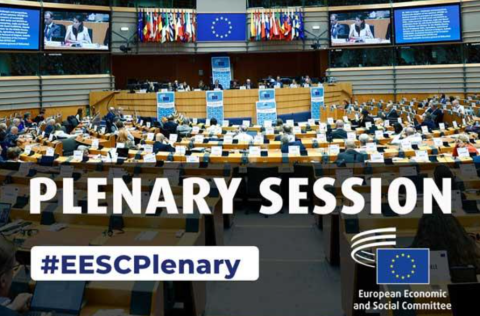
18-19 February 2026
European Commission, Charlemagne building (Alcide De Gasperi room), 1040 Brussels
Web stream click here
Debates
Wednesday 18 February 2026 at 15:00
The lasting scars of Russia’s war against Ukraine: its devastating toll on children and youth
with Olena Zelenska, First Lady of Ukraine (video message) (tbc); Kaja Kallas, EU High Representative for Foreign Affairs and Security Policy (tbc); Maryna Domushkina, Senior Advisor at GLOBSEC Kyiv Office; Munir Mammadzade, UNICEF Representative to Ukraine (remotely) (tbc); Danielle Bell, Head of the UN Human Rights Monitoring Mission in Ukraine (remotely); Rachel Watkins, Child Protection and Deinstitutionalisation Technical Advisor at ‘Save the Children’ (remotely); Mariia Sulianina, head of the Centre of civil education ‘Almenda’ (remotely); and Kateryna Rashevska, legal expert at the Regional Centre for Human Rights (remotely)
Thursday 19 February 2026 at 10:00
From ambition to action: an EU Affordable Housing Plan delivering for the people
with Dan Jørgensen, European Commissioner for Energy and Housing (video message); Matthew Baldwin, Deputy Director-General of the European Commission’s Directorate-General for Energy (DG ENER) and leader of the European Commission’s Housing Task Force; Michaela Kauer, Director of the Brussels office of the City of Vienna and Coordinator of the EU Urban Agenda Housing Partnership; Marie Linder, President of the International Union of Tenants (IUT) and President of the Swedish Tenants’ Union; Chiara Martinelli, Director of Climate Action Network Europe; and Thomas Kattnig, rapporteur for TEN/866 - Tackling housing scarcity through affordable, sustainable and family-oriented housing policies to be adopted in March
Thursday 19 February 2026 at 12:00
The potential of sodium batteries for the EU
with Marc Lemaître, Director-General of the European Commission’s Directorate-General for Research and Innovation (DG RTD); Fabrice Stassin, Secretary-General of the Batteries European Partnership Association (BEPA), and Alain Coheur, President of the EESC’s Consultative Commission on Industrial Change (CCMI)
linked to CCMI/250 - Enhancing EU strategic autonomy and developing a greener and bluer economy: the potential of the sodium battery manufacturing sector
Opinions in the spotlight
ENERGY
Energy connectivity, electricity grids (TEN/865, rapporteur: Christophe Béguinet (FR-II))
This opinion explores modernising grids, adopting smart technologies, expanding connections and investing in storage and transmission innovation. It aims to improve integration and reliability to build a resilient European energy system in cooperation with neighbouring regions. More
INDUSTRY
Enhancing EU strategic autonomy and developing a greener and bluer economy: the potential of the sodium battery manufacturing sector (CCMI/250, rapporteur: Paul Rübig (AT-I), co-rapporteur: Hervé Jeannin (FR-Cat. 2))
The EESC calls for coordinated EU action to develop a competitive sodium battery industry as a strategic complement to lithium-ion. It urges stronger investment, support for R&D and large-scale production, and alignment of EU funding with industrial policy goals. Sodium batteries, made from abundant materials available in Europe, could lower costs, reduce reliance on critical raw materials and strengthen energy security. More
ENVIRONMENT
Roadmap towards Nature Credits (NAT/961, rapporteur: Arnaud Schwartz (FR-III), co-rapporteur: Teppo Säkkinen (FI-I))
The EESC asks the European Commission to secure strong and stable funding to protect biodiversity, with nature credits supporting, not replacing, public money. It calls for clear rules, strong environmental laws and a science-based system with high standards. The nature credits market should be transparent, fair and inclusive, and must not turn nature into a commodity or increase inequalities. The EESC also advises a cautious legal approach, good alignment with EU policies and careful use of projects outside the EU. More
ECONOMY
2026 European Semester – Autumn Package (ECO/688, rapporteur: Luca Jahier (IT-III))
The Committee provides key recommendations on the 2026 European Semester – Autumn package, addressing crucial economic and social challenges facing the EU. The EESC highlights the importance of investment and stresses the need of addressing the fragmentation of EU financial markets, reinforcing economic and social governance, recognising human capital as strategic infrastructure, and embedding European defence cooperation within a fiscal and strategic EU framework. More
Revision of the tobacco taxation Directive (ECO/605, rapporteur: Matteo Borsani (IT-I))
The EESC supports the revision of the Tobacco Taxation Directive, recognising the need to adapt the excise framework to market developments, new products and public health objectives. The Committee stresses that actions taken should be in line with the principle of ‘less harm, less tax’ and the objectives of the Europe’s Beating Cancer Plan. More
The Island Dimension in EU Policies (ECO/689, rapporteur: Ioannis Vardakastanis (EL-III))
The EESC calls for the establishment of a dedicated Union strategy for islands (‘Islands Pact’), supported by a specific legislative framework (‘Islands Act’). That framework should be accompanied by a formal strategy and provide for the effective implementation of an ‘insularity clause’, with a view to systematically integrating the specific needs and constraints of islands into Union policies on cohesion, transport, energy, state aid, the environment and maritime affairs. More
HEALTH
The European Life Science Strategy along with the Strategy on Research and Technology infrastructures with focus on the treatment of rare diseases (TEN/867, rapporteur: Milena Angelova (BG-I))
This EESC opinion explores how European partnerships can promote inclusive participation, enhance cross-border cooperation, and strengthen research capacity, while ensuring innovation contributes to quality employment, fair working conditions, and robust social dialogue across the EU. More
For more information, please contact:
EESC Press Unit
E-mail: press@eesc.europa.eu
Tel: + 32 2 546 9793
@EESC_PRESS