The aim of the opinion is to draw attention to the impact of the non-Schengen status of Bulgaria and Romania and neighbouring EU-countries on the Single Market, to assess the impact of non-Schengen membership on the competitiveness of these countries and the potential costs/benefits of Schengen for them, and to propose recommendations for policy-makers on how to address the negative effects of non-Schengen on the Single Market.
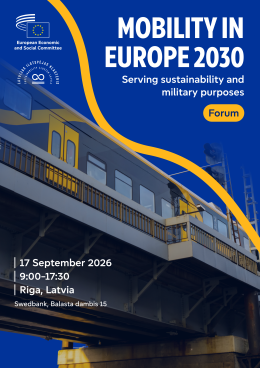
The TEN section, in cooperation with the Latvian Sustainability Cluster, is organising a forum on Mobility in Europe 2030 – serving sustainability and military purposes on 17 September 2026 in Riga, Latvia. The forum will deliver recommendations, identify investment and regulatory priorities, and clarify implementation pathways. The outcome of the forum will feed into the EESC’s policy work at EU level and provide practical guidance for Member States in advancing climate-neutral, resilient and competitive mobility systems, including strengthened military mobility, in response to evolving geopolitical challenges.
EESC, JDE 61, Rue Belliard/Belliardstraat 99| 1040 Bruxelles/Brussels | Belgium
The fifth meeting of the EU-Armenia Civil Society Platform (CSP) is scheduled to be held on 15 October 2024 in Brussels.
The meeting will focus on assessing progress in the implementation of the EU-Armenia Comprehensive and Enhanced Partnership Agreement (CEPA), with a strong emphasis on its impact in the Areas of Democracy, Rule of Law, Anti-Corruption, and Human Rights.
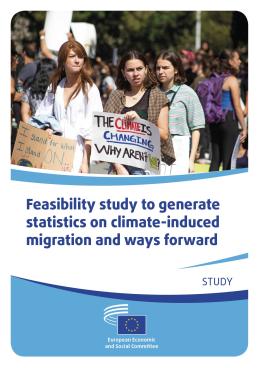
This feasibility study to generate statistics on climate-induced migration and ways forward sought to gather and review existing data on climate-induced migration, focussing on five Member States (France, Germany, Greece, Italy and Spain) and one candidate country (Türkiye), to inform an effective EU response. There is no universally agreed definition of climate-induced migration. The majority of population movements as a result of rapid onset events takes place within a country as opposed to across borders.
Our members comment on the results of the US presidential election and reflect on their possible impact;
Guest articles by Lennart NILSSON (General Confederation of Agricultural Cooperatives - COGECA), Beatriz ABELLÁN MERELO (Foundation for European Progressive Studies - FEPS) and Francesca CARLSSON (European Environmental Bureau - EEB);
Report on our recent conference on protecting Europe's most vulnerable through sustainable and affordable housing;
Interview with rapporteur Anastasis YIAPANIS on the new EESC opinion on 'Advanced materials for industrial leadership'.
Civil Society Organisations' Bulletin - December 2024
This study explores policy solutions for affordable and sustainable housing in the European Union, emphasising a number of factors which are crucial throughout the building process: habitability, community, economic accessibility, resource efficiency, circularity and climate change resilience.
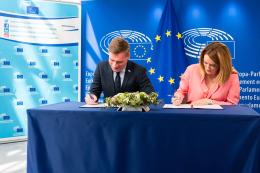
On Tuesday 14 May 2024, the Presidents of the European Economic and Social Committee (EESC), Oliver Röpke, and of the European Parliament (EP), Roberta Metsola, signed a cooperation agreement to strengthen the relations between the two institutions and the overall role of the Committee as policy advisor to the European Parliament.
Cooperation Agreement between the European Parliament and the European Economic and Social Committee
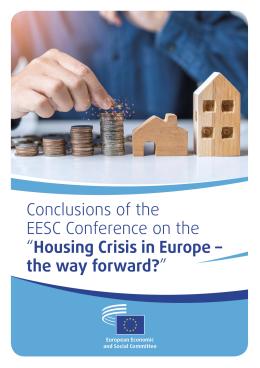
On 20 February 2024 in Brussels, the EESC organised a conference on the Housing Crisis in Europe. This publication sets out the participants' assessment of the current state of affairs and their recommendations on how to tackle the current housing crisis.