
European Economic
and Social Committee
Employers' Group launches study on AI-powered tools to cut red tape
As regulatory requirements grow in complexity and scope, companies across industries are seeking innovative solutions to manage the mounting compliance workload while they call for overarching simplification. Artificial Intelligence (AI) is emerging as a transformative force, offering the potential to significantly reduce the regulatory burden by automating processes, enhancing accuracy, and enabling proactive risk management.
In May 2025 the Employers' Group launched a new study, "A Business-Centric Approach to Cutting Red Tape - From Complexity to Clarity: Reducing EU Regulatory Burdens with AI", on innovative tools designed to complement and reinforce the Commission’s goals, as outlined in the 'Simpler and Faster Europe' Communication.
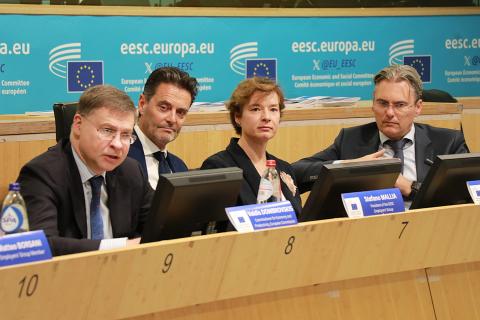
"We share the same priorities: reducing reporting obligations, enhancing legal clarity, and ensuring more coherent implementation across Member States," said Group President, Stefano Mallia, who presented the study in the presence of Valdis Dombrovskis, Commissioner for Economy and Productivity; Implementation and Simplification.
"The problem is not regulation —it’s overload," said Mallia. "Too many rules drain innovation, bury businesses under paperwork, and slow down progress. Over 60% of businesses still consider this a top barrier to growth".
"Continuing with business as usual is no longer an option – echoed Dombrovskis. "It is clear that Europe must urgently take action to secure our long-term prosperity and security (…) Simplification – or, to put it simply, cutting red tape – is a central element of building a competitive Europe. In fact, you could say that it is the key to unlocking Europe's full competitive potential," he added.
In this context, the study – conducted by SIRA Consulting and Y.digital – proposes a bold, data-driven framework to streamline EU regulation using artificial intelligence. At the core is the Regulatory Burden Index (RBI), a new AI-supported tool capable of monitoring and quantifying the compliance burden of EU laws in real time. This is complemented by the SME Indicator Company approach, which leverages sectoral business cases to set realistic, measurable reduction targets.
AI technologies, such as natural language processing (NLP) and machine learning, can process vast amounts of regulatory information and internal data in real-time. This allows companies to stay updated with the latest regulatory changes, swiftly identify new requirements, and ensure continuous adherence to evolving standards. By automating the monitoring and reporting processes, AI minimizes the need for manual oversight. This not only accelerates compliance workflows but also improves accuracy, enabling compliance teams to focus on higher-value strategic activities.
AI is also being used to support the legislative process itself. Advanced NLP models can automatically identify administrative burdens within legislative documents, enabling evidence-based impact assessments. This not only streamlines the evaluation of new regulations but also helps policymakers understand and minimize the compliance costs imposed on businesses.
The European Commission has set out ambitious targets for all administrative costs: reducing them by 25% for all companies and 35% for SMEs. This translates into cutting approximately €37.5 billion in annual administrative costs by the end of this Commission's current mandate. Dombrovskis signalled a change in the regulatory culture of the Commission and a focus towards ensuring that EU rules are as simple and cost-effective as possible, and that they deliver on the ground.
The Group's study calls for four pillars of action for effective burden reduction:
- Develop the Regulatory Burden Index (RBI): Integrate AI-driven burden assessment into policymaking to improve legislative quality, clarity, and consistency. Embed the RBI in impact assessments and REFIT evaluations to enable real-time, comparable burden assessments across the EU.
- Implement the SME Indicator Company approach: Use sectoral SME benchmarks to track and reduce burdens, with concrete 20–25% reduction targets per indicator company. This method provides practical, measurable outcomes without requiring exhaustive baseline studies.
- Ensure evidence-informed and adaptive legislation: Delay full entry into force of new rules until operational clarity is secured. Leverage AI for cumulative burden analysis, introduce interim support measures for SMEs, and mandate simultaneous implementation across Member States to preserve the Single Market.
- Promote uniform implementation and legislative coherence: Advocate “One EU rule in, 27 national rules out” where harmonisation is needed. Use regulations over directives where justified, and apply mutual recognition where uniformity cannot be guaranteed
Talking about the study, Sandra Parthie, President of the EESC Section for the Internal Market (INT) said: "The tool should become a standard for EU lawmakers, particularly in the context of competitiveness checks. AI is a true driver for competitiveness. It's time to let business do business, not fill in forms."
Work organisation
Related content

Recommended for you
EU:n ja Yhdysvaltojen kauppa- ja teknologianeuvoston on tartuttava tilaisuuteen ja otettava tavoitteeksi johtoasema kaupan, teknologian ja innovoinnin alalla
News
Euroopan talous- ja sosiaalikomitea (ETSK) totesi heinäkuun täysistunnossaan, että uudesta kauppa- ja teknologianeuvostosta (Trade and Technology Council, TTC) voi tulla sekä EU:ta että Yhdysvaltoja…
”Sinun Eurooppasi, sinun mielipiteesi” ‑tapahtuma 2023: Nuoret vaativat avoimempaa, digitaalisempaa ja yksinkertaisempaa EU:ta
News
Euroopan talous- ja sosiaalikomitea (ETSK) isännöi 23.–24. maaliskuuta 14. ”Sinun Eurooppasi, sinun mielipiteesi” -tapahtumaa, joka toi Brysseliin 105 opiskelijaa 35 koulusta EU:n 27 jäsenvaltiosta…
Puurakentaminen voi auttaa vähentämään hiilidioksidipäästöjä
News
Euroopan talous- ja sosiaalikomitean järjestämässä keskustelussa kävi ilmi, kuinka hyödyllistä puurakentaminen voi olla, kun EU pyrkii saavuttamaan hiilineutraaliuden tavoitteen vuoteen 2050 mennessä…
Pro Lapinlahti -yhdistykselle ja Lilinkotisäätiölle ETSK:n mielenterveysaiheinen kansalaisyhteiskuntapalkinto
News
Suomalaisorganisaatiot jakoivat mielenterveyttä edistäville hankkeille myönnetyn Euroopan talous- ja sosiaalikomitean (ETSK) kansalaisyhteiskuntapalkinnon muut palkintosijat kahden muun hakijan…
Euroopan talous- ja sosiaalikomitea on avannut mielenterveysaiheisen kansalaisyhteiskuntapalkintonsa haun
News
Kansalaisyhteiskunnan organisaatiot, yksityishenkilöt ja yksityiset yritykset voivat nyt ehdottaa voittoa tavoittelemattomia hankkeitaan tätä eurooppalaisten henkisen hyvinvoinnin tukemiselle…