
European Economic
and Social Committee
European Disability Card will remove barriers for persons with disabilities to travel, work and study across Europe
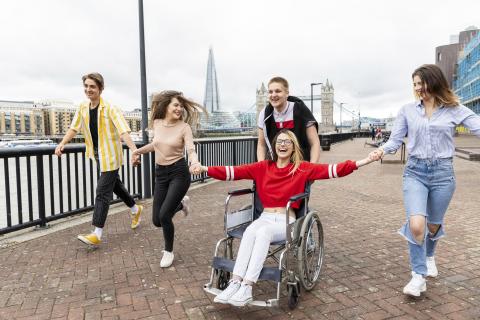
One of the top priorities of the disability movement, called for for many years, the European Disability Card will enable people with disabilities to exercise their fundamental right to freedom of movement in the EU on the same footing as people without disabilities.
The European Economic and Social Committee (EESC) has welcomed the initiative to introduce a European Disability Card, which has been launched by the European Commission to help people with disabilities move and reside freely within the European Union. It warned, however, that the success of the card will depend on mutual recognition of disability status between EU countries, which is currently not the case.
In an opinion adopted at its plenary session in April, the EESC raised concerns over the lack of mutual recognition of disabilities among Member States, which deprives persons with disabilities of support measures when travelling to other countries. According to the EESC, this is a fundamental violation of their freedom of movement, which is a core EU value.
The mutual recognition of disability is a prerequisite for an effective European Disability Card,
said the rapporteur for the opinion, Ioannis Vardakastanis.
We now have first- and second-class European citizens, the first class being those who can move from one Member State to another for travel, work, or study, or to set up residence, and the second class being those who cannot. The European Disability Card will break down these barriers and create a European open space for persons with disabilities to exercise their right to free movement,
he stressed.
The EESC noted in the opinion that the European Disability Card had been a high priority of the disability movement and something that they had long called for. It recommended that the card be established through a regulation, as this is a more appropriate instrument that would ensure its consistent and universal application and avoid differences in implementation at national level.
Complementary measures should also be taken to ensure that transport, services, and buildings are accessible to all, while the personal data contained in the card should be protected by the data protection regulations. In this way, the card will function as a European Disability Passport which will eliminate barriers for persons with disabilities.
In the EESC's view, the card will compel Member States to improve current systems which are primarily based on a medical approach to disability and align them with models that abide by the UN Convention on the Rights of Persons with Disabilities (UNCRPD).
To ensure the success of the card, the EESC called for the full involvement of persons with disabilities and their organisations in all phases of its roll-out and during the monitoring process.
Another demand is for the physical separation of the EU Disability Card and EU Parking Card. This would make it easier for persons with disabilities to navigate transport systems and access public services.
According to the EESC, the card must be issued in a physical, standard-ID-size format with digital capabilities. It must be fully accessible and include information about the cardholder's personal assistant and/or companion.
It should be accompanied by an EU-level, fully accessible website in all EU languages, with an easy-to-read version and sign language availability. It should include practical information for every country.
The card has already proven its worth during a pilot project conducted between 2016 and 2019 in eight Member States. The project demonstrated the card's feasibility and its clear benefits for users. It enabled easier mobility, boosted participation in the culture and leisure sectors, and improved tourism experiences abroad.
Work organisation
Recommended for you
EU:n ja Yhdysvaltojen kauppa- ja teknologianeuvoston on tartuttava tilaisuuteen ja otettava tavoitteeksi johtoasema kaupan, teknologian ja innovoinnin alalla
News
Euroopan talous- ja sosiaalikomitea (ETSK) totesi heinäkuun täysistunnossaan, että uudesta kauppa- ja teknologianeuvostosta (Trade and Technology Council, TTC) voi tulla sekä EU:ta että Yhdysvaltoja…
”Sinun Eurooppasi, sinun mielipiteesi” ‑tapahtuma 2023: Nuoret vaativat avoimempaa, digitaalisempaa ja yksinkertaisempaa EU:ta
News
Euroopan talous- ja sosiaalikomitea (ETSK) isännöi 23.–24. maaliskuuta 14. ”Sinun Eurooppasi, sinun mielipiteesi” -tapahtumaa, joka toi Brysseliin 105 opiskelijaa 35 koulusta EU:n 27 jäsenvaltiosta…
Puurakentaminen voi auttaa vähentämään hiilidioksidipäästöjä
News
Euroopan talous- ja sosiaalikomitean järjestämässä keskustelussa kävi ilmi, kuinka hyödyllistä puurakentaminen voi olla, kun EU pyrkii saavuttamaan hiilineutraaliuden tavoitteen vuoteen 2050 mennessä…
Pro Lapinlahti -yhdistykselle ja Lilinkotisäätiölle ETSK:n mielenterveysaiheinen kansalaisyhteiskuntapalkinto
News
Suomalaisorganisaatiot jakoivat mielenterveyttä edistäville hankkeille myönnetyn Euroopan talous- ja sosiaalikomitean (ETSK) kansalaisyhteiskuntapalkinnon muut palkintosijat kahden muun hakijan…
Euroopan talous- ja sosiaalikomitea on avannut mielenterveysaiheisen kansalaisyhteiskuntapalkintonsa haun
News
Kansalaisyhteiskunnan organisaatiot, yksityishenkilöt ja yksityiset yritykset voivat nyt ehdottaa voittoa tavoittelemattomia hankkeitaan tätä eurooppalaisten henkisen hyvinvoinnin tukemiselle…