The Civil Society Days 2022 brought together citizens, civil society organisations and European institutions to debate and address the challenge of ensuring shared prosperity. This major challenge has never been more crucial for Europe as the impacts from the Russia-Ukraine war emerge and the COVID-19 pandemic continue to be felt, speakers emphasised.
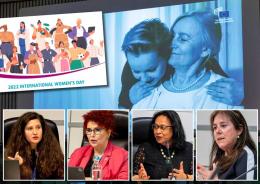
The conference on Women in the Labour Market organised by the EESC to mark International Women's Day, was held on 8 March under the shadow of the war. The participants paid tribute to the remarkable Ukrainian women for their strength, bravery and resilience. Attention was drawn to different aspects of gender equality such as the need to increase women's participation in the labour market, especially with regard to new digital and green jobs, to facilitate female entrepreneurship, to improve care services and work-life balance, and to tackle gender stereotypes and work-related harassment.
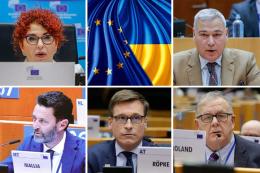
In a spontaneous debate initiated by the EESC President Christa Schweng during the February plenary session, the members of the European Economic and Social Committee condemned the unjustified and unprovoked invasion of Ukraine by the Russian Federation. EESC members expressed their solidarity with the Ukrainian people and called for firm actions at both EU and national level in a spirit of unity in this dramatic time.
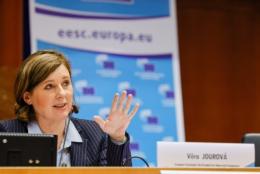
The February plenary of the European Economic and Social Committee (EESC) hosted a debate led by its President Christa Schweng and European Commission Vice-President Věra Jourová. Key takeaway: the extraordinary measures taken to fight the pandemic should not endanger the EU's founding principles of democracy, the rule of law and fundamental rights.
The European Commission relaunched the public debate on the review of the EU economic governance framework in October 2021, almost a year after it was put on hold. Following up on this relaunch, the European Economic and Social Committee (EESC) and the European Commission's Directorate-General for Economic and Financial Affairs (DG ECFIN) held a joint online conference as part of the public debate. The event, split into two presentations and panel discussions, aimed to engage civil society so as to build consensus on the future of the economic governance framework.
Today, as a true pan-European collaborative venture, the European Commission, the European Economic and Social Committee (EESC), the European Committee of the Regions (CoR), COPA-COGECA and IFOAM Organics Europe are together launching the first ever EU organic awards. These awards will recognise excellence along the organic value chain, rewarding the best and most innovative actors in organic production in the EU. Applications will be open from 25 March until 8 June 2022.
The long-awaited ruling of the top European Court, issued today, confirms the legitimacy of protecting the Union budget from negative effects resulting from breaches of the principles of the rule of law.
With discrimination and hate crime against Jews on the rise in Europe, the EESC is throwing its support behind the first-ever European strategy on combating antisemitism and fostering Jewish life as an indispensable ingredient of European culture and a prerequisite for the preservation of EU common values
The key role of raw materials was discussed at some length at the high-level conference hosted by the European Economic and Social Committee (EESC) on Monday 31 January.
The European Economic and Social Committee (EESC) has welcomed the designation of 2022 as the European Year of Youth, but feels that it should go beyond mere promotional activities: it should contribute towards the EU's Youth Strategy through clear plans and commitments aimed at achieving concrete results for all young Europeans.