
European Economic
and Social Committee
The EU social policy actions must be better aligned to strengthening competitiveness
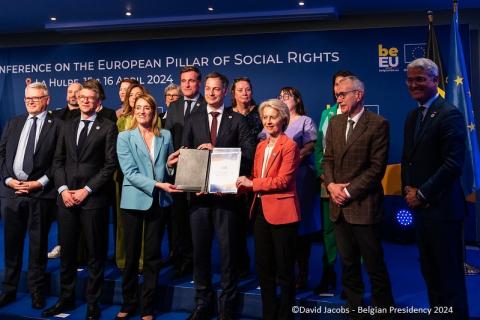
Employers' Group statement in the wake of the EESC signing of the La Hulpe Declaration on the Future of the European Pillar of Social Rights
16 April 2024 - The EU is lagging behind its competitors. In 2023, EU growth was only 0.5%, compared to 2.5% in the US and 5.2% in China. This, together with past and on-going crises clearly indicate that the EU is in dire need of reforms to improve the business climate and deserves a European Competitiveness Deal to restore growth and industrial competitiveness.
The Employers' Group welcomes the invitation for the EESC to be one of the signatories of the declaration La Hulpe Declaration on the Future of the European Pillar of Social Rights and indeed signalled that it did not oppose that the EESC sign the declaration. It is important to include organised civil society in the discussions on the EU social dimension. Moving forward, we equally expect the EESC to also participate in future initiatives concerning competitiveness.
The Employers' Group would like however to express serious reservations about the content of the declaration. Amongst the main shortcomings the Group has identified are, for example:
- No explicit acknowledgement of the fact that economic growth, competitiveness and higher productivity, based on entrepreneurship and skills and knowledge, as well as well-functioning internal market are prerequisites for achievements in the social field. There is no social dimension without a sound economic foundation.
- The text seems to aim to anticipate the next European Commission's policies and work programme(s), which should be left to the prerogative of the next political mandate.
For this reason, the decision to not oppose the signing of this declaration by the EESC cannot in any way be understood as anticipating the position of the Employers' Group to initiatives that might be proposed in the field of social policies during the next EU legislative term.
Labour and skill shortages remain a major challenge for companies to operate and grow. The Employer's Group asks for well- functioning, flexible and adaptable labour markets with active labour market policies, longer and more diverse careers, as well as more people in the job market, including through labour migration and integration of migrants. Promoting different and new forms of work, as well as providing conditions that encourage self-employment and entrepreneurship, are means of attaining our goals, together with more efforts on upskilling, reskilling and effective life-long learning systems.
We need adequate and sustainable social protection systems, and comprehensive education and training systems based on a competitive economy, contributing to better economic and social convergence.
Social partners and governments have a key role to play, supported by EU-level action if needed, with full respect of national models, national competences as well as the subsidiarity and proportionality principle. The EU already has a wide array of legislation on the labour market and social matters. In order to avoid over-regulation that hampers companies from creating new growth and jobs, we should focus on implementing and enforcing the existing measures instead of proposing new legislation.