
European Economic
and Social Committee
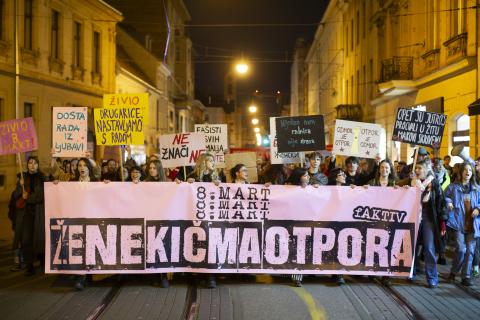
Every first Saturday of the month, groups of men kneel in Croatian city squares to pray for women to dress modestly and for men to reclaim spiritual authority in the family. Croatian feminist collective fAKTIV says the prayer vigils have meagre public support but warns they are part of a broader backlash against women's rights across Europe. We spoke with them after their traditional Night March for 8 March about the wider pressures shaping women’s lives in Croatia and Europe: from work and poverty to reproductive rights, violence, and the rise of the far right.
The 10th Night March for 8 March, organised by fAKTIV, gathered 12,000 people ─ the largest turnout so far. Under what slogan was it held and what were its main messages?
The 10th Night March was held under the slogan 'Women – the Backbone of Resistance.' We know that women carry a double burden on their backs — we are the backbone of society, but also of resistance. We are burdened by overtime and unpaid work, the kind often described as a labour of love because it involves caring for family and loved ones, housework, and emotional care.
The same applies during official working hours: women uphold the last pillars of the welfare state. They make up the majority of the workforce in public services, and social protection has a female face. All of these systems are underpaid and understaffed.
In such conditions, in a system that neither cares for nor protects women, we become the backbone of resistance because we have no other choice. That is why we marched ─ to show that the system cannot break women’s solidarity, whether it means naming violence, standing with women workers whose employers and the state have owed them wages for decades, protecting a neighbour from an abuser, defending nature from investors and destruction, or taking a friend to a neighbouring country because she cannot obtain an abortion in her own country, where that right is guaranteed by law.
How do you interpret such a large turnout — does it reflect a growing sense that women’s rights are under threat, or greater mobilisation and awareness in society? How do you assess the state of gender equality in Croatia and Europe today?
Thanks to continuous work and collective organising, for years around ten thousand people have marched through Zagreb on 8 March. This year there were more than 12,000 of us. We consider our greatest achievement to be the people who march, drum and sing with us, paint banners and volunteer as stewards. We brought the International Women’s Day, historically a day of workers' struggle, back to the streets, back to the people, where it belongs. These are some of the reasons why people march.
At the same time, we live in a country where most salaries do not last until the end of the month. Public healthcare is underfunded, and social services such as kindergartens and homes for the elderly remain a privilege of larger cities. In Croatia in 2026 abortion is still most often spoken about in whispers, as if we were discussing a crime rather than healthcare. At the same time, organisations that want to ban abortion are announcing the formation of a new political party.
The new Minister of Labour is advocating raising the retirement age to 67 or even higher. In just one year, Varteks, the clothing manufacturer, has sold off its properties; Nama, the department store chain, has closed its doors; production has stopped at Gredelj, the railway rolling-stock factory; Alpina, the footwear manufacturer, has shut down its plants; the paper factory in Belišće has closed; and Benetton has left its factory in Osijek. Violence has become part of everyday life, and the number of people targeted by violence continues to grow. These, too, are reasons for marching.
Finally, we march to celebrate those who refuse to bend their backs. This year saw the first strike of foreign workers in Croatia. Women workers at the Croatian supermarket chain Plodine have refused to leave their union despite threats of dismissal. Across Europe we are witnessing the largest labour mobilisations in years, while antifascist and antimilitarist voices are growing stronger.
Every first Saturday of the month, men gather in Zagreb’s main square to kneel and pray for women to dress modestly and to ask for guidance for men to become the spiritual authority in the family. How do you interpret this phenomenon? Do you see it as folklore, a local religious movement, or a dangerous political gesture with wider social consequences?
The men taking part in the so-called prayer vigils are in fact advocates for banning abortion and divorce, for women’s submissiveness and their return to the four walls of the household. They claim that our confidence threatens their masculinity simply because we dare to walk freely through the streets and demand our rights and equality.
They began their mission by kneeling in Zagreb’s main square and have since spread to other cities. Their expansion and persistence are not surprising – this is a carefully designed movement that seeks to impose its views as social and legal norms. Financially secure and internationally connected, they import ideas from abroad and attempt to implement them in Croatia.
What their vision of society looks like can be seen in the example of Poland and the way the country has treated women in recent years. Abortion is banned, and in 2026 women are dying in agony as a result. At the same time, activists fighting for safe and accessible abortion are facing criminal prosecution.
The men taking part in the prayer vigils also clearly do not see gender-based violence as a problem, since they advocate pushing women back into the private sphere of the household. That means returning women to economic dependence on men, one of the main obstacles faced by women who want to leave abusive partners.
Of course they are dangerous, and we are already paying the price. In many countries this movement has entered the mainstream of the Catholic Church and official politics. Nevertheless, there is no ultraconservative movement that faces stronger public condemnation: on several occasions more than 70 percent of Croatian citizens have clearly shown they do not support either their politics or their messages.
Croatia introduced femicide as a specific criminal offence in 2024 (only four other countries treat the murder of a woman as a separate crime), punishable by 10 to 40 years in prison. Yet Croatia ranks third in the EU in the number of femicides. How do you explain this, and can the new law bring change?
At the 10th Night March, we asked precisely these questions: how many more generations must grow up in fear before physical and psychological abuse of women becomes a thing of the past? How many more decades must we fight before gender-based violence becomes history?
In the ten years we have been marching, numerous laws have been adopted, strategies written and conventions ratified. Thanks to women who shoulder the burden and tirelessly remind the system that inaction endangers women’s health and lives, penalties are stricter today, and protocols and shelters exist. But the reality remains thousands of reports of domestic violence every year, rising numbers of rapes, women threatened by those closest to them, and women killed by husbands, fathers, sons and former partners.
Femicide is the tragically predictable outcome of previously reported violence. The warning signs are there, the regulations and policies exist, yet the system fails and protection never comes.
Hatred, violence and abuse are not isolated incidents or moments of weakness; they form a structure that sustains male power and female subordination. It protects the privileged while leaving women and others on the margins to fend for themselves.
You also described the Night March as a struggle against fascism. What developments or processes lead you to believe that society is becoming fascist, and how do such tendencies affect gender equality?
Of course the Night March, as the largest feminist protest in the country, will explicitly address fascist threats in society and criticise a system that does nothing to stop them. Just as there is no antifascism without a struggle against capitalism, there is no feminism without a struggle against fascism. In Croatia we can no longer speak of occasional fascist outbursts; this is a continuous process that is becoming more widespread and more dangerous.
Hatred in public space and the media has become normalised. Public discourse is filled with disinformation and inciting lies, while the number of those suffering the consequences continues to grow. Foreign workers are attacked both in the Croatian Parliament and on the streets. Hatred towards Serbs is spreading, while transgender people are denied the right to exist.
Naturally, feminism and women’s rights are a thorn in the side of the political right. But as we said at last year’s Night March: feminism has no borders. There is no stronger, louder or more determined political force than women who refuse to remain silent in the face of violence, who refuse to bow down, who refuse to return to kitchens and church pews, and who defend their legally guaranteed right to abortion and stand in solidarity with those most vulnerable.
fAKTIV is a feminist collective based in Croatia fighting for women’s labour and social rights, advocating for reproductive and sexual rights, and against gender-based violence.