
European Economic
and Social Committee
EESC PLENARY: Interview with rapporteur Pietro Barbieri
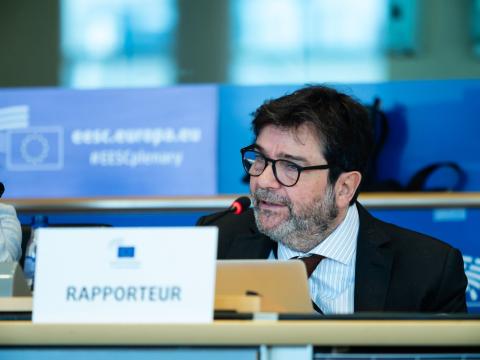
We spoke with the rapporteur for the EESC opinion SOC/840 'EU strategy to support, protect and empower civil society'
The EESC welcomes the initiative on an EU civil society strategy. What should this future strategy include?
An EU strategy for civil society should introduce measures based on: 1) a safe and enabling environment for civil society; 2) sustainability and independence; and 3) stronger civic participation and civil dialogue. When it comes to dialogue between the European institutions and civil society organisations (CSO), in our view, certain key elements arise that the strategy cannot ignore. First and foremost, for the EESC it is fundamental that the dialogue be cross-cutting and involve the whole European Commission – not just the Commissioner responsible for creating the strategy and the proposed Civil Society Platform. While Commissioner McGrath has important responsibilities, as always, these are not sufficient to cover the entire area of interest for CSOs. We are also proposing that other institutions – such as the Council and the European Parliament – be involved, through an interinstitutional agreement. There is moreover a need to clarify certain points about how this civil dialogue would work. We believe: i) it must be meaningful; ii) the agenda – and therefore also the priorities – must be agreed on; and iii) the right conditions must be put in place, starting with support aimed at ensuring that CSOs are able to participate actively and on an informed basis. This could take the form of direct funding for empowerment. Finally, there needs to be assessment of the results, based on effective, ongoing monitoring of progress, with reporting at least every two years.
What are the main recommendations or proposals of the opinion?
As part of the opinion, we propose the launch of a pilot project with the European Commission and the EESC's Liaison Group to establish a broad dialogue process on key topics for civil society. This is part of our response to the Civil Society Platform that the Commission proposed. This pilot project is, without a doubt, our most important proposal. It could be considered a trial for a permanent civil dialogue process. In other words, it gives the Commission a ‘laboratory’ where it can build the platform, brick by brick, without being exhaustive, as this should be a joint process. However, we do suggest a governance system, which has already been tested in a number of EESC activities in agreement with the Commission. An example is the European Migration Forum, which the EESC is organising with the Commission since 2015. We propose a tripartite governance structure, with the Commission on one side, the EESC and its national representatives on another, and the EESC Liaison Group, which includes 47 European organisations and networks of civil society already operating in the EESC, on another. We believe that this set-up will help make it possible for all these stakeholders to participate in direct discussions on a range of topics. Obviously, we are also contemplating how this new structure might guide the policy direction of the Commission, the Parliament and the Council in the future. We are thinking, primarily, of an experimental project that would guide dialogues on democracy, fundamental rights and the rule of law. Later it could also address cross-cutting issues – such as the Commission’s work programme and the multiannual financial framework. We believe that all of this can contribute to the EESC’s normal activities, substantially enriching them.
After the adoption of this opinion, what have you done/will you do to promote it?
The EESC produces a large number of opinions not only on legislative initiatives and on requests from the rotating presidency of the Council of the European Union, but also on topics that are not on the European agenda, and that civil society would like to see included. This is already a form of civil dialogue, built up since the founding Treaties of the European Union. In terms of the kind of dialogue being contemplated now, the EESC has experience in facilitating dialogue and channelling the voice of civil society into EU decision-making. If we draw on this experience, the interplay between the EESC and the Civil Society Platform could have extremely positive effects if based on convergence, mediation and wider consensus. It is a matter of working towards compromise, and our proposals go in that direction.
Promoting our proposals will require a conscious effort from the whole Committee, starting from the top. This is a political task of interweaving, involving the Commission, civil society organisations at EU level, and the EESC. The key challenge for us is not to lose sight of the unfolding developments and to stay firmly on the path taken of working across the board, with the other parties. Naturally there are different levels of engagement. The Committee leadership will be involved in certain levels, while myself and the other two rapporteurs will be involved in others. All three rapporteurs are in contact with the Commission concerning the follow-up of our opinion on the proposed civil society strategy.
The opinion on 'EU strategy to support, protect and empower civil society' was presented and adopted at the EESC plenary session in July 2025. Read it at: https://www.eesc.europa.eu/en/our-work/opinions-information-reports/opinions/eu-strategy-support-protect-and-empower-civil-society
 Pietro BARBIERI (Italy)
Rapporteur for the EESC opinion SOC/840 'EU strategy to support, protect and empower civil society'
Vice-President, Civil Society Organisations’ Group
Former Spokesperson, Third Sector Forum
President, Center for Autonomy
© EU/EESC