
European Economic
and Social Committee
EESC PRESIDENT SÉAMUS BOLAND IN MONTENEGRO: PUTTING CIVIL SOCIETY AND SOCIAL DIALOGUE AT THE CENTRE OF THE ACCESSION JOURNEY
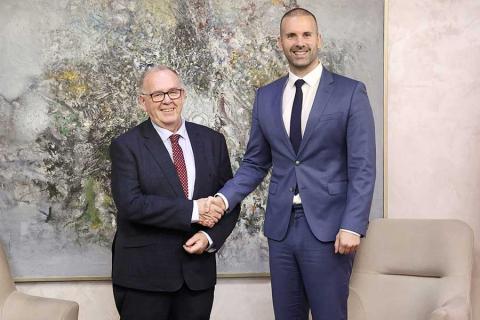
Montenegro’s progress towards EU membership must include better living conditions and give citizens a say in the country’s future. During a visit to Podgorica on 7–9 October, EESC President Séamus Boland urged the government to keep civil society, social partners and young people involved throughout the accession process.
Meeting Prime Minister Milojko Spajić, Mr Boland welcomed the reform progress achieved in recent months and encouraged the government to maintain momentum. Their talks focused on accession negotiations and how organised civil society can help shape balanced, sustainable reforms.
'Montenegro’s accession is about more than joining the European Union,' Mr Boland said. 'It is about building a fairer, more inclusive society where citizens see and feel the benefits of reform and where civil society has a real voice in shaping the country’s future.'
The visit, which began with a briefing by the EU Ambassador to Montenegro, Johann Sattler, brought together political leaders, civil society representatives and young people to discuss both the reforms and public participation in them.
Fighting poverty, improving social inclusion and addressing demographic challenges were central to talks with the Minister of Social Welfare, Family Care and Demography, Damir Gutić.
'European integration is not just about aligning legislation,' Mr Gutić said. 'Its true purpose is to ensure that citizens receive better protection, more accessible services, more opportunities and a better quality of life.'
Mr Boland stressed that civil society organisations and social partners have a vital role in making sure social reforms respond to people’s needs and bring tangible improvements.
In a separate meeting, the Minister of Labour, Employment and Social Dialogue, Naida Nišić called for social dialogue to function as 'a genuine mechanism for shaping public policies rather than merely a formal obligation in the European integration process'. Citizens, employees, employers and civil society should actively participate in Montenegro’s journey towards membership, she said.
At Europe House, the EESC president met students and Young European Ambassadors from the Youth Network of Montenegro. He emphasised that their ideas and ambitions must be heard throughout the accession process.
He also met employers, trade unions and civil society organisations, including members and observers of the EU–Montenegro Joint Consultative Committee and participants in the EESC’s Enlargement Candidate Members initiative. Discussions examined the progress of negotiations, civil society’s influence on reforms and the effectiveness of social dialogue.
The visit ended with a meeting with Montenegro’s Ombudsman, Siniša Bjeković, on the protection of fundamental rights, the rule of law and the functioning of independent oversight institutions.