
European Economic
and Social Committee
EESC to hold debate on better regulation with European Commissioner Valdis Dombrovskis at September plenary
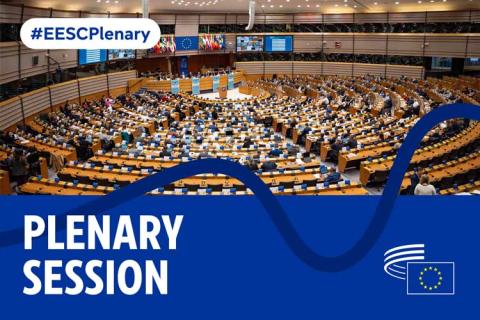
23-24 September 2026
European Parliament, Paul-Henri Spaak building (Grand hemicycle – PHSHEM), 1047 Brussels
Web stream click here
AGENDA
Debates
Wednesday 23 September 2026 at 15:00
Better regulation
with Valdis Dombrovskis, European Commissioner for Economy and Productivity, Implementation and Simplification; Zdeněk Zajíček, President of the Chamber of Commerce of the Czech Republic; Ludovic Voet, Confederal Secretary at European Trade Union Confederation (ETUC) and Sophia Zakari, Director at SMEunited
linked to INT/1129 - Communication on a Simpler, Clearer and Better Enforced EU Rulebook
Wednesday 23 September 2026 at 16:15
Modernising cohesion policy: the way forward
with Raffaele Fitto, Executive Vice-President of the European Commission for Cohesion and Reforms
linked to NAT/982 - A rural proofing tool to unlock the full potential of rural areas and communities through better rural-centred EU policymaking for a fair and sustainable EU
Thursday 24 September 2026 at 9:00
Presentation of the priorities of the French Economic, Social and Environmental Council
with Claire Thoury, President of the French Economic, Social and Environmental Council
Thursday 24 September 2026 at 12:00
The EU organic awards as a showcase of innovative and sustainable EU agriculture supporting food security, viable rural communities, social inclusion and climate and biodiversity objectives
with Christophe Hansen, European Commissioner for Agriculture and Food
linked to NAT/983 - Social farming as a tool for innovation in agriculture
Opinions in the spotlight
TRANSPORT
Protection of passengers with single ticket (TEN/857, rapporteur: Baiba Miltoviča (LV-III))
The EESC suggests that, in the event of missed connections and subsequent delays, passengers should be allowed to use rail services during the next leg of their trip, without any restriction, for the following 3 hours or using the first subsequent similar connection. The Committee also supports the introduction of automatic compensation and reimbursement mechanisms for passengers affected by delays, cancellations or missed connections when the trip concerned is covered by a single ticket. More
Rail ticketing (TEN/860, rapporteur: Dumitru Fornea (RO-II))
The EESC calls for a single, interoperable European rail ticketing framework to overcome fragmentation and enable seamless travel across operators and borders. The Committee also calls for safeguards against dominant digital platforms, including excessive commissions, discriminatory rankings and algorithmic self-preferencing. More
Multimodal booking (TEN/861, rapporteur: Mateusz Szymański (PL-II))
The EESC welcomes the proposed Commission's regulation as a useful step towards improving transparency and competitiveness in the EU ticket distribution market, notably through neutral presentation of search results, limits on paid placement, obligations for platforms with significant market presence and the prohibition of anti-competitive contractual clauses. However, the Committee considers that the proposal does not address the key problem of the very limited availability of multimodal journeys purchasable through a single ticket, and calls for more far-reaching measures to ensure effective multimodal booking. More
HOUSING
Making Housing Affordable – Increasing Modern Methods of Construction and Lowering Costs (TEN/889, rapporteur: John Comer (IE-III), co-rapporteur: Thomas Kattnig (AT-II))
The EESC believes that modern methods of construction (MMC) are one of the key enablers of the circular economy in the construction sector and underlines that all Member States, the Commission, the Housing Alliance and all stakeholders have a role to play in promoting standardisation, eliminating fragmented regulations and ensuring proper oversight and certification of the MMC systems. More
ENERGY
Omnibus on energy products labelling (TEN/891, rapporteur: José Angel Hernandez Colomer (ES-III))
The EESC recommends that the Commission's proposal extend beyond pre-contractual data to cover post-purchase information, integrating the European Product Registry for Energy Labelling (EPREL) into the product lifecycle via the future Digital Product Passport. The Committee also stresses that relevant information must remain free and accessible without registration for as long as the product is usable, even after the model has been withdrawn or the supplier has ceased its activities, so that consumers, repairers and technicians can still service and repair the product. More
PUBLIC SECTOR
The public services sector in the EU adapted to new challenges (SOC/863, rapporteur: Mateusz Szymański (PL-II))
High-quality, accessible and affordable public services are essential for social cohesion, democracy and economic development. The EESC calls for greater investment in public services, stronger preparedness for future crises, better monitoring through the European Semester, and the responsible use of digital technologies and AI. More
SOCIAL AFFAIRS
ProtectEU: Agenda to prevent and counter terrorism (SOC/867, rapporteur: Christian Moos (DE-III))
The EESC supports the ProtectEU agenda but warns that counter-terrorism policies rely too heavily on security and repressive measures. It calls for a more balanced approach that tackles the root causes of radicalisation, strengthens democratic resilience, supports victims, involves civil society and social partners more closely, and reinforces prevention efforts alongside security measures. More
Strategy on Intergenerational Fairness (SOC/868, rapporteur: María del Carmen Barrera Chamorro (ES-II), co-rapporteur: Krzysztof Balon (PL-III))
The EESC welcomes the European Commission's Strategy on Intergenerational Fairness and calls for it to become a cross-cutting principle across all EU policies. The Committee urges the EU to tackle inequalities between generations through concrete targets, stronger social investment, affordable housing, quality jobs, accessible public services and meaningful participation of both young and older people in decision-making. More
Action plan against cyberbullying "Safer online, stronger together" (SOC/869, rapporteur: Michael McLoughlin (IE-III))
Cyberbullying is a growing threat to children and young people, and the EESC welcomes the European Commission’s Action Plan to tackle it. The Committee calls for stronger enforcement of existing EU rules, closer alignment with the Digital Services Act, AI Act and Digital Fairness Act, greater accountability for online platforms, and stronger prevention measures, including support for safe offline spaces, education and protection for vulnerable groups. More
GENDER EQUALITY
EESC Contribution to the EU's Priorities at the 71st session of the United Nations Commission on the Status of Women - UN CSW71 (SOC/871, rapporteurs: Giulia Barbucci (IT-II), Juliane Marie Neiilendam (DK-III) and Christa Schweng (AT-I))
As the 2030 deadline approaches, the EESC calls for renewed efforts to accelerate gender equality and the empowerment of all women and girls. The Committee stresses that achieving the Sustainable Development Goals requires stronger action on women's economic empowerment, equal access to quality jobs and care services, the fight against gender-based violence, digital inclusion, and a gender-responsive approach to climate and environmental policies. More
ECONOMY
The role of civil society in improving financial literacy (ECO/699, rapporteur: Giuseppe Guerini (IT-III))
The EESC calls on Member States to develop and monitor financial literacy strategies in close cooperation with social partners and civil society, using their trusted local networks to reach workers, young people, older people and vulnerable groups. It recommends tailored, impartial learning materials, workplace- and school-based education, digital awareness campaigns and practical guidance on borrowing, pensions, savings, investment and fraud prevention, backed by adequate institutional and financial support. More
Boosting the capacity of the EIB Group and national promotional banks (ECO/702, rapporteur: Philip von Brockdorff (MT-II))
The EESC calls for a stronger role and greater financial capacity for the European Investment Bank (EIB) Group and national promotional banks to support innovation, strategic infrastructure, industrial transformation and the scale-up of European businesses. It advocates closer institutional cooperation, simpler procedures and investment instruments that deliver genuinely additional, long-term public value. More
INTERNAL MARKET
Communication on a Simpler, Clearer and Better Enforced EU Rulebook (INT/1129, rapporteur: Katrīna Zariņa (LV-I))
The EESC stresses that Better Regulation is not deregulation, but a means of ensuring simpler, clearer, proportionate and enforceable EU rules and calls for the “Think Small First” principle to be applied systematically, with particular attention to the impact of legislation on SMEs and competitiveness. The Committee urges the EU institutions to assess the effects of substantial amendments throughout the legislative process, including changes introduced by the co-legislators and during trilogues. More
DIGITAL
Cloud and AI Development Act (INT/1126, rapporteur: Miroslav Hajnoš (SK-II))
The EESC welcomes the objective of the Cloud and AI Development Act (CADA) to strengthen Europe’s cloud and AI ecosystem and reduce the EU’s dependence on non-European cloud and AI providers. However, the Committee calls for the proposal’s financing to be secured rather than assumed, recommending treating cloud and AI infrastructure as a protected priority in the next multiannual financial framework, with resources matching its capacity objectives. More
AGRICULTURE
Rural Europe cannot be an afterthought in EU policymaking (NAT/982, rapporteur: Lidija Pavić-Rogošić (HR-III))
Rural needs are still too often overlooked when EU policies are designed. The EESC calls for a clear EU-wide rural proofing approach, built into policymaking from the start, to assess impacts on rural communities, close the rural-urban gap and give civil society a stronger voice. More
When farming becomes care: unlocking the potential of social farming (NAT/983, rapporteur: Roman Haken (CZ-III))
Farms can do more than produce food: social farming can provide care, create jobs and fill gaps in health and social services, particularly in rural areas. The EESC calls for less red tape, stable funding, EU-wide quality standards, and dedicated training to unlock its potential across Europe. More
ENVIRONMENT
Can the EU get bigger and greener at the same time? (NAT/984, rapporteur: Teppo Säkkinen (FI-I))
EU enlargement will bring more emissions into the Union, but also a major opportunity to speed up the green transition in candidate countries. The EESC calls for stronger pre-accession climate support and clarity on the EU’s 2040 climate target to ensure that a bigger EU stays firmly on the path to climate neutrality. More
For more information, please contact:
EESC Press Unit
E-mail: press@eesc.europa.eu
Tel: + 32 2 546 9793
@EESC_PRESS
Recommended for you
Skrajni čas za vlaganje v mlade na Zahodnem Balkanu
News
Da bi vlade držav Zahodnega Balkana svojim državljanom zagotovile boljšo prihodnost, se morajo lotiti reševanja težav, s katerimi se srečujejo mladi, ki imajo ključno vlogo pri njenem ustvarjanju.…
Vaša Evropa, vaš glas! v letu 2023: Mladi si želijo, da bi bila EU preglednejša, bolj digitalna in enostavnejša
News
Evropski ekonomsko-socialni odbor (EESO) je 23. in 24. marca gostil dogodek Vaša Evropa, vaš glas! Potekal je v Bruslju, udeležilo pa se ga je 105 dijakov 35 šol iz vseh 27 držav članic EU in sedem…
Začetek zbiranja prijav za nagrade za civilno družbo EESO na temo duševnega zdravja
News
Organizacije civilne družbe, posamezniki in zasebna podjetja lahko svoje nepridobitne projekte prijavijo za nagrado EESO, namenjeno spodbujanju duševnega zdravja Evropejcev Evropski ekonomsko…
Oddajte svoj glas junija 2024: EESO poziva Evropejce, naj volijo za enotno in demokratično Evropo
News
Demokracija po vsem svetu nazaduje, širijo se dezinformacije in vse več je nezadovoljstva zaradi naraščajoče inflacije ter preteče nevarnosti vojne, zato so letošnje evropske volitve, na katerih bodo…
Ohranjanje zagona širitve EU: prizadevanje civilne družbe, da bi s postopnim vključevanjem prinesla koristi Zahodnemu Balkanu
News
Evropski ekonomsko-socialni odbor (EESO) je 20 let po pristopu Slovenije k EU v Ljubljani zbral politične voditelje in voditelje civilne družbe, da bi obeležili to simbolično obletnico in poudarili…