European Economic
and Social Committee
European Economic
and Social Committee
The European Economic and Social Committee (EESC) is the voice of organised civil society in Europe.
Find out more about its role and structure at http://www.eesc.europa.eu/en/about
The EESC issues between 160 and 190 opinions, evaluation and information reports a year.
It also organises several annual initiatives and events with a focus on civil society and citizens’ participation such as the Civil Society Prize, the Civil Society Days, the Your Europe, Your Say youth plenary and the ECI Day.
Find the latest EESC opinions and publications at http://www.eesc.europa.eu/en/our-work/opinions-information-reports/opinions and http://www.eesc.europa.eu/en/our-work/publications-other-work/publications respectively.
The EESC is active in a wide range of areas, from social affairs to economy, energy and sustainability.
Learn more about our policy areas and policy highlights at http://www.eesc.europa.eu/en/policies
The EESC holds nine plenary sessions per year. It also organises many conferences, public hearings and high-level debates related to its work.
Find out more about our upcoming events at http://www.eesc.europa.eu/en/agenda/our-events/upcoming-events
Here you can find news and information about the EESC'swork, including its social media accounts, the EESC Info newsletter, photo galleries and videos.
Read the latest EESC news http://www.eesc.europa.eu/en/news-media/news and press releases http://www.eesc.europa.eu/en/news-media/press-releases
The EESC brings together representatives from all areas of organised civil society, who give their independent advice on EU policies and legislation. The EESC's326 Members are organised into three groups: Employers, Workers and Various Interests.
Find out more about our Members and groups at http://www.eesc.europa.eu/en/members-groups
The EESC has six sections, specialising in concrete topics of relevance to the citizens of the European Union, ranging from social to economic affairs, energy, environment, external relations or the internal market.
Find out more at http://www.eesc.europa.eu/en/sections-other-bodies
Brez socialnega dogovora ne bo zelenega dogovora.
Pripravila skupina delojemalcev v EESO
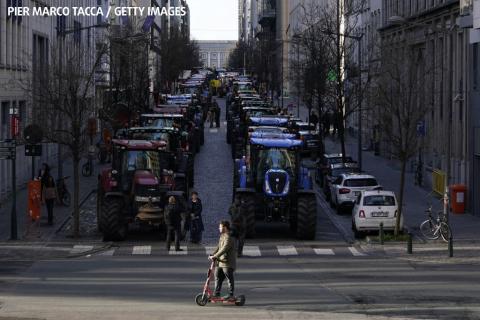
Kmetje so 26. februarja s svojimi traktorji blokirali ulice v Bruslju in tako že drugič v nekaj tednih protestirali. Namesto običajnih suknjičev in lepo urejenih pričesk je bilo v evropski četrti videti tovornjake, traktorje, kupe sena in gorečih gum. Razlogi za proteste kmetov so različni, od SKP in okoljskih politik pa do popolnoma drugih vprašanj.
Res je, da je evropsko podeželje v težki situaciji, in tako je že dolgo. Skupina delojemalcev in EESO kot institucija vedno znova opozarjata, da brez socialnega dogovora ne bo zelenega dogovora. Čeprav bi lahko to trditev odpravili kot zgolj še eno frazo bruseljskega žargona, pa bi bila to usodna napaka. Podeželje se sooča z resničnimi težavami. Mednje sodijo posredniki, ki proizvajalcem plačujejo miloščino, a potrošnikom zaračunavajo nesramno visoke cene, nezadostna pomoč za izvajanje okoljskih reform, (nepravična) prosta trgovina, težki delovni pogoji in podnebne spremembe.
Odziv Evropske komisije, ki je naglo opustila zahteve glede pesticidov, je še bolj zaskrbljujoč kot premalo resničnih posvetovanj in sodelovanja s socialnimi partnerji ter neukrepanje na socialnopolitični ravni. Podobno kot pri okoljskih ukrepih lahko odstop od teh zahtev našim politikom zagotovi nekaj časa, toda hkrati nas lahko v zvezi z okoljem potisne na točko, od koder ne bo več vrnitve.
Poleg vsega skrajna desnica pred volitvami poskuša izkoristiti nezadovoljstvo kmetov, in deloma ji celo uspeva, da proteste preusmerja zoper cilje trajnostnega razvoja, zeleni dogovor in Agendo 2030.